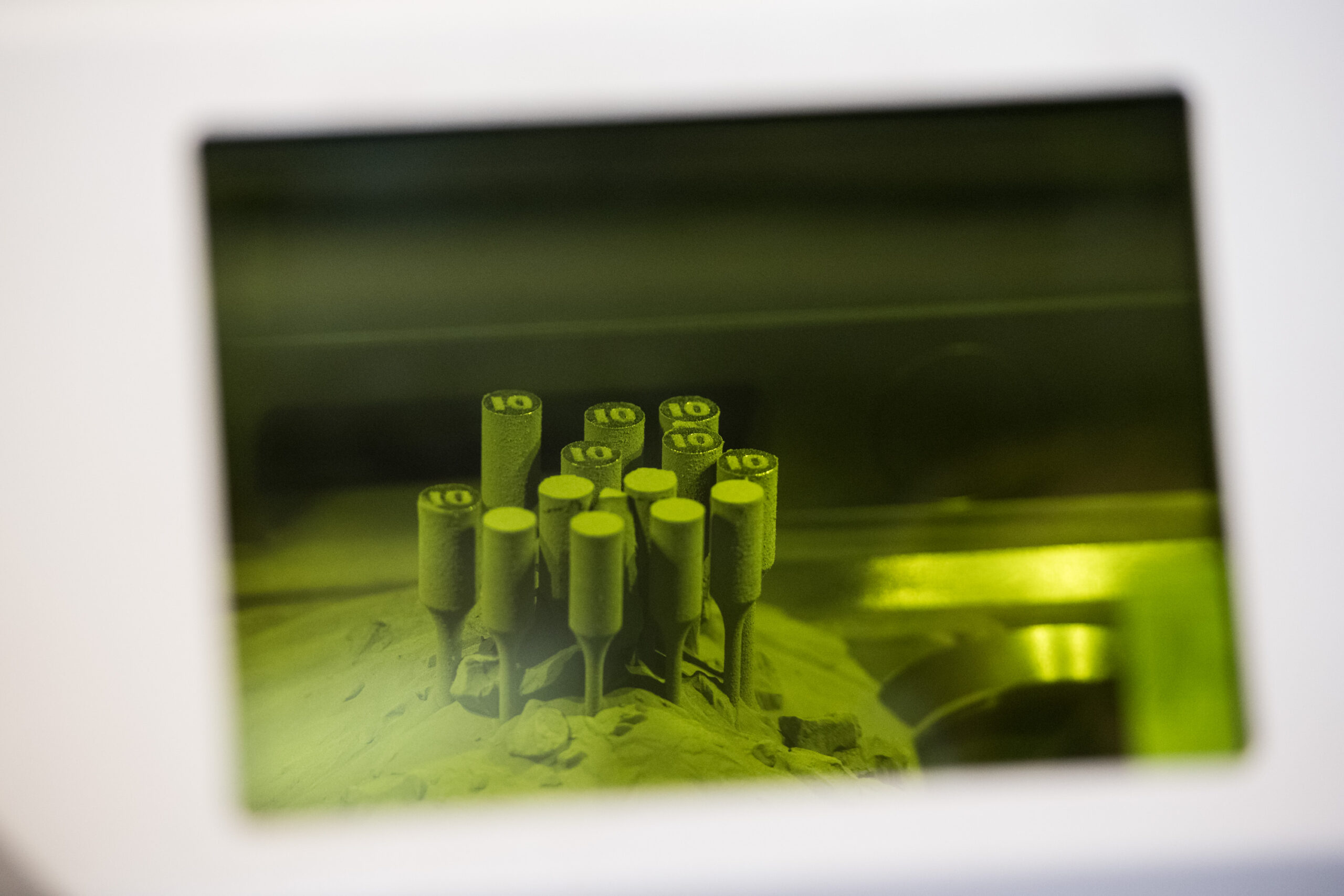
What is the DLMS / DMLS 3D printing method?
In specialist literature and practice, you will encounter the abbreviations DMLS, SLM or the general term PBF (Powder Bed Fusion). In Czech, DLMS is sometimes written incorrectly, but the correct name of the technology is:
- DMLS – Direct Metal Laser Sintering – direct laser sintering of metal powder
DMLS is a method of 3D printing metals from powder using a laser. A powerful laser is directed at a thin layer of metal powder in a sealed chamber, selectively melting (or, more precisely, sintering) the powder according to data from a 3D model. Layer by layer, a fully functional metal part with high density and mechanical strength is created.
According to ASTM classification, DMLS belongs to the powder bed fusion (PBF) family of technologies, which also includes Selective Laser Melting (SLM) and Electron Beam Melting (EBM). In practice, DMLS and SLM are very similar – they differ mainly historically and according to the machine manufacturers.(en.wikipedia.org)
How DMLS works step by step
The DMLS process begins with digitization and ends with a fully metal part ready for machining or assembly.
1. Preparing the 3D model
- Designing the part in CAD (SolidWorks, Fusion 360, Inventor, etc.).
- Exporting to the STL / 3MF format.
- Importing into the printer software and setting the orientation, supports, and process parameters.
- Slicing the model into thin layers (typically 20–60 μm).(en.wikipedia.org)
2. Preparing the machine and powder
- The hopper is filled with metal powder (stainless steel, titanium, aluminum, Inconel, cobalt–chromium, etc.).(us.arrk.com)
- The build chamber is filled with inert gas (argon or nitrogen), and the oxygen content is reduced to a very low level so that the powder does not oxidize at high temperatures.(sinterit.com)
3. Applying the powder layer
- The recoater (blade or roller) evenly spreads a thin layer of powder across the build platform (on the order of tens of micrometers).
- The platform is precisely controlled in height along the Z axis.
4. Laser sintering / melting
- A powerful fiber laser scans the surface of the layer according to the shape of the given cross-section of the part.
- At the point where the laser hits, the powder particles melt and fuse into compact metal.
- Untouched areas remain as loose powder, which later serves as support material and can be recycled.(element.com)
5. Repeating the layers
- After one layer is completed, the platform lowers by the layer thickness (e.g. 40 μm).
- A new layer of powder is applied and the laser sintering process is repeated.
- In this way, the part is “built” from the bottom up, until the entire model is complete.
6. Cooling and removing the part
- After printing is complete, the chamber is allowed to cool down to minimize internal stresses.
- Excess powder is suctioned out and filtered for further use.
- The part is still attached to the build platform and usually contains supports.
7. Postprocessing
This is followed by a series of steps that are a standard part of the process for DMLS:
- Heat treatment / “stress relief” – reducing internal stresses.
- Removing supports (cutting, milling, grinding).
- Possibly HIP (Hot Isostatic Pressing) to achieve almost 100% density and eliminate microdefects.
- Final machining: CNC machining, grinding, polishing, surface treatments.
What materials can be printed with DMLS?
One of the greatest advantages of DMLS is the wide range of metal materials that can be used. These typically include:
- Stainless steels – for example, 316L for the chemical, food, and general industries.
- Titanium alloys (Ti6Al4V) – aerospace, implants, sports equipment.
- Aluminum alloys (e.g. AlSi10Mg) – lightweight structures in the automotive and aerospace industries.
- Nickel‑based superalloys (Inconel) – high-temperature and corrosion-resistant parts in the energy, turbine, and aerospace industries.
- Cobalt‑chromium – dentistry, medical implants.
- Special steels for toolmaking (conformal cooling of molds, stamping tools).(us.arrk.com)
Because the materials are often identical to alloys used in serial production, DMLS parts can be fully deployed in operation, rather than serving only as prototypes.
Advantages of DMLS over conventional machining
1. Geometric freedom and topological optimization
Thanks to layer-by-layer printing, it is possible to design very complex shapes that would be:
- extremely expensive,
- or completely impossible to produce by milling, turning, or casting.
These include:
- internal channels (e.g. conformal cooling of molds),
- lattice structures for weight reduction,
- organic shapes resulting from topological optimization.
2. Part consolidation and lower weight
DMLS makes it possible to combine multiple parts into a single unit, thereby:
- shortening assembly time,
- reducing the number of joints and potential failure points,
- significantly reducing weight – for example, by 20–25% in aerospace parts in many cases.(businessresearchinsights.com)
3. Shorter lead times and lower inventories
For one-off and small-batch production, DMLS can be significantly faster than procuring tooling, molds, and conventional manufacturing. This is particularly useful for:
- prototypes and functional validation,
- spare parts on demand,
- customized components (e.g. patient-specific implants).
4. High density and mechanical properties
Modern DMLS systems can achieve very high density in printed parts; with suitable parameters and subsequent HIP, the results approach or match parts made from conventionally manufactured semi-finished products. This is crucial for the aerospace and healthcare sectors.(sinterit.com)
Limitations and disadvantages of DMLS
However, DMLS is not a universal replacement for all technologies. It has several significant limitations:
1. High acquisition and operating costs
- DMLS printers are considerably more expensive than FDM/FFF or resin machines – often costing hundreds of thousands of euros.
- Metal powders are expensive and require careful storage and handling.
- Operation requires trained personnel and strict safety rules (dust, inert gases, high temperatures).
That is why DMLS is currently used mainly where the added value outweighs the costs – namely in aerospace, healthcare, energy, and high-end industries.
2. The need for supports and part orientation
- Most overhangs below approximately 45° require supports, which hold the molten metal in place and dissipate heat.
- Incorrect part orientation can lead to deformation, cracking, or poor surface quality.
- Supports must be removed after printing, often by machining.
Therefore, for DMLS, knowledge of design for additive manufacturing (DfAM) is crucial.(en.wikipedia.org)
3. Rougher surfaces and necessary postprocessing
- The surface of printed parts is usually rougher than that of machined parts (due to the powder size of 50–100 μm and layer thickness).(en.wikipedia.org)
- For precise mating and functional surfaces, CNC machining is necessary.
4. Limited build volume
- Most DMLS printers have a build chamber measuring on the order of hundreds of millimeters (e.g. 250 × 250 × 300 mm, 300 × 300 × 400 mm).
- Larger parts must be segmented and subsequently joined – by welding, bolts, or adhesive bonding.
DMLS vs. SLM – what is the difference?
The terms DMLS and SLM (Selective Laser Melting) are often used almost interchangeably.
- Historically, DMLS is the trade name of EOS, originally emphasizing the sintering of metal powders (especially alloys).
- SLM refers to fully melting metal powder into a homogeneous structure.
In practice, most industrial systems referred to as DMLS today fully remelt the powder, so the difference is mainly a matter of detail:
- DMLS is more often used for alloys, where controlled “sintering” helps manage different melting points.
- SLM is often used for pure metals (e.g. titanium, aluminum), where full melting with the highest possible density is desired.
For a designer and user, the specific machine, process settings, and subsequent heat treatment are more important than the verbal distinction between these abbreviations.(sinterit.com)
Typical DMLS applications in practice
1. Aerospace industry
DMLS is now one of the key technologies for aerospace:
- Lightweight and strong structural ribs, brackets, and mounts.
- Parts for rocket engines and fuel systems.
- Turbine components and high-temperature engine parts.
Market studies show that the aerospace and defense sector accounts for approximately 35–40% of the share of the DMLS services market, primarily due to the demand for weight reduction and high performance.(businessresearchinsights.com)
2. Healthcare and dentistry
In medicine, DMLS enables:
- patient-specific implants (hips, spinal implants, cranial replacements),
- dental restorations and bridges made from cobalt–chromium,
- lightweight titanium structures that support osseointegration (lattice structures).
Thanks to the combination of biocompatibility, high strength, and customization options, metal 3D printing is becoming a standard part of modern orthopedics and dentistry.(thebusinessresearchcompany.com)
3. Automotive and motorsport
In the automotive industry, DMLS is currently used mainly in development and racing programs:
- lightweight brackets, mounts, and suspension components,
- complex engine and exhaust components, optimized for flow,
- tools and injection molds with conformal cooling, shortening production cycles.
Cost remains a factor in serial production, but as metal technologies gradually become more affordable, wider adoption in mainstream models is expected.
DMLS makes it possible to produce injection molds and tools with internal channels following the geometry of the molded part. The result is:
- faster and more uniform cooling,
- a shorter production cycle for plastic parts,
- better surface quality.
This application is typical, for example, in the production of molds for automotive, consumer electronics, or packaging.
DMLS trends and future (2025+)
Growth of the metal 3D printing market
The metal 3D printing market, including DMLS, is growing very rapidly:
- Estimates indicate that the global metal additive manufacturing market will grow from a few billion dollars in 2024 to more than 30–40 billion USD around 2034–2035.(thebusinessresearchcompany.com)
- According to some analyses, DMLS services alone are expected to grow at a rate of over 20% annually.
The main drivers are aerospace, healthcare, automotive, and energy.
Multilaser systems and larger machines
New generations of DMLS machines use multiple lasers in a single chamber, which significantly accelerates printing. The share of large-format systems with a build volume exceeding 300 mm on each axis is also growing, enabling larger parts to be printed in a single step.(businessresearchinsights.com)
Better software tools and monitoring
Tools for the following are becoming more widespread:
- topological optimization (reducing weight while maintaining strength),
- simulation of deformation and stresses during printing,
- online monitoring of the melt pool and layer, which helps detect defects during the build itself.
This is turning DMLS into a repeatable and controlled manufacturing process, suitable for serial production, not just prototyping.
Sustainability and powder recycling
In the DMLS process, powders are largely recycled – excess material can be reused after sieving and inspection. Increasing attention is also being paid to:
- the energy demands of the machines,
- the use of recycled metals in powder form,
- material traceability throughout its entire life cycle.
Basic design principles for DMLS
If you are considering manufacturing a part using DMLS, it is useful to know several practical design rules:
- Consider the part orientation – try to minimize large surfaces with an angle of < 45° relative to the powder bed, as they would require substantial supports.
- Leave machining allowances – for precise mating surfaces, threaded areas, or bearing seats, design an allowance of 0.1–0.5 mm for subsequent CNC machining.(en.wikipedia.org)
- Avoid enclosed cavities filled with powder – where excess powder cannot be emptied or suctioned out; alternatively, design service openings.
- Optimize wall thicknesses – walls that are too thin may be prone to deformation, while overly massive volumes can cause stress accumulation.
- Use lattice structures – where solid material is not necessary, they reduce weight and save powder and printing time.
For initial projects, it is worthwhile to consult the design with a DMLS service provider – they often have their own recommendations and design guidelines for specific machines and materials.
Summary: when does DMLS make sense?
DMLS (DLMS) is an advanced metal 3D printing method that enables the creation of lightweight, strong, and highly complex metal parts directly from powder, without the need for molds and extensive machining.
It makes the most sense if you:
- need maximum performance (aerospace, motorsport, energy),
- are dealing with customized or patient-specific parts (implants, dentistry),
- want to use topological optimization and conformal cooling,
- manufacture small batches or prototypes with high added value.
Conversely, for large series of simple parts made from ordinary steels or aluminum, conventional machining, casting, or pressing will still be more economical.
For 3D printing users, DMLS is an important milestone: it shows that additive manufacturing has long been about more than plastic models, and increasingly concerns real, load-bearing metal components that are entering serial production.