Free shipping from 1 999 Kč
Fast shipping
Verified store
Thousands of customers




Free shipping from 1 999 Kč
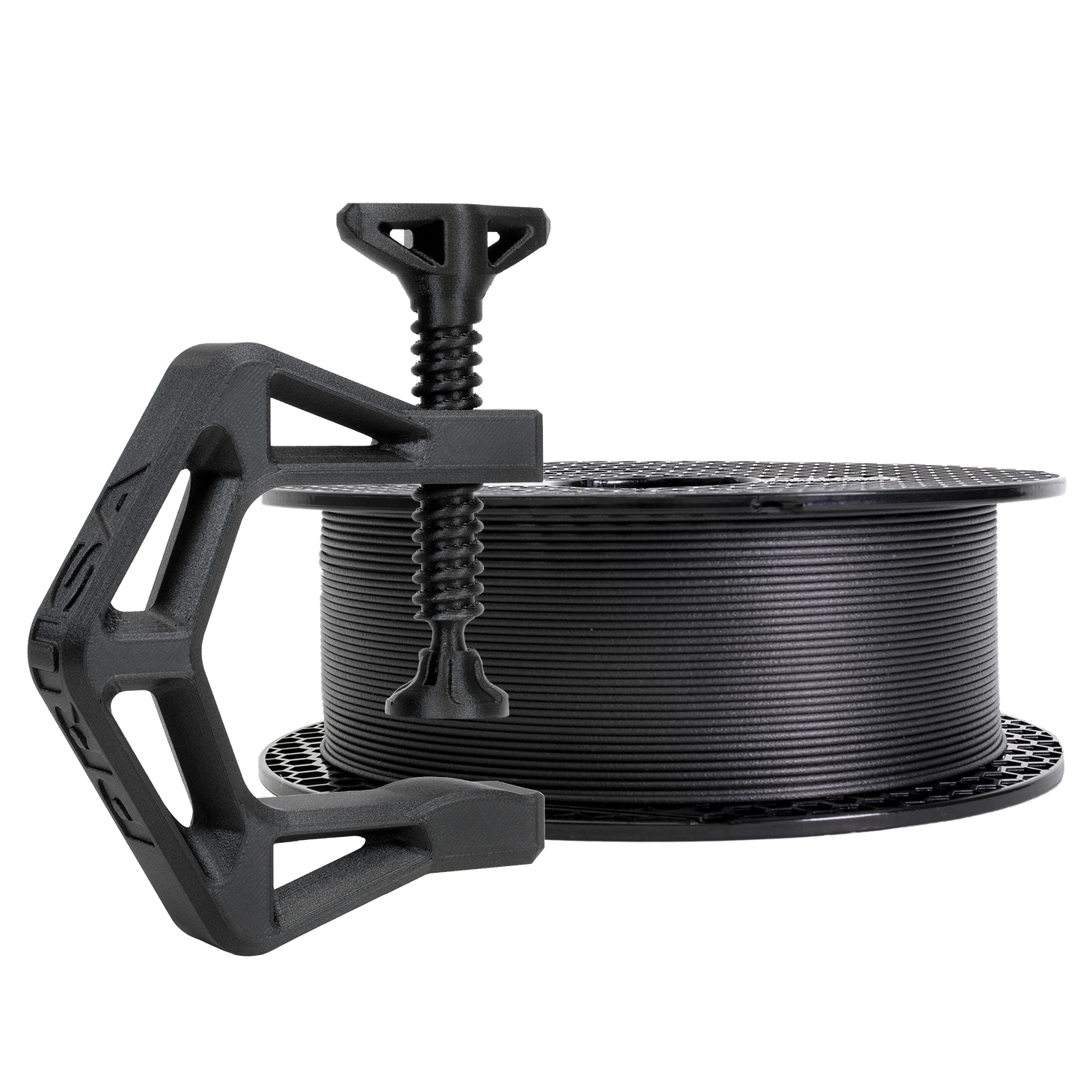
Carbon-fiber composite filament is not an automatic replacement for standard PETG, ASA or nylon. It is a specialized material for parts where you need higher rigidity, less warping, more stable dimensions and a technical matte finish. On the other hand, if you need ibility, high impact resistance or an inexpensive material for standard brackets, regular filament will often serve you better.
In the abbreviations PETG-CF, ASA-CF, PA6-CF and PAHT-CF, CF means an admixture of short carbon fibers. They work somewhat like reinforcement in a plastic matrix. The part is usually stronger in bending and, above all, stiffer, deforms less and prints with less shrinkage. At the same time, the filament is abrasive, more sensitive to proper drying and usually more expensive.
| Material | Choose it when you need | It is not suitable when |
|---|---|---|
| PETG-CF | an easy-to-print rigid part, brackets, jigs, covers, an attractive matte appearance | the part will be exposed to heat, direct sunlight or extreme mechanical loads for a long time |
| ASA-CF | outdoor parts, UV resistance, more heat-resistant covers and mounting components | you do not have an enclosed printer or do not want to deal with ASA fumes and shrinkage |
| PA6-CF | strong technical parts in a dry environment, clamps, levers, jigs, geared and friction components | the part will operate in moisture without treatment or you do not have reliable filament drying |
| PAHT-CF | parts exposed to higher temperatures, chemicals and long-term stress | you need an inexpensive material or print on an open hobby printer without a suitable hotend |
You will notice the biggest difference in rigidity. With the same geometry, a composite part bends less than a part made of pure plastic. This is an advantage for sensor arms, linear-guide brackets, assembly jigs, electronics covers or templates that must maintain precise dimensions.
The second advantage is stability during printing. Carbon fibers reduce shrinkage and help maintain sharp edges. That is why CF materials often print more cleanly than their base plastics. The matte surface also hides layers and minor irregularities.
The disadvantage is nozzle wear. A brass nozzle will quickly wear down when used with CF filament, enlarging the opening and reducing print quality. Plan on using hardened steel, a hardened nozzle, or possibly a ruby or other abrasion-resistant variant. For nylon and high-temperature composites, a 0.6 mm nozzle makes sense because it reduces the risk of clogging and allows the fibers to pass through more easily.
PETG-CF is a good first choice if you want a stiffer and better-looking part than one made from standard PETG, but do not want to deal with nylon right away. It prints relatively easily, tends to warp less than pure PETG, and usually has a matte, technical-looking surface.
Use it for camera brackets, mounting adapters, simple workshop jigs, electronics covers, spacers or functional prototypes. Compared with standard PETG, you get less rubberiness and better dimensional stability. This is noticeable, for example, with an endstop bracket that must not bend when the screw is tightened.
Do not expect a miracle in terms of temperature resistance. PETG-CF is still based on PETG, so it is not ideal for parts near an engine, in a car behind glass or in an enclosed electrical cabinet with higher temperatures. It may also not be the best choice for parts that need to or withstand sudden impacts.
Practical settings: use a hardened 0.4 or 0.6 mm nozzle, print somewhat slower than PLA and dry the filament before printing. If you see stringing, popping at the nozzle or a rough surface, the problem is often moisture rather than an incorrect profile.
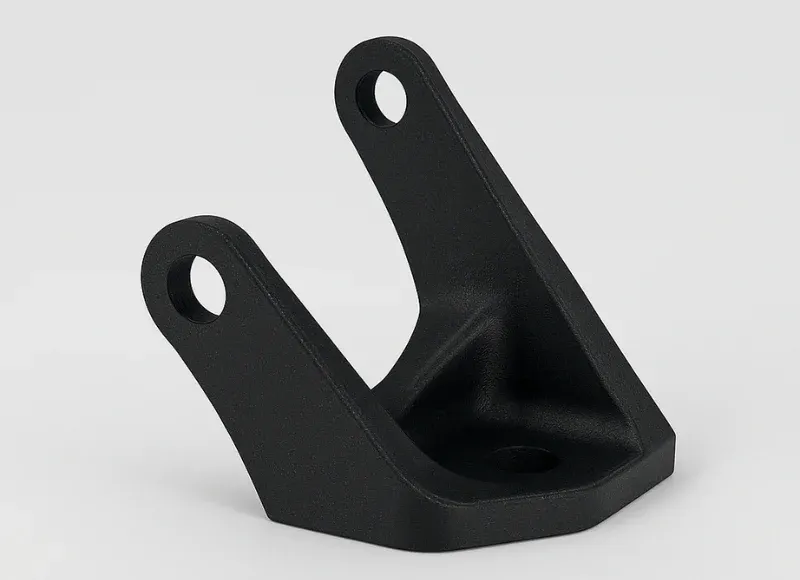
ASA-CF is the choice for parts that will be outdoors, in sunlight or in a warmer environment. Standard ASA has good resistance to UV radiation and weather, while carbon fiber adds rigidity, stability and a matte surface. Typical applications include antenna brackets, sensor covers, outdoor mounts, garden equipment components or technical covers on machines.
Compared with PETG-CF, it handles outdoor environments better. Compared with pure ASA, it is usually more dimensionally stable and warps less, but it still behaves like ASA. An enclosed printer, a stable chamber temperature and good ventilation are ideal. For larger parts, a heated chamber, a wider brim and slower cooling can help.
ASA-CF does not make sense for parts you will print in a living room without filtration and ventilation. Fumes must be taken seriously when printing ASA. Also expect bed adhesion and internal stresses to be more important than with PETG-CF.
Example: a cover for an outdoor temperature sensor is better made from ASA-CF than PETG-CF because it will be exposed to sunlight over the long term. Conversely, a simple bracket inside a printer where UV resistance is irrelevant may be cheaper and easier to make from PETG-CF.
PA6-CF is a significantly more technical material. Its base is PA6 nylon, which offers good toughness, chemical resistance and mechanical durability. Carbon fiber adds rigidity and reduces deformation during printing. The result is suitable for jigs, jaws, clamps, levers, transmission components, guides or machine parts.
PA6-CF’s strength is mechanical use in a dry environment. If a part must retain its shape under load while not being as brittle as some hard plastics, PA6-CF is often a better choice than PETG-CF or ASA-CF. It is well suited to workshop tools that are frequently tightened, pressed or subjected to dynamic loads.
Its weakness is moisture. Nylon readily absorbs water from the air. Moist filament pops, creates bubbles, worsens the surface and can significantly weaken the part. A finished part can also change dimensions and mechanical properties in a humid environment. That is why PA6-CF belongs in a dry box and should be put in a dryer before important prints.
With PA6-CF, do not worry about whether a standard hotend and brass nozzle will be sufficient. You need an abrasion-resistant nozzle, a sufficiently high hotend temperature, an enclosed printer and reliable drying. Slower printing and limited cooling can also help with larger parts.
PAHT-CF refers to high-temperature polyamide with carbon fiber. However, this name can cover different types of polyamides depending on the manufacturer. Therefore, do not rely only on the name on the spool and always check the data sheet for the specific filament.
Choose PAHT-CF when PETG-CF is no longer sufficient in terms of temperature resistance, ASA-CF is not mechanically adequate and PA6-CF is too sensitive to moisture or dimensional changes during operation. Typical applications include heat shields, brackets near motors, manufacturing jigs, functional machine parts, robust adapters and components that need to remain rigid in more demanding environments.
An advantage over PA6-CF may be better stability at higher temperatures and, with some formulations, lower moisture absorption. The disadvantages are the price, more demanding printing and greater equipment requirements. PAHT-CF often needs a 0.6 mm nozzle, higher temperatures, an enclosed chamber and very well-dried material. If the printer cannot maintain stable conditions, the result may be worse than with a cheaper material.
Example: a jig used with a heated machine that must repeatedly maintain a precise position is a candidate for PAHT-CF. A camera cover indoors is unnecessarily expensive when made from PAHT-CF; PETG-CF is more than sufficient.
Start with the environment. Will the part be outdoors? Choose ASA-CF. Will it be exposed to heat or located near a machine? Consider PAHT-CF. Will it be in a dry workshop and carry mechanical loads? PA6-CF. Is the main goal a rigid, attractive and easy-to-print part? PETG-CF.
Then consider the type of load. Short-carbon-fiber composites excel in rigidity, but they are not equally strong in every direction. Layer orientation remains crucial. A hook or bracket loaded perpendicular to the layers can fail even when made from an expensive material. If the part must carry a load, orient the layers so that the main tension does not act between layers, add larger radii and do not underestimate the number of perimeters.
Finally, check whether the material matches the printer. An open printer with a brass nozzle is suitable at most for simple PETG-CF experiments after replacing the nozzle. An enclosed printer is practically essential for ASA-CF and nylon composites. For PAHT-CF, expect the profile, drying and bed adhesion to determine the result.
With CF filaments, design parts like technical molded components, not decorations. Replace sharp internal corners with radii, add enough material around screws and avoid thin webs that are meant to . The composite is rigid, but a thin section can break sooner than a more ible plastic.
For functional parts, 4 to 6 perimeters often work better than extreme infill. Perimeters carry the main load and improve the strength of holes, ribs and edges. Set the infill according to the application, for example 25 to 40 percent for standard jigs and more for locally loaded blocks. For bolted connections, consider metal threaded inserts.
If the part must maintain precise dimensions, first print a short test: a screw hole, pin, snap-fit or mating surface. CF materials may have different tolerances than their unreinforced variants, and the harder surface is more difficult to modify afterward.
The first mistake is printing from a wet spool. With PETG-CF, this worsens the appearance; with nylons, it can ruin the mechanical properties. The second mistake is using a brass nozzle. Even if the first small part turns out well, the nozzle gradually wears and subsequent prints will be worse. The third mistake is expecting excessive strength. CF filament will not fix poorly oriented layers, an overly thin wall or a sharp corner at a point of stress.
The fourth mistake is choosing the most expensive material without a reason. PAHT-CF is excellent when you genuinely need its properties. For a bracket on a desk, however, it mainly adds cost and printing difficulty. With composites, it pays to choose based on the part’s requirements, not on what sounds most professional.
Treat PETG-CF as a practical introduction to composites. Use ASA-CF outdoors and in sunlight. Choose PA6-CF for mechanically loaded parts in a dry environment. Use PAHT-CF only when you need higher temperature resistance, stability and professional technical properties.
The most important accessories are not just an expensive spool. They are a dry box, a filament dryer, an abrasion-resistant nozzle, a well-chosen part orientation and a real-world test under the conditions in which the part will operate.


