Free shipping from 1 999 Kč
Fast shipping
Verified store
Thousands of customers




Free shipping from 1 999 Kč
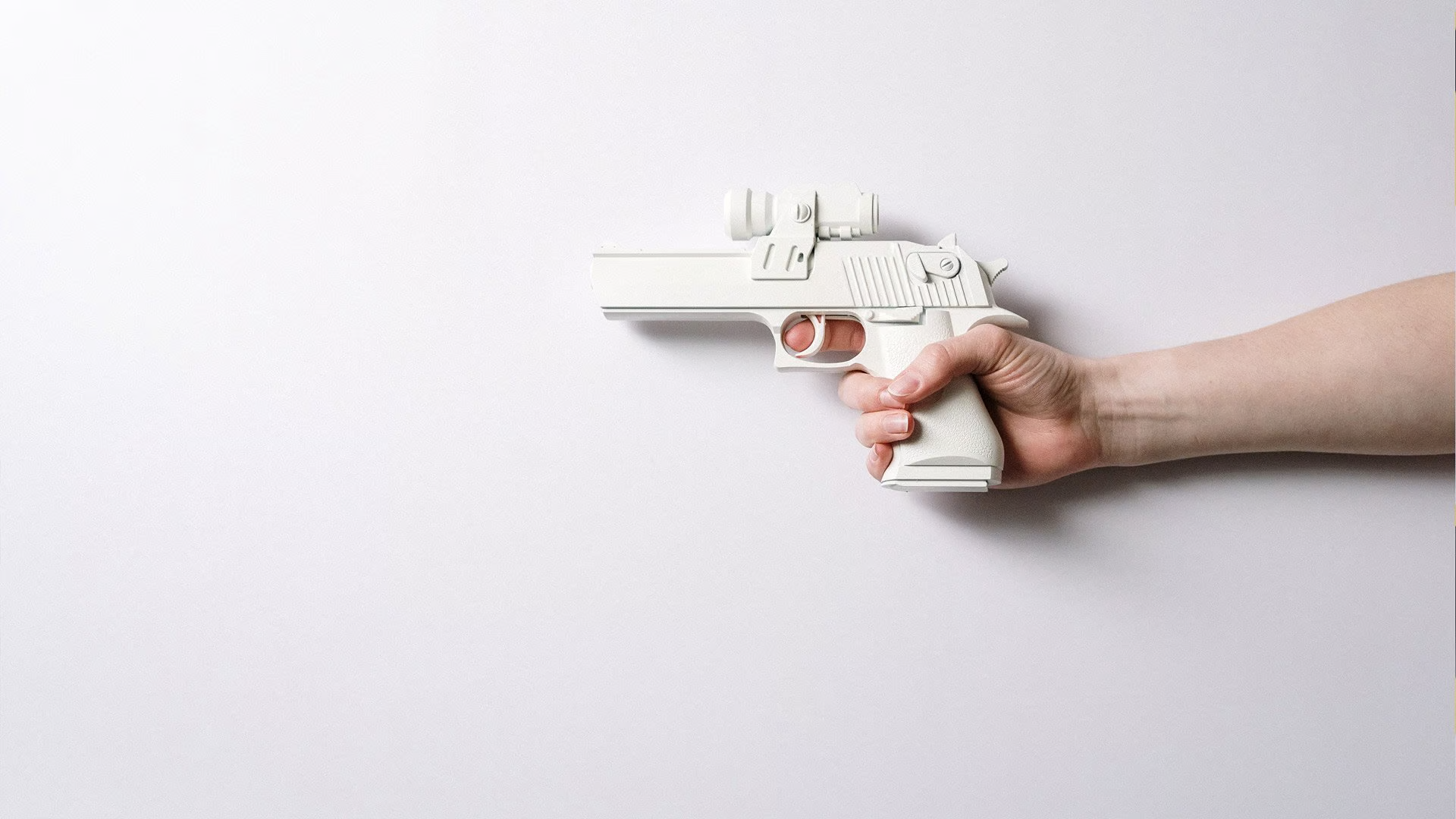
Are 3D-printed guns something we should be concerned about? We will examine the reports, facts, history and legal situation surrounding these controversial weapons.
Desktop 3D printing is generally considered a harmless practice and a promising technology. But what happens when you can quickly, quietly and easily print key gun components in your bedroom or garage?
This issue is highly controversial and has been the subject of heated debates across the internet, in the media and in political circles, dating back to the beginning of 2010 and the early days of the 3D-printing boom.
Beginners in the field of homemade gun manufacturing tend to dismiss it as “media hysteria” and reject any concerns by saying that 3D-printed guns are the domain of enthusiasts; too difficult to manufacture and too unreliable to fall into the hands of criminals. Conversely, a growing number of articles point to technological advances over the years, recurring episodes of violence associated with 3D-printed guns, and questions surrounding traceability and regulation.
When examining the topic, technical, social, political and legal aspects must be considered. This article provides an overview of 3D-printed guns, presenting the history, key events, communities, cultures and aspects that make this a current and complex issue.
HISTORY
Homemade Guns
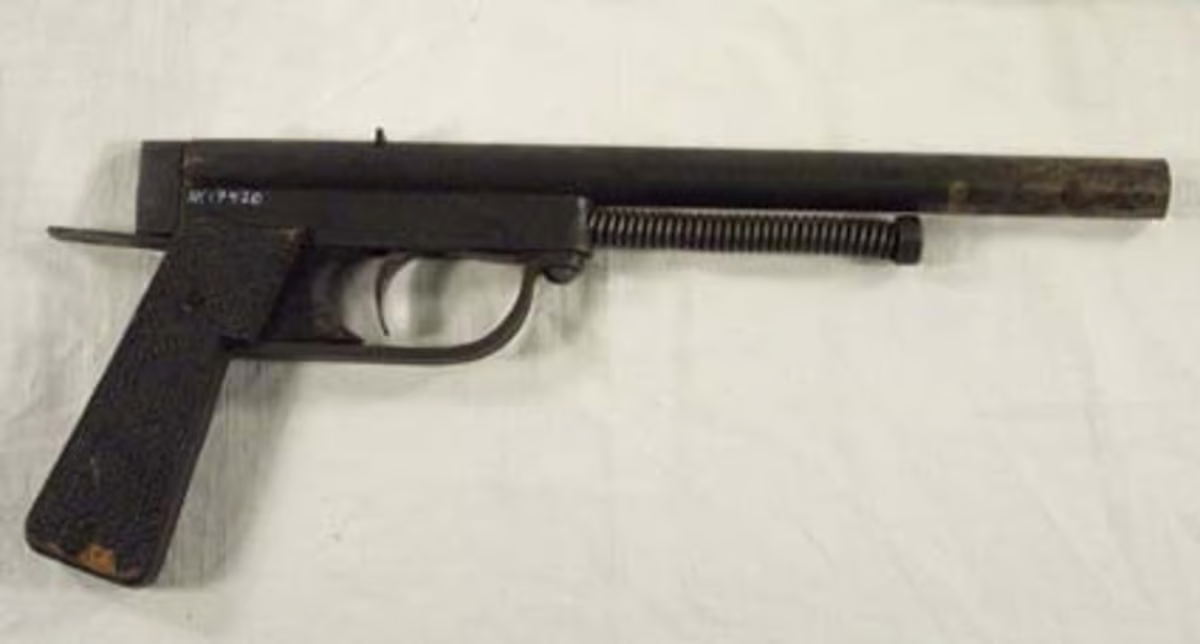
Pictured: A homemade pistol confiscated by Swedish police. This pistol was probably made by “Ljugas-Andersson” and sold by mail between 1900 and 1940.
The history of homemade guns dates back to the time when traditional guns themselves were invented. Since the invention of gunpowder, improvised replicas of conventional weapons and guns that only vaguely resembled pistols have been assembled from scrap and repurposed materials. In recent history, weapons of this kind were used by resistance s in armed guerrilla conflicts during World War II and, more recently, by insurgent forces in Iraq, Syria and Yemen. After World War II, rudimentary weapons known as “zip guns” – simple designs with wooden grips, rubber bands as triggers and weak tubes – became widespread in the USA.
Today, the internet makes it easier to share instructions and designs for making homemade guns. It has consolidated an already strong gun culture, especially in the USA, and paved the way for new and inventive methods of creating weapons in your garage without needing more than basic technical skills and a few woodworking tools.
The advent of home 3D printing found an enthusiastic community of gun makers ready to take advantage of this technology.
THE ADVENT OF 3D PRINTING
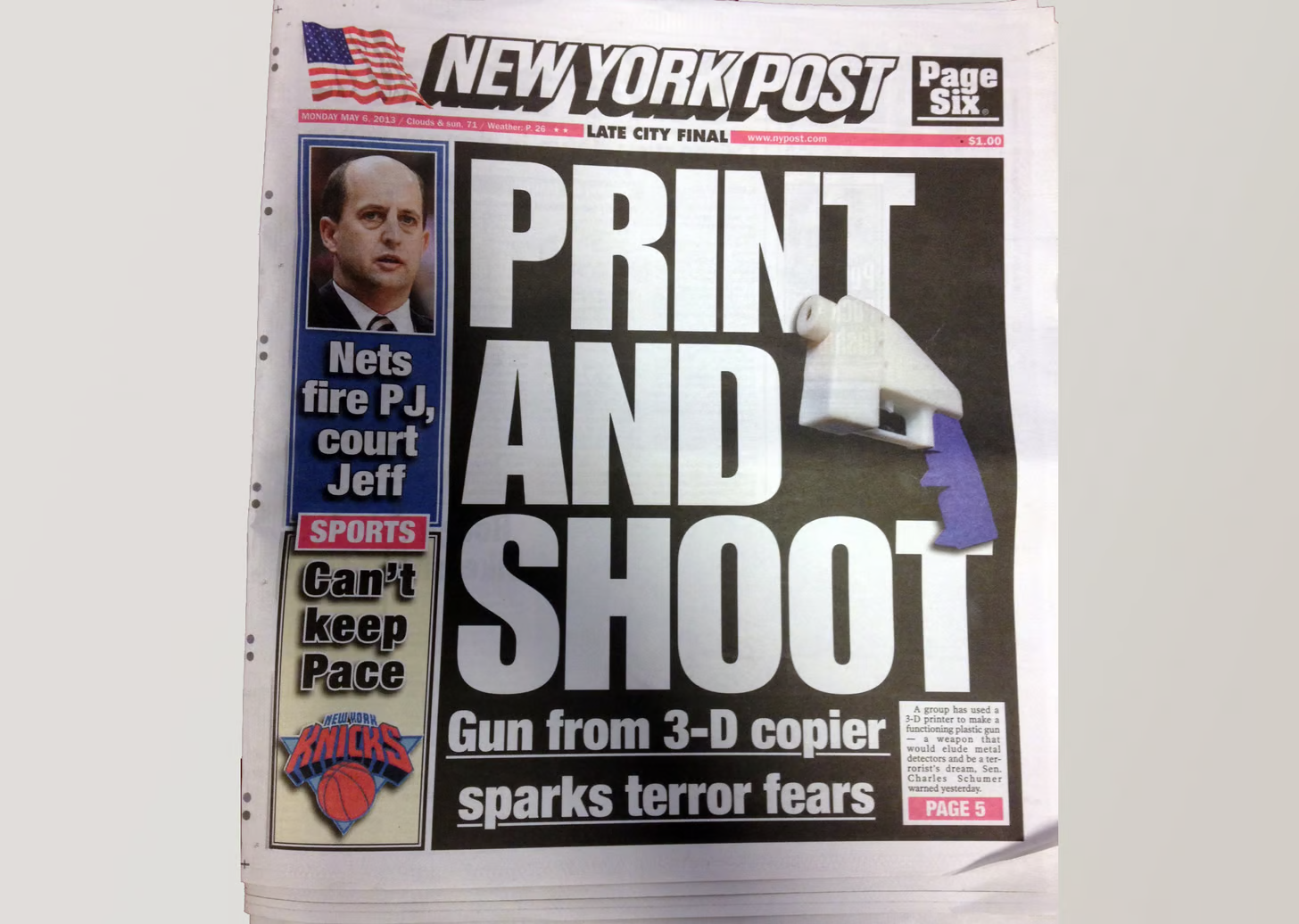
Pictured: An image of the Liberator by Defence Distributed on the front page of the New York Post, May 6, 2013.
As 3D printing became more popular at the beginning of the 21st century and desktop 3D printers became more affordable, new possibilities emerged for home-manufacturing enthusiasts. Private owners of the first 3D printers were able to access CAD files and print simple objects from various plastics. In this new wave of 3D-printed creations, the first models for guns and their polymer components began to emerge. However, this did not happen until 2013, when the first fully functional 3D-printed revolver, known as the Liberator, appeared.
The Liberator is a single-shot, polymer-based pistol created by Cody Wilson, founder of Defense Distributed, and published in May 2013 on the company’s open-source file repository, DefCad. The publication of the weapon followed the removal of gun blueprints from Makerbot Industries’ popular 3D-model repository, Thingiverse, in late 2012.
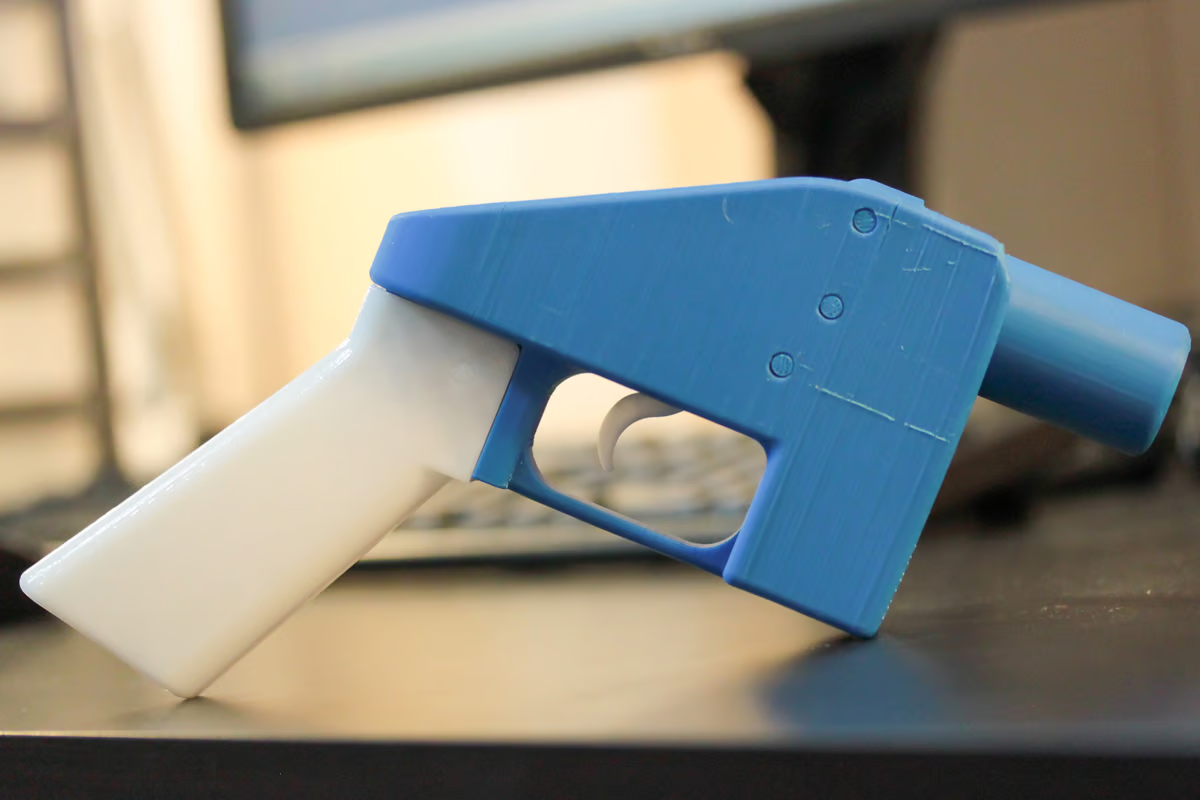
Pictured: The Liberator gun, designed by Defence Distributed.
Just two days after they were published, the US Department of State took the files offline, citing a violation of ITAR (International Traffic in Arms Regulations) – that publishing the files was equivalent to the unauthorized export of weapons.
In the same year that the Liberator sparked heated debate about 3D-printed guns, Solid Concepts printed what it believed to be the first industrially manufactured firearm. The gun is made from Inconel using the DMLS (Direct Metal Laser Sintering) process and is called the 1911 DMLS. It is a replica of the Colt Government Model 1911.
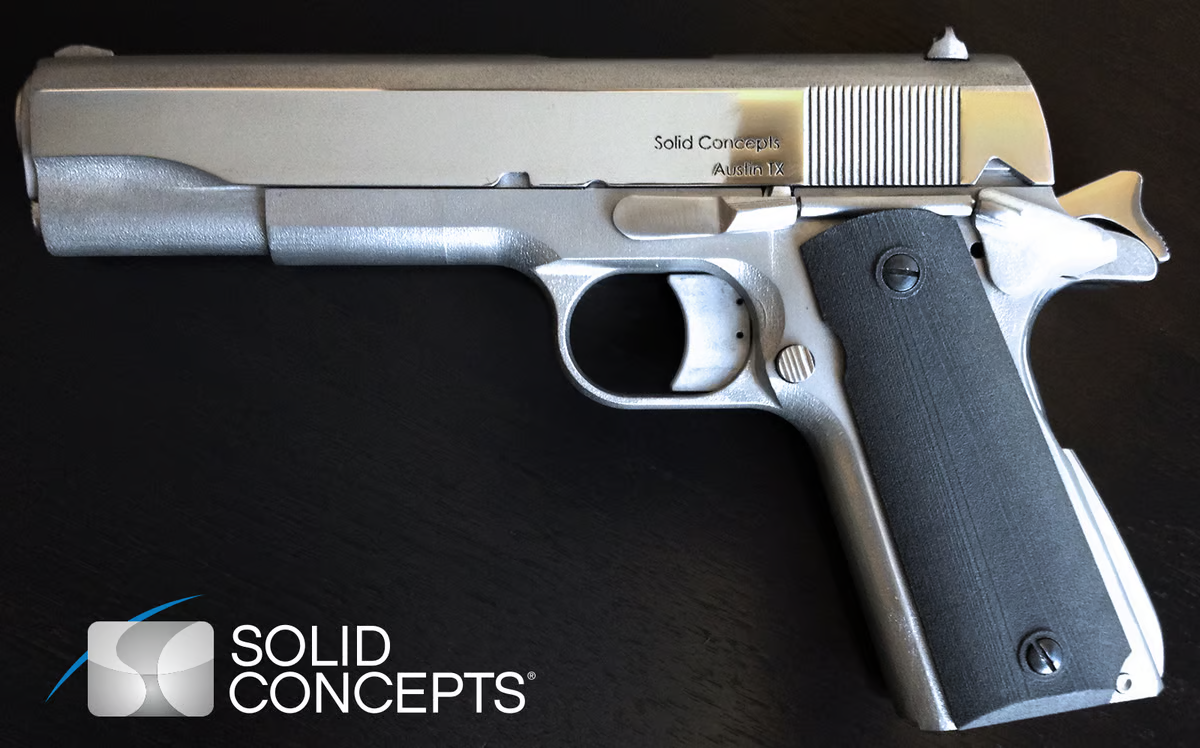
Pictured: A 1911 pistol printed by Solid Concepts.
In 2015, Wilson sued the United States government, accusing it of violating his First Amendment rights with this action. He won in 2018. Since then, Defense Distributed has focused primarily on CNC milling and its Ghost Gunner product.
Inspired by Wilson, several s promoting the same ideals emerged, sharing designs for 3D-printed guns on forums and social media. Groups such as Deterrence Dispensed and Fosscad have created communities of thousands of members that publish new and improved gun designs, including submachine guns and rifles. Whereas the simple single-shot Liberator was once the standard, it is now possible to print semi-automatic weapons such as the FGC-9 (Fuck Gun Control-9) by Deterrence Dispensed or the Scz0rpion by Are We Cool Yet.
In 2021, improved and reliable designs such as the FGC-9 were spotted in the hands of guerrilla fighters in Myanmar, likely making these the first 3D-printed guns used in an armed conflict.
INDUSTRIAL AND MILITARY APPLICATIONS
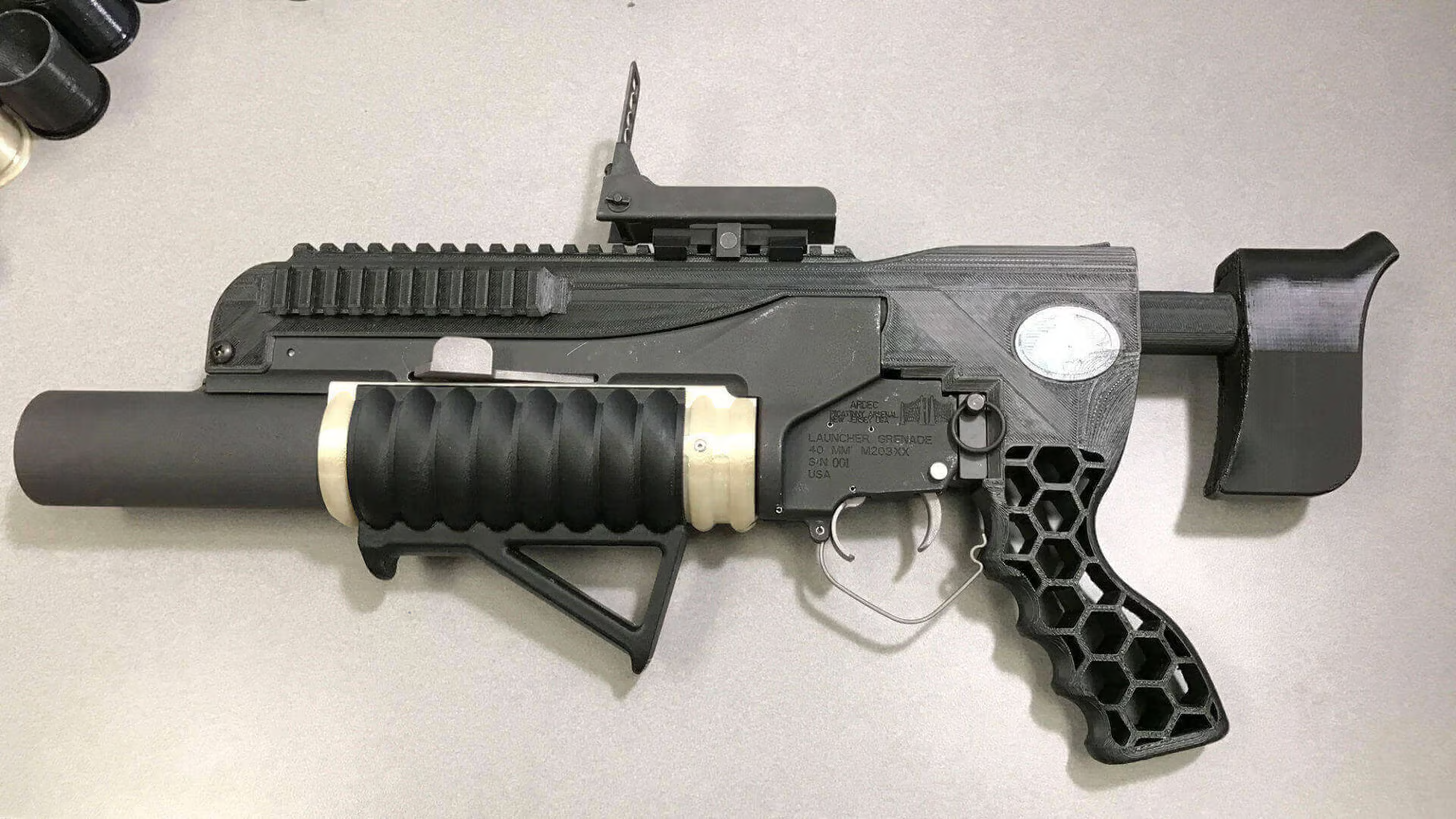
Pictured: The 3D-printed RAMBO grenade launcher.
Like many other manufacturing sectors, the firearms and military-equipment industries have embraced the benefits offered by additive manufacturing. It is not unusual to find that weapons produced by major manufacturers contain components made using industrial additive-manufacturing systems.
Beyond conventional manufacturing, 3D printing also has a role in the field and other “active” environments.
In 2019, the US Army experimented with a 3D-printed grenade-launcher system called RAMBO (Rapid Additively Manufactured Ballistic Ordnance). RAMBO fires 40mm grenades produced by 3D printing, is modeled after the M203 military grenade launcher, and demonstrates how rapid, localized manufacturing could replace or supplement traditional supply chains.
COVID-19: A (Brief) Shortage and Demand
During the COVID-19 pandemic, the number of people involved in homemade gun manufacturing in the USA was believed to have risen sharply. Parts for making guns at home were sold in large quantities in America, leading to a brief shortage.
Some argue that the increase in demand resulted from the Biden administration’s efforts to introduce stricter regulations concerning homemade guns. While this is difficult to determine precisely, there may also have been a shift in the national mood.
The perceived urgency of preparing for armed conflict, also referred to as a “bunker mentality,” is certainly part of it – one of many factors exacerbated by the pandemic and its pressure on global and social norms.
TYPES & MODELS
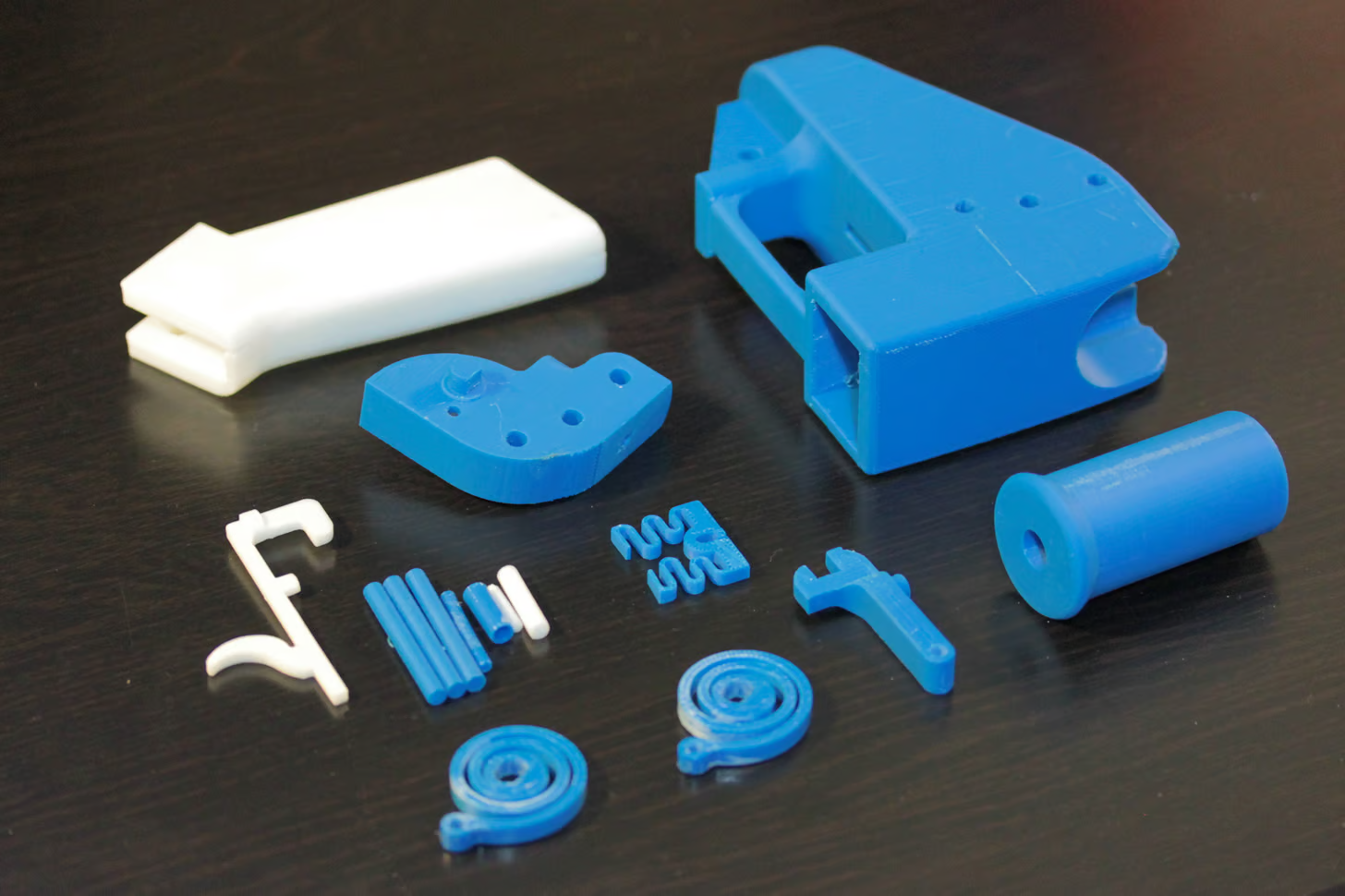
Pictured: Parts of the 3D-printable Liberator pistol, designed by Defense Distributed.
A 3D-printed gun is made partly or entirely using a 3D printer. There are three types of 3D-printed guns: fully 3D-printed (F3DP), hybrids, and complete kits (or conversions of parts kits – both abbreviated as “PKC”).
Some guns, such as the Liberator, can be produced almost entirely using a 3D printer. These fully 3D-printed gun models are, as the name suggests, almost entirely plastic and made from printed components. They may use negligible household items, such as a nail as a firing pin and an elastic band to drive it, but all pressure-bearing parts are printed. As a result, they are assumed to have limited usability and to predictably break after only a few shots, if they last that long at all.
After the Liberator, several F3DP models, such as the Songbird, Washbear and ZigZag, attracted widespread attention.
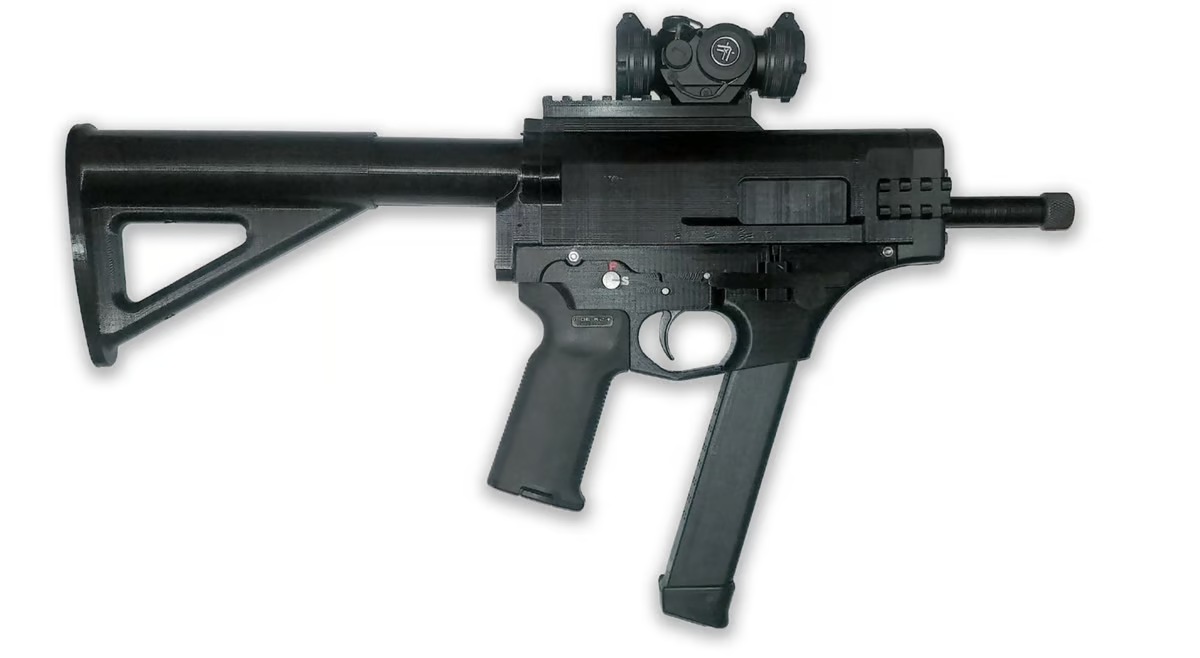
Pictured: The FGC-9 prototype created by its designer, JStark1809.
On the other hand, hybrids use some 3D-printed parts – usually frames and lower receivers – alongside professionally manufactured or improvised non-printed components. Popular examples include AR-15- and AK-47-style rifles, Glocks, models inspired by the .380 Luty submachine gun, the FGC-9 and the Scz0rpion.
Complete kits are assemblies that use ready-made or nearly finished parts and require the user to print or obtain the missing components separately.
Some gun dealers in the USA specialize in selling kits that do not require 3D printing at all, instead providing so-called “80% receivers” or “unfinished receivers.” These must be completed at home using additional tools, often included in the kit.
What is a “Ghost Gun”?

Pictured: A so-called “ghost gun”? Perhaps. It depends on whether it has a serial number and can be traced.
Ghost guns are guns that do not have a serial number and are therefore unmarked and untraceable.
Under the Bureau of Alcohol, Tobacco, Firearms and Explosives (ATF), prospective gun buyers in most US states must undergo a background check and apply for a serial number for the gun before they can purchase it in a store. Although exceptions such as purchases at public gun shows bypass ATF checks, dealers have sought other ways to prevent this. Until 2022, companies could exploit a loophole in the legislation by selling kits with 80% receivers – guns were regulated only to the extent that they contained a completed receiver. As a result, such PKCs could be sold and purchased without being subject to federal law.
With a few exceptions (see the Law section for more information), all homemade guns are ghost guns from the moment they are created. This means that all 3D-printed guns are also ghost guns. Some US states require these guns to be registered, but ultimately it is precisely this untraceability that has made them such a sensation in the mainstream media.
Many of these guns are not marked with serial numbers and cannot be traced; police cannot easily identify their origin, which is why a growing number of ghost guns are ending up in the hands of offenders and being found at crime scenes.
Accessibility is a major appeal. Convicted criminals who are prohibited from purchasing a gun through conventional means can instead buy a kit and assemble a gun at home using common hardware-store parts and a 3D printer.
To prevent further abuse of this loophole and in an effort to limit threats to public safety, the ATF proposed revising the definitions of “frame or receiver of a weapon,” “complete weapon” and “privately made weapon.” As of April 2022, it became legally significant to include split receivers and “buy, build, shoot” kits in the definition of a gun, forcing manufacturers selling such components to obtain licenses and add serial numbers to each one. Before completing a sale, buyers should undergo background checks, as is already common for other commercially manufactured guns.
Other individual parts, kits or ghost guns already in circulation – including those made by 3D printing – should be marked with serial numbers before being sold when they come into the possession of federal licensees or pawnbrokers.
HOW TO MAKE A 3D PRINTED GUN
TECHNOLOGY
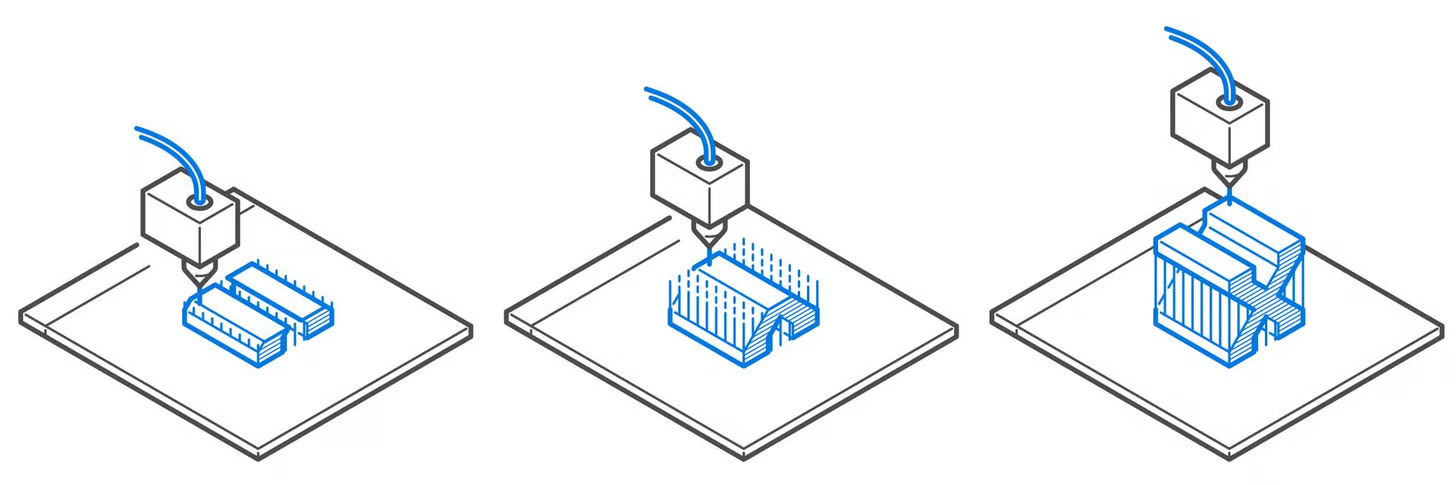
Pictured: Material extrusion technology, such as fused deposition modeling (FDM), layers melted plastic one layer at a time.
Parts and guns 3D-printed using a standard desktop printer with FDM (Fused Deposition Modeling) technology can be produced. This technology works by extruding thin plastic lines that are gradually layered onto a build plate until the complete 3D model is finished.
In consumer 3D printing, users typically use thermoplastic polymers such as PLA, its more durable variant PLA+, ABS or PETG. PLA is usually inexpensive and readily available, but relatively brittle compared with the other materials mentioned.
Technically advanced materials such as nylon and polycarbonate are also possible, but they are difficult to print using today’s widespread and inexpensive consumer 3D printers.
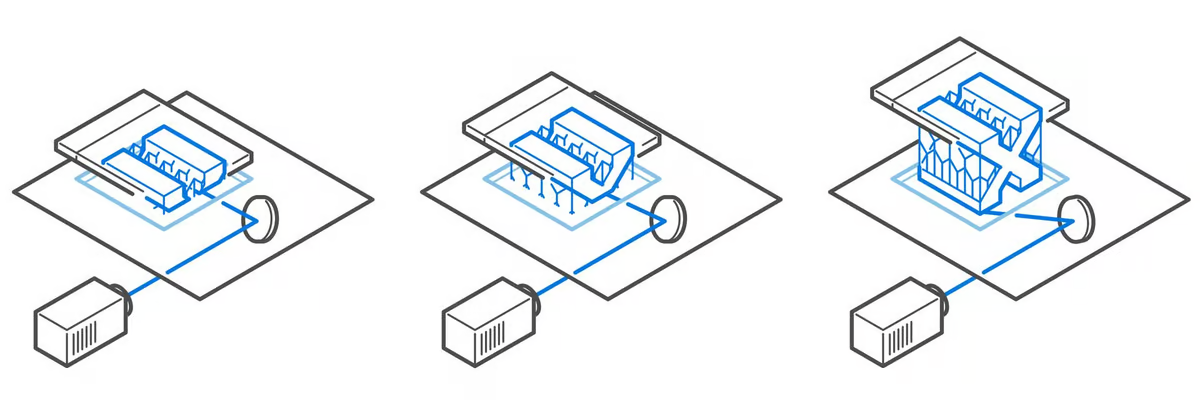
Pictured: Vat polymerization uses UV light to cure photosensitive resins.
Alternatively, vat photopolymerization printers use UV light to cure liquid photopolymer resin. These printers are becoming increasingly popular for home 3D printing, with materials generally being fairly brittle, although the picture has been changing in recent years with a broader range of materials. One advantage of vat photopolymerization over FDM printing is its homogeneity, which ensures strength in all printing directions.
The designs you print can take various forms. While CAD data and related file types from design software are possible, users usually download models in STL format from the internet or create them themselves. These files are then processed in slicing software (which determines the 2D “slices” for the printer), resulting in a machine-readable file that you upload to the printer for printing.
3D PRINTING vs CNC MILLING
Historically, basic milling and turning equipment was all you needed to manufacture your own firearm. Machines with computer-controlled motion systems modernized this process, with CNC (computer numerical control milling) generally considered more desirable and effective than 3D printing for manufacturing durable homemade firearms. While 3D printing works by depositing layers of plastic, CNC milling uses software and milling cutters to machine much more durable materials—typically metals.
In recent years, Defense Distributed has focused on improving and selling CNC machines for finishing unfinished receivers for automatic rifles. As promoted on the Ghost Gunner website, no prior experience is required to operate this CNC machine. Through its software, the company claims that it allows you to “legally manufacture unserialized rifles and pistols in the comfort and privacy of your home.”
In response to recent efforts by the Biden administration to regulate unfinished receivers, Defense Distributed now offers the “Ghost Gunner 3 Zero Percent kit,” which allows an AR-15 receiver to be machined from a raw block of aluminum. If attempts to regulate 80% lowers are successful, Defense Distributed claims that 3D printing and such CNC machines will be the only legal method in the USA for manufacturing an unserialized lower receiver at home (except for New Jersey, which has stricter state laws).
FILE COLLECTIONS
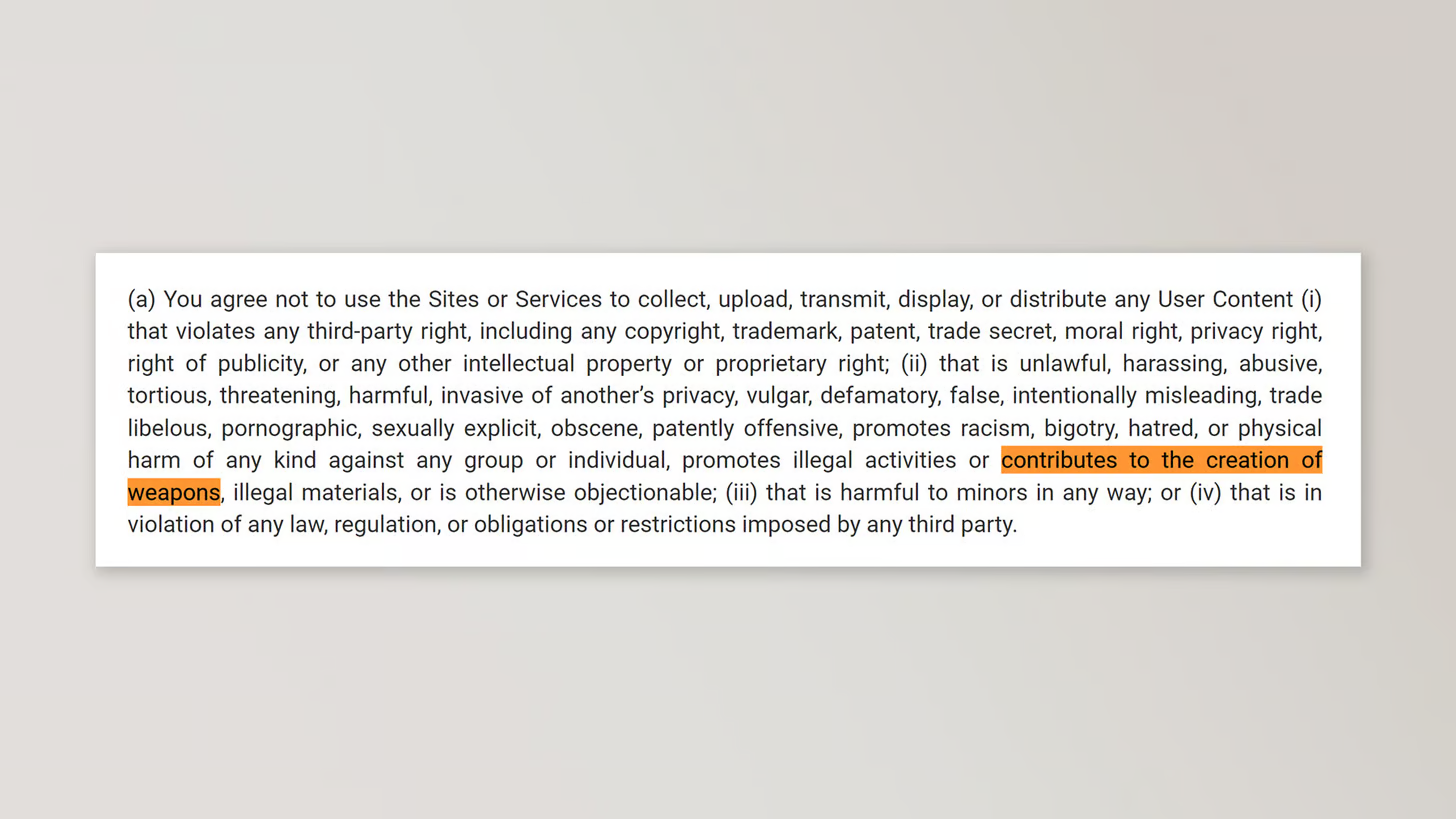
Passage from MakerBot Terms of Service, section 3.3 paragraph ‚a,‘ ‚Acceptable Use Policy‘.
In addition to general 3D model repositories, popular websites exist that primarily host designs for weapon components. Perhaps the best known, probably due to Wilson and the high-profile legal proceedings against him, is DefCad.
Users who pay an annual membership fee gain access to a wide range of CAD files for download and subsequent printing or milling. Weapon files are also available on selected 3D printing-related repositories, with geography and politics determining how much is tolerated and available on each one.
However, many more designs are shared on closed forums and private chat rooms, sometimes supported by blockchain technology, which can decentralize the distribution of plans, making it nearly impossible to regulate.
The open-source firearms advocacy Deterrence Dispensed is known for sharing its files via the website Spee.ch, which is supported by the LBRY blockchain.
Some hosting services censor designs, leading weapon-sharing communities to move to new, less controlled corners of the internet, where they continue sharing their work without regulatory oversight.
A particularly visible case of this involved the encrypted platform Keybase, shortly after it was acquired by video-conferencing giant Zoom. The service was known for its encryption and respect for privacy before the acquisition, but in December 2020 it removed communities of homemade weapons enthusiasts from the platform because its policies began aligning with those of the new parent company.
3D PRINTING SERVICES
Those who do not have access to a 3D printer can turn to a 3D printing service. These companies generally allow you to upload a 3D file for printing to their platform, generate a quote based on the materials and printing technologies used, and then have the object printed for you.
Because creating a printed part is a legally ambiguous area, 3D printing service providers differ in whether they accept orders to print weapon components.
Major 3D printing services Materialise and Sculpteo have clearly stated that they reserve the right to refuse orders, including orders to print weapon components, because this is inconsistent with their values.
A representative of Craftcloud, the 3D printing marketplace from All3DP, provided the following statement regarding the service’s policy:
“Because we often do not know the purpose of the designs ordered through our service, we cannot always accurately assess their intended use. Nevertheless, we require every customer of our service, since they sign the terms and conditions of our platform, not to request printing for improper use or to cause any harm or injury.”
WHO USES 3D-PRINTED GUNS?
HOBBYISTS, ANARCHISTS, FREE SPEECH AND SECOND AMENDMENT ADVOCATES

Approximately 700 people gathered in front of the Minnesota State Capitol to condemn all efforts to restrict guns, March 31, 2018. (Source: Fibonacci Blue from Minnesota, USA, CC BY 2.0, via Wikimedia Commons)
The design and manufacture of firearms using 3D printing technology are likely a meeting point between two cultures.
On one side, we have enthusiasts: technophiles and engineering enthusiasts who enjoy experimenting with new technologies and self-qualification while designing and creating the objects they use. Here, a printed gun may be considered an object of design and self-expression.
Competitions for printed guns now exist, further developing this aspect of the hobby. The National Gun Maker Competition, founded in 2021 and held in Florida, attracted widespread attention after being prominently featured in a Vice documentary on the subject.
The Are We Cool Yet claims that its guns are works of art and are protected not only by the Second Amendment (as “arms”), but also by the First Amendment. Wilson successfully used this argument to defend himself and DefCad’s publication of designs, ending a three-year legal battle in 2018.
On the other hand, some s view 3D-printed guns less as artistic expression and more as a fundamental right and an activist tool.
Wilson describes himself as a crypto-anarchist and is a passionate advocate of the Second Amendment. Many active members of the 3D-printed firearms community combine their passion for homemade manufacturing with fervent political views. The Deterrence Dispensed and Defense Distributed communities promote themselves with slogans in line with the Second Amendment, such as “Come and Take It,” “Live Free or Die,” and “Free Men Don’t Ask,” and are open about their intention to oppose gun control and arm themselves with a view to rebelling against the federal government.
CRIMINALS AND EXTREMISTS
Criminals and violent extremists have also become known for seeking out 3D printing technology and designs in order to obtain undetectable weapons. A leaked report from the Joint Counterterrorism Assessment Team cites two instances in 2020 and 2021 when gun files and privately manufactured machine-gun parts fell into the hands of racially motivated extremists. Wired points to the online purchase of illegal gun parts by the so-called Boogaloo, a described by the Institute for Strategic Dialogue as an “anti-government, extremist anti-law militia.”
Other notable cases in which 3D-printed guns appeared in criminal activity include the discovery of a workshop for 3D-printed guns and white supremacist materials in Tenerife, Spain, in 2021, and the 2019 synagogue shooting in Halle, Germany.
LAW
UNITED STATES
Under the Gun Control Act of 1968, it is illegal to sell homemade firearms without a license, but it is not illegal to manufacture and own homemade firearms.
Attempts to change this regulation, including reclassifying “80% ” or “unfinished” receivers so that they would fall under the definition of a firearm, as described earlier in this article, have been concluded.
Other changes include regulating stabilizing braces, components that can convert untraceable pistols into untraceable short rifles.
Other federal rules governing homemade firearms include the Undetectable Firearms Act, which requires every homemade firearm to contain at least 105 g of metal. This ensures that it can be detected by a metal detector.
Although this is the current situation at the federal level, laws vary by state.
Since 2018, it has been strictly illegal in New Jersey to purchase parts for manufacturing an unserialized firearm at home. To 3D print a firearm, you need a manufacturing license.
In California, even homemade firearms require a serial number. As of January 1, 2024, every firearm owner or new resident of the state with a firearm that does not have a valid state or federal serial number or identifying mark must apply for one from the Department of Justice within 60 days of arriving in the state. Manufacturers are required to apply for a number before manufacturing a firearm. Other strict safety rules also apply, including operational safety and means of imprinting identifying marks on cartridge casings.
Other states have similar laws or plan to implement their own restrictions based on new national legislative changes.
EUROPE
In Europe, the situation is completely different.
The manufacture and possession of homemade firearms, including 3D-printed guns, are prohibited in EU countries. In addition to such legislation, nations have and enforce their own more specific rules. In some parts of Europe, even possessing 3D-printable gun files is considered a crime.
In the UK, for example, Home Office guidelines on firearms licensing law were updated in 2013 to specifically criminalize the manufacture, purchase, and sale of 3D-printed guns and gun parts. The first known conviction in the United Kingdom for manufacturing a 3D-printed firearm capable of firing came in 2018.
Although the files are freely available on the internet, enforcing some of these laws is difficult. Some draw parallels between the futility of controlling gun designs and attempts to stop the piracy of films, video games, and other digital material.
OTHER NOTABLE LEGISLATION
In other parts of the world, some countries are paying particular attention to the issue of 3D-printed guns.
To combat the rise of 3D-printed guns, New South Wales, Australia, adopted a law that equates possession of 3D gun files with possession of an actual 3D-printed gun. In 2015, the country amended its firearms law to include a clause stating: “A person must not possess a digital plan for the manufacture of a firearm on a 3D printer or an electronic milling machine… [nebo budou čelit] maximum penalty: imprisonment for 14 years.”
Some parts of China have also adopted extreme measures to monitor and prevent the emergence of 3D-printed guns and other weapons. Police in Chongqing require all companies with 3D printers to register as a “special industry” and demand details about the equipment used, security measures, and even information about all employees.
In Singapore, the Arms Offences Act of 1973 provides that “any firearm, air gun, air pistol, automatic pistol and any other weapon or gun from which any shot, bullet or other projectile can be discharged” is classified as a weapon. Because a 3D-printed gun is no different, possessing one carries a prison sentence; attempting to use a weapon carries the death penalty.
SAFETY
CAN 3D-PRINTED GUNS EXPLODE?
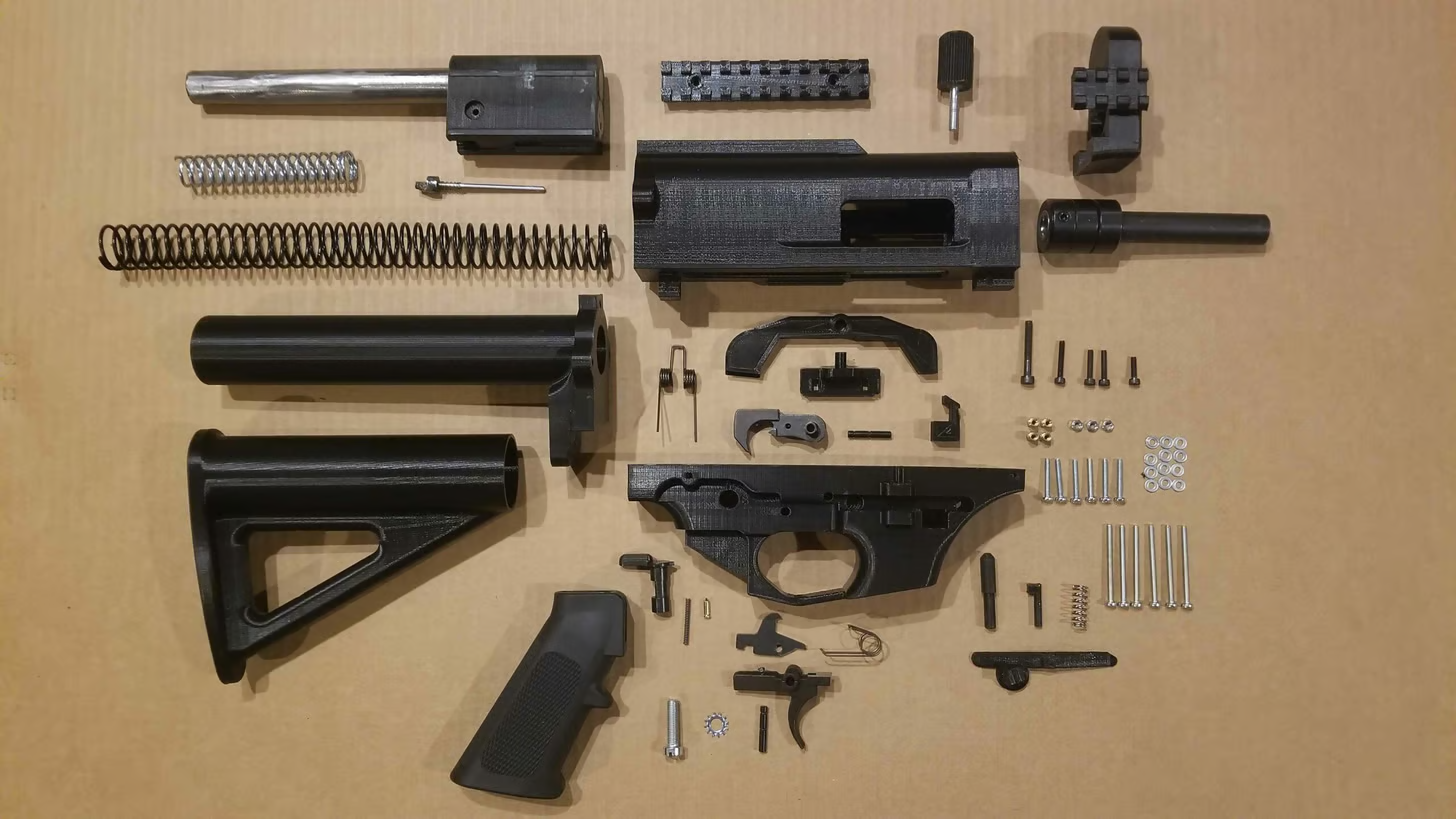
Photograph of disassembled components of the FGC-9 firearm, included in the original FGC-9 files (Source: JStark1809 / Deterrence Dispensed, CC BY 4.0, via Wikimedia Commons)
Since the emergence of the first models, 3D-printed guns have maintained a reputation for jamming, and perhaps even exploding in the user’s hand. A popular opinion online is that 3D-printed guns are more dangerous for users than other firearms. A 2021 Vice documentary about Ghost Guns shows several homemade firearms failing at the first 3D-printed gun competition, but it is worth noting that well-built examples of 3D-printed guns functioned perfectly.
The Halle Synagogue shooter, who recorded the crime on camera, was heard commenting that he had “certainly demonstrated how absurd improvised weapons are” after repeated jams.
Because 3D-printed guns are homemade, the quality of the firearm depends on the builder’s skills.
As 3D printing technology becomes more accessible and the pool of shared knowledge about 3D printing grows, it is clear that such improvised weapons are becoming increasingly effective.
Some users in communities of weapons and printing enthusiasts have gained a following for their reliable designs.
Derwood, a Fosscad weapons and printing enthusiast, is known for creating and sharing well-functioning models, including the Shuty MP-1 semi-automatic pistol. The FGC-9 semi-automatic pistol, designed by JStark1809 of Deterrence Dispenced, is durable, and with the 2021 MkII revision, it is now more reliable and easier to build.
PROLIFERATION AND PUBLIC SAFETY
In addition to becoming more sophisticated and reliable than ever, 3D-printed weapons are now also cheaper and easier to manufacture. Deterrence Dispensed co-founder Ivan the Troll told Slate that the FGC-9 requires no technical skill to build and is the simplest, cheapest, most interesting, and most reliable semi-automatic homemade weapon he knows of. He also said that someone with experience could make an FGC-9 in a week or less, while a motivated beginner could manage it in two weeks. Just 200 USD can now comfortably buy a 3D printer capable of producing such prints, plus spools of material.
Advances and the greater accessibility of the technology have raised concerns about the potential misuse of 3D-printed weapons. A popular counterargument among supporters of 3D-printed weapons is that it would be much easier for criminals to obtain a weapon illegally on the streets or on the black market. At the same time, however, criminals appear to be taking advantage of the technology's lower prices, lower barriers to entry, and improved, freely available designs. Some statistics show that crimes involving ghost guns are increasing in America, with an information brief prepared by the Policing Institute recording an increase in some areas. It should be noted, however, that it is not entirely clear how many of these ghost guns are actually 3D-printed.
The same institute also acknowledges inconsistencies in how police departments collect and evaluate their data on ghost guns, making it difficult to obtain an accurate nationwide picture of the actual seizure of ghost guns in connection with criminal activity.
The public safety threats associated with 3D-printed weapons are a sensitive issue in countries with stricter or nonexistent public gun ownership. The growth of 3D printing technology provides a new and accessible tool that can be used by those with malicious intentions to circumvent gun laws and manufacture illegal weapons that would otherwise be difficult to obtain.
Efforts to prevent 3D-printed weapons from falling into the wrong hands are further complicated by the controversial nature of enforcing laws that could be regarded as an infringement on freedom of speech, as well as the near impossibility of regulating the spread of information on the internet.
WHAT NEXT?
As a by-product of a manufacturing technology that has proven to have many beneficial applications, 3D-printed weapons will never be easy to regulate.
Although it may not be possible or desirable to halt progress, it is essential to view technological advances in the broader context of existing cultures that influence them and into which they become integrated. Therefore, we should consider the issue of 3D-printed weapons at the intersection of internet DIY culture and gun culture, as well as the social, legal, and political complications arising from the easy access to and sharing of potentially dangerous information online.
Sensational stories about 3D-printed weapons used in criminal activity and conflicts will continue. Enthusiasts will continue to refine and showcase their designs. Lawmakers in some parts of the world, certainly in the USA, will continue to struggle with how to reconcile the technological and cultural aspects of 3D-printed, homemade weapons with existing legislation. Regardless of whether they succeed, people will continue to print weapons using 3D printing.


