Free shipping from 1 999 Kč
Fast shipping
Verified store
Thousands of customers




Free shipping from 1 999 Kč
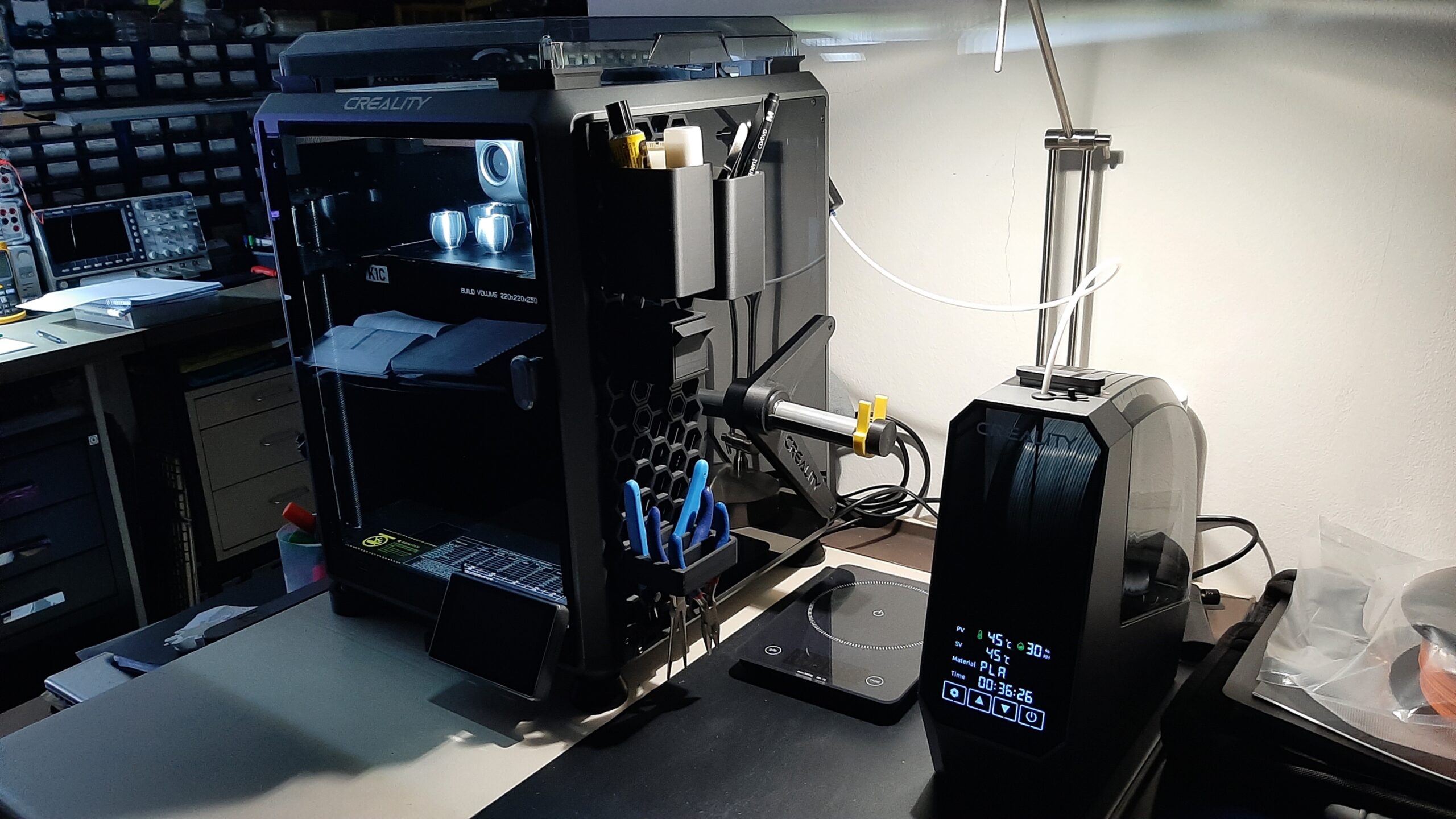
Wet filament is nothing new. It simply shows its effects faster and more visibly today. Printers have become faster, standard profiles use higher flow rates, and many hobby workshops no longer print only PLA. PETG, TPU, nylon, support materials, and composites react to moisture much more sensitively than standard PLA, so a problem that previously looked like minor stringing now often means a failed multi-part print overnight.
The good news is that the solution does not have to be expensive. Some users only need sensible storage: sealable boxes, bags, and regenerable silica gel. An active dryer makes sense once you print hygroscopic materials, leave spools open for longer periods, or need a reliable result for a custom job.
The most important rule is simple: a drybox is not the same as a dryer. A drybox keeps dry filament in good condition. An active dryer can remove moisture from filament that has already absorbed it.
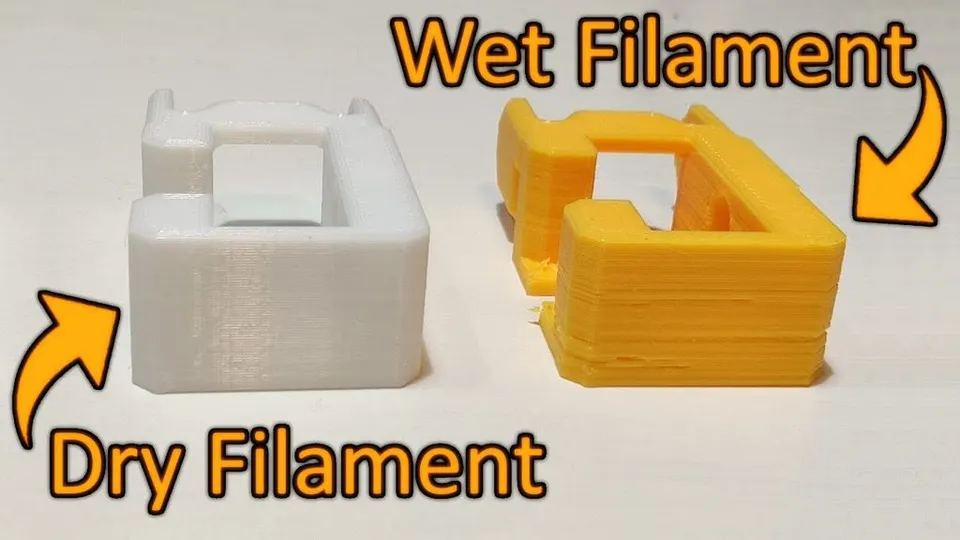
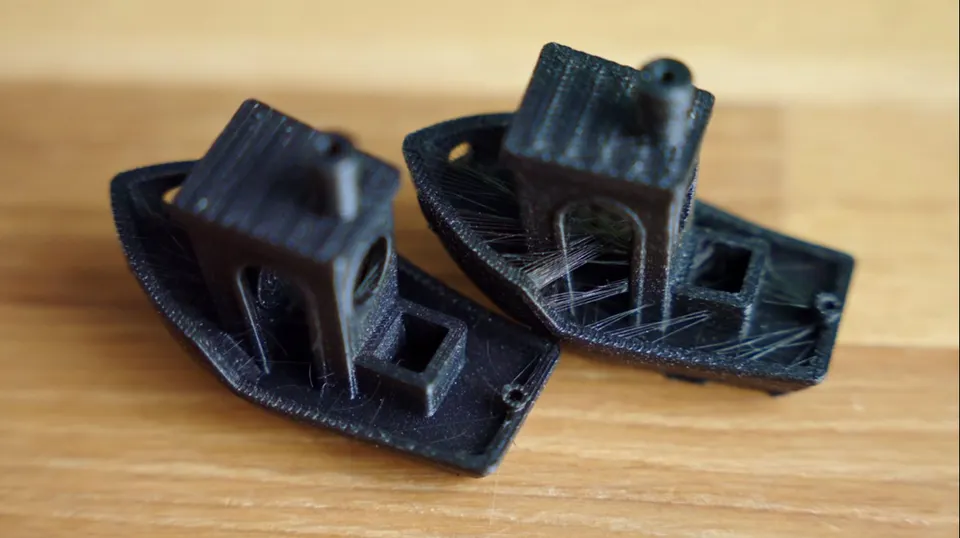
Moisture turns into steam in the hotend. It disrupts the flow of molten plastic, creates tiny bubbles, and causes pressure fluctuations in the nozzle. The result is often confused with incorrectly set retraction, excessive temperature, or poor cooling.
Typical symptoms include:
The practical test is simple: if the same g-code printed cleanly last month and today suddenly produces strings with the same spool, dry the filament first. Only then adjust retraction, temperature, and speeds.
PLA absorbs moisture more slowly than PETG, TPU, or nylon. A freshly opened spool of PLA usually does not need preventive drying if it was stored in a bag with silica gel and you are not printing in an extremely humid room.
Dry PLA mainly when the spool has been sitting on an open shelf for weeks, has started cracking in the extruder, or the print has suddenly developed a rough surface. A safe working range is usually approximately 45-50 °C for 4-7 hours. With PLA, do not increase the temperature just to finish faster. Excessive heat can soften the filament on the spool, causing individual strands to stick together and shifting the problem from print quality to feeder jams.
For standard home PLA, it is therefore often enough to return the spool to a sealable bag after printing, add dried silica gel, and avoid leaving it next to a window, in the garage, or in the basement all summer.
PETG is a material where moisture shows its effects very often. A typical scenario: you are printing a holder or box, and suddenly the model is covered in fine strings, while increasing retraction does not help. If the PETG spool has been open for more than several days or weeks, drying is a more sensible first step than further profile tuning.
In practice, PETG is dried at approximately 55-65 °C for 6-8 hours. For critical prints, transparent parts, or high-speed profiles, preventive drying is worthwhile. Dry PETG has more stable extrusion, fewer bubbles, and better layer adhesion.
Store PETG in a sealed box or vacuum bag with silica gel. If you print PETG often, it is convenient to keep one active spool in a drybox with a fitting for a PTFE tube and store the other spools separately.
TPU and other ible materials are sensitive to both moisture and the mechanics of feeding. When TPU is wet, it does not only cause stringing. It often foams, loses its attractive surface, develops weaker layer adhesion, and can make printing generally unstable with soft materials.
Expect to dry TPU more often than PLA. A typical range is approximately 50-60 °C for 6-8 hours, depending on the specific hardness and the manufacturer's recommendations. With soft TPU, do not rush to use a higher temperature, as both the filament and the spool can deform.
For long ible parts, it is ideal to print directly from a drybox or a dryer with a filament outlet. This limits the situation where the first hour looks good but the end of the print has already absorbed moisture from the room.
Nylon is in a different league. It absorbs moisture quickly and in practice can lose print quality within a single day in an open room. For functional parts, gears, holders, jigs, or technical prototypes, drying nylon is practically mandatory.
Typical values are around 70-90 °C for 8-16 hours, with some nylons requiring even higher temperatures according to the material data sheet. An ordinary plastic box with silica gel is no longer enough here. You need an active dryer that genuinely maintains the required temperature, has air circulation, and can handle safe long-term operation.
After drying, do not print nylon from an open spool. Ideally, print directly from the dryer or a sealed drybox. If you simply place the spool on a holder next to the printer after drying, you will lose part of the work before completing a longer print.
A drybox is a sealed container with a gasket, silica gel, and ideally a hygrometer. It is excellent for storage and for printing from an already dry spool. It works well for PLA, PETG, and TPU if the filament is not significantly wet beforehand. An inexpensive solution can be a sturdy plastic box with a gasket, spool holder, PTFE fitting, and a bag of regenerated silica gel.
An active dryer adds controlled heating and airflow. This is the difference that matters for PETG, TPU, nylon, and support materials. A good dryer has an adjustable temperature, a timer, space for standard 1kg spools, and the option to print directly from it. With technical materials, pay particular attention to the maximum temperature. A dryer that tops out at 55 or 60 °C may be sufficient for PLA and some PETG, but it will not be ideal for nylon.
An AMS with active drying combines automatic feeding of multiple materials, enclosed storage, and controlled drying. With modern systems such as AMS 2 Pro, an important practical limit is the maximum drying temperature of around 65 °C. This is very useful for PLA, PETG, and some common materials, but it is not enough to completely dry all technical filaments. Nylon, some PA-CF, PC, or highly demanding support materials may require a more powerful drying unit.
Before purchasing, also check whether your specific printer, firmware, and power supply support the scenario you want to use. With some combinations, it may not be possible to actively dry the same unit from which you are currently printing. This does not mean the system is useless; it simply requires planning: one spool can be drying while printing takes place from another unit or an external holder.
A drybox is enough if you mainly print PLA, use up spools quickly, and return them to a sealed bag or box after printing. A drybox is also a good first step for PETG if you do not print custom jobs and can dry the spool elsewhere before a critical print if necessary.
Consider an active dryer if:
For a small workshop, a combination makes sense: one or two active dryers for material preparation and several passive dryboxes for storing partially used spools. This is cheaper and more practical than buying active drying for every spool.
In winter, indoor air is often drier, but watch out for basements, garages, and unheated storage areas. In summer and during rainy weather, problems with PETG, TPU, and nylon occur more frequently. That is why it pays to establish a simple routine.
With PLA, mainly check for brittleness and surface quality. If the spool has been left open for more than a month, give it a short drying cycle before an important print. With PETG, dry it before a longer or appearance-critical print if the spool has been open for more than a week. Dry TPU before every more important printing session. Always dry nylon and print directly from an enclosed environment.
Regenerate silica gel regularly. Indicator silica gel is practical because you can see when it is saturated. Treat the hygrometer in the box as an approximate guide, not a laboratory instrument. If the box shows high humidity for a long time, replace the gasket, add fresh silica gel, or reduce the box volume.
| Material | When to dry | Approximate drying | Recommended storage |
|---|---|---|---|
| PLA | When cracking, brittleness, or a poorer surface appears | 45-50 °C, 4-7 h | Bag or box with silica gel |
| PETG | With stringing, after extended exposure, or before a critical print | 55-65 °C, 6-8 h | Drybox or vacuum bag |
| TPU | Before a longer print, when foaming or stringing occurs | 50-60 °C, 6-8 h | Drybox with printing through a PTFE fitting |
| Nylon | Practically always before printing | 70-90 °C, 8-16 h | Print directly from the dryer or a sealed box |
If you treat these values as a starting point rather than dogma, you will avoid most problems. Specific filament may have different limits depending on the blend, color, additives, and spool type. With more expensive technical materials, always follow the manufacturer's recommendations.
The first mistake is drying at too high a temperature. A higher temperature does not necessarily mean a better result. With PLA, it can ruin the entire spool; with TPU, it can cause deformation; and with plastic spools, it can create problems before the material itself does.
The second mistake is believing that silica gel will dry wet filament. Silica gel reduces the humidity of the air in the box, but it cannot reliably remove moisture trapped in the material without heat and time.
The third mistake is tuning the slicer before drying. If the filament is wet, adding retraction only masks the cause. With PETG, you can easily end up with a profile that works only by chance and will be wrong again next time.
The fourth mistake is leaving the filament exposed after drying. If you dry a spool and leave it on a holder for a week, you are starting over. Drying and storage must work as one process.
If you mainly print PLA and occasionally PETG, first buy good sealable boxes, silica gel, and a hygrometer. If you print PETG often, add an active dryer with the option to print from the box. If you use TPU or nylon, an active dryer is no longer a convenience but part of material preparation.
An AMS with active drying makes the most sense for users who want to combine multiple colors or materials while keeping spools in a more controlled environment. However, do not treat it as a universal replacement for a powerful dryer for all technical materials. It is a very practical system for everyday printing, while nylon and demanding composites still deserve separate attention.


