Free shipping from 1 999 Kč
Fast shipping
Verified store
Thousands of customers




Free shipping from 1 999 Kč
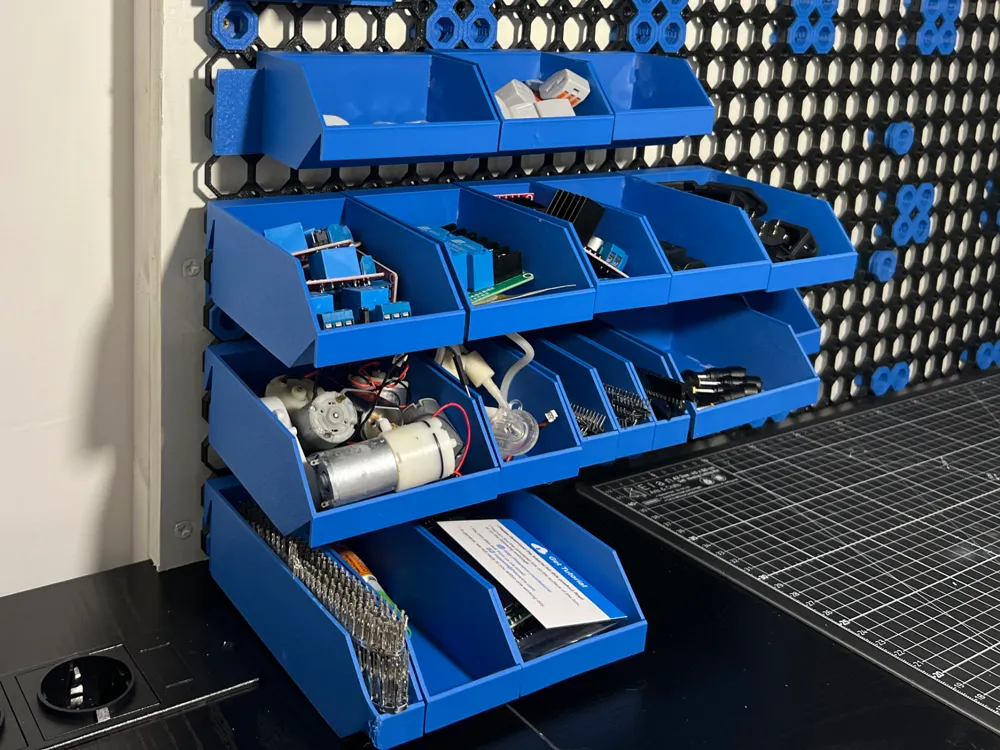
Workshop organization does not start with printing an entire wall of panels. It starts with giving every item you often pick up its own place exactly where you use it. That is why systems like Gridfinity, Skadis and Multiboard are so popular: they do not just solve storage, but also speed up your work.
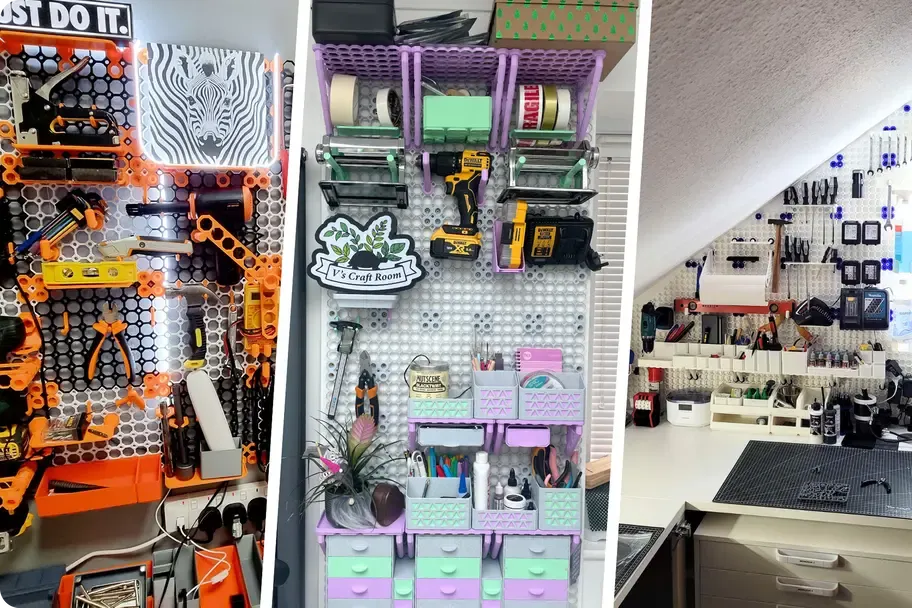
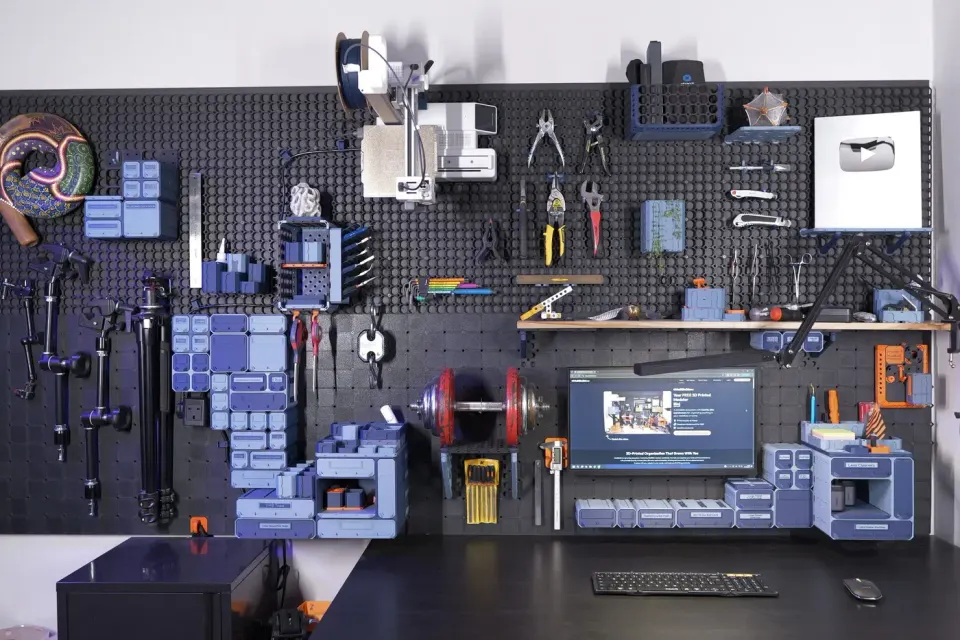
Gridfinity is best for drawers, shelves and the workbench. Skadis makes sense when you want a finished wall quickly and mainly want to print hooks and holders. Multiboard is suitable for a sturdier workshop wall with heavier tools, but requires more time, material and planning.
| Situation | Best choice | Why |
|---|---|---|
| Drawer with screws, nozzles, connectors and bits | Gridfinity | Modular boxes stay aligned in the grid and can be rearranged |
| Workbench with everyday essentials | Gridfinity | Low boxes, bowls and stands are right at hand |
| Wall above the workbench without lengthy panel printing | IKEA Skadis + printed accessories | Buy the panel ready-made and print only useful holders |
| Workshop wall for tools and heavier loads | Multiboard | Sturdier modular panel, suitable for hooks and holders |
| Combination of drawers and wall | Gridfinity + Skadis or Multiboard | Small items go below, tools and frequently used things above |
The biggest mistake is trying to organize the entire workshop at once. First, print a small test: one base, several boxes and one wall holder. Only after a week of use will you know whether you need more boxes, different heights or an open wall instead.
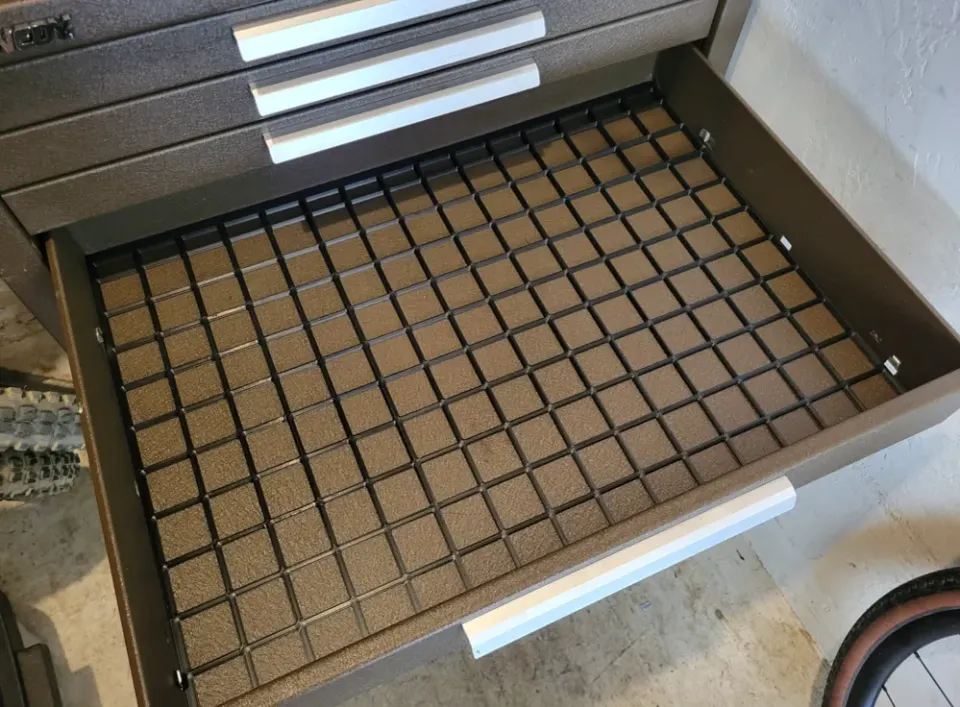
Gridfinity is based on a 42 x 42 mm grid. The base plate sits in a drawer or on a workbench, and individual boxes fit into it. This keeps screws, nozzles and small tools from shifting when you open the drawer.
Start with one drawer. Measure the internal dimensions, subtract a few millimeters for clearance and print only as many base pieces as you really need. Magnets are convenient, but they are not necessary for every drawer. For low boxes holding small components, the shape of the base alone is often enough.
Practical tip: put only things you look for every week in the first drawer. If you also fill Gridfinity with components you take out once a year, you will use up material without improving organization.
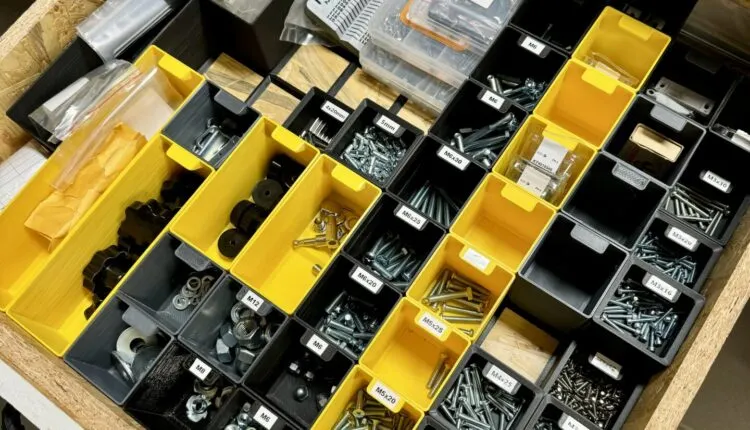
A 3D-printed screw box is one of the most rewarding workshop models. For M3, M4 and M5 screws, low 1 x 1 or 1 x 2 boxes work well. For longer wood screws, cable ties and springs, use 1 x 3 or 2 x 3.
Sorting is more important than size. Do not mix different lengths in one compartment if you cannot easily distinguish them at a glance. Three smaller labeled boxes are better than one large box full of mixed metal parts.
PLA is sufficient for a standard workshop. For a garage, car or area with higher temperatures, choose PETG because it withstands heat and long-term loads better.
Not every drawer needs to be completely Gridfinity. Sometimes it is enough to print a divided insert precisely sized for a specific drawer. This is useful for hex key sets, tweezers, replacement nozzles, scrapers, adhesives or small replacement parts for a printer.
The advantage of a custom insert is lower material consumption. The disadvantage is less ibility. Once you change the drawer's contents, the old insert may no longer make sense. Therefore, it is worth using full inserts only for stable tool sets and Gridfinity for things that change frequently.
Labels are a small detail that determines whether a system lasts. Without labels, after a few weeks you will return to putting things in the nearest available compartment.
The simplest solution is a box with a front window for a paper label. If you print in multiple colors, you can print the label directly as contrasting text. For a workshop, however, a replaceable label is often more practical because the contents of boxes change over time.
A good label is not long. Write M3 x 8, 0.4 nozzles, PH bits or JST connectors. A short label is quicker to read and also fits on a small box.
Bits are lost more easily than almost anything else. A 3D-printed bit holder therefore makes sense as one of the first projects. A Gridfinity module with holes for 1/4-inch bits is suitable for a drawer. For a wall, a rail or holder near the screwdriver is more practical.
With bit holders, account for tolerances. If the holes are too tight, you will have to pull the bits out forcefully. If they are loose, they will fall out when handled. First print a short test piece with several hole diameters, and only then print the entire organizer.
For everyday use, color sorting helps: red for flat-head, blue for Phillips, gray for Torx, yellow for hex. Color is not decoration, but a shortcut for your eyes.
AA, AAA, button batteries and rechargeable batteries for measuring instruments deserve a separate box. A battery organizer should separate charged and discharged batteries; otherwise, you are merely moving the chaos into a nicer box.
A Gridfinity battery box is suitable for a drawer. On the wall above the workbench, a dispenser may be better, with batteries taken from the bottom and replenished from the top. For rechargeable batteries, add a label with the type and purchase date, especially if you use multiple brands.
Do not print batteries into a closed box without visibility. You need to see the number of pieces and quickly recognize what is missing.
Calipers, tweezers, a deburring tool, side cutters and spatulas are tools you want to pick up with one hand. They get scratched in a drawer, get in the way on the workbench and are often easiest to see on the wall.
A Skadis or Multiboard holder works well for measuring tools and tweezers. For small replacement nozzles and needles, a Gridfinity box with a lid or a deeper compartment is better. Do not put sharp tools in open, shallow bowls where you could touch the tip.
If you use a tool at the printer, the holder should be by the printer. If you use it at the workbench, it does not belong in the cabinet with the filament.
Skadis 3D printing is an ideal introduction to wall organization. You do not need to print the panel itself, saving hours of printing and hundreds of grams of filament. Use your printer for parts that make sense: hooks, cups, shelves, pliers holders, a screwdriver holder or a tape measure mount.
PLA is sufficient for light items, but PETG is safer for hooks under constant load. PLA can slowly loosen under long-term stress, especially in a warmer room or near a window.
Skadis is a good choice for a clean work corner, office, packing table or hobby workshop. For a heavy drill, grinder or hammer, a more robust system and firm anchoring to the wall are better.
Cups and bowls on a Skadis panel are excellent for markers, brushes, adhesives, USB cables, memory cards, scissors or small replacement parts. Unlike hooks, they can hold items that do not have a hole for hanging.
Pay attention to depth. A cup that is too deep invites you to throw everything inside. For organization, several smaller cups are better than one large container. Use shelves for items with a stable shape, such as a box of knives, adhesive, cleaner or a small charger.
If you use something every day, put it at eye or hand level. Items used once a month can be higher or lower.
Multiboard 3D printing makes sense when you want a modular wall and do not mind printing a larger number of panels. Compared with a ready-made pegboard, it is more ible and customizable, but getting started is slower.
Before printing an entire wall, make a test panel and two types of hooks. Check how the tolerances fit, how the hooks slide in and how the panel is anchored. With heavier tools, strength is determined not only by the plastic, but mainly by the wall, screws and substrate. A hook printed from PETG will not help if it is held only by a weak wall plug.
Multiboard is suitable for hand tools, bit holders, milling cutters, screwdrivers, smaller cordless tools and workshop fixtures. For truly heavy items, plan to anchor them into a load-bearing substrate.
The first step is not downloading dozens of models, but taking inventory. Write down 20 things you look for most often in the workshop. For each one, decide whether it belongs in a drawer, on the workbench or on the wall.
Then print only a starter set:
Use this set for at least a week. If things automatically return to their places, the system works. If you keep putting them somewhere else, the holder is in the wrong place or has the wrong shape.
PLA is sufficient for drawer boxes and lightweight organizers. It prints easily, holds its dimensions and is inexpensive. For wall holders, hooks and parts under constant load, use PETG. For a garage, car or outdoor space, consider ASA or ABS if you have a printer suitable for these materials.
Practical starting settings:
Watch for warping with long, straight panels. A clean build plate, the correct temperature and a sufficiently slow first layer for PETG will help.
The most versatile setup is simple: Gridfinity in drawers, Skadis above the workbench and several sturdier wall holders for tools. You do not need to choose one system and stick with it forever.
Gridfinity handles small parts and drawers. Skadis quickly clears the work surface. Multiboard comes into play when you want a true tool wall and are willing to invest more printing time in panels.
A good 3D-printed workshop organizer is not the biggest or prettiest one. It is the one your hand naturally returns to. When you can clear the workbench in a minute after working, you have printed the right things.


