Free shipping from 1 999 Kč
Fast shipping
Verified store
Thousands of customers




Free shipping from 1 999 Kč
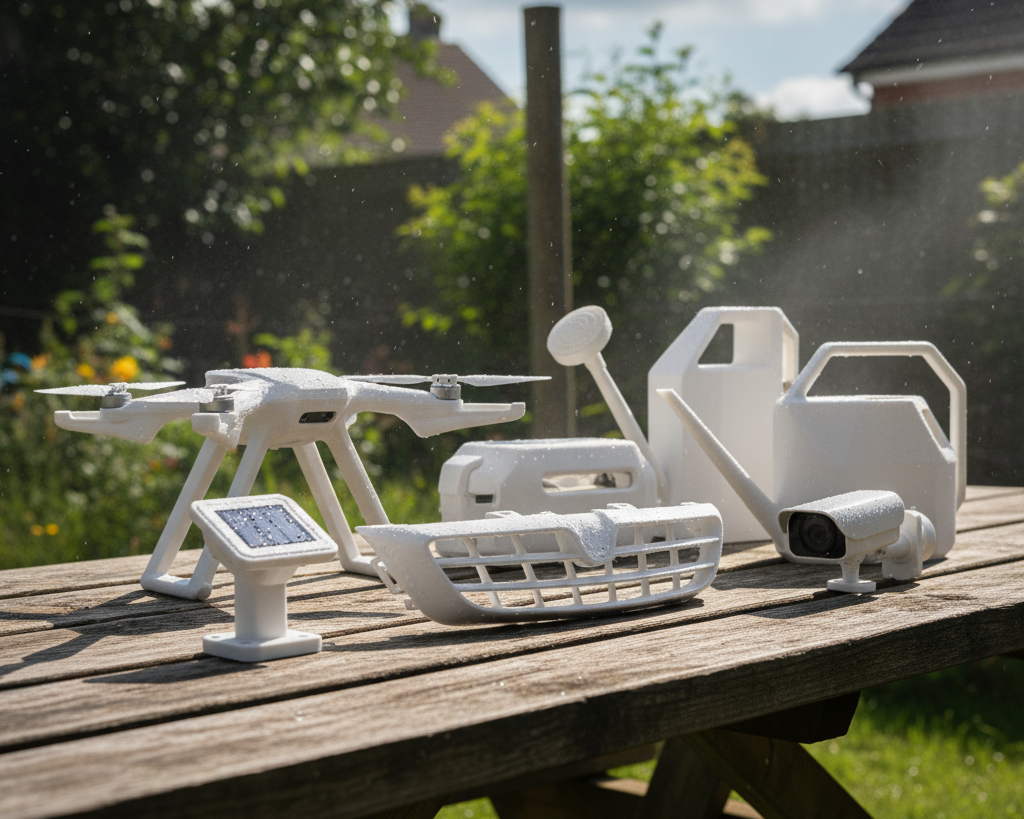
Outdoor 3D printing is not just a question of strength. A part that looks great on a desk may become brittle, change color, or warp after a few weeks in the sun. In the garden and on the balcony, rain, moisture, frost, soil, fertilizer chemicals, and mechanical stress are added to the mix. In a car, heat is the main problem: the interior of a parked car can heat up much more than the surrounding air in summer.
The short answer is: use PLA mainly for decorations, prototypes, and short-term parts kept in the shade. PETG is a practical compromise for most garden and balcony parts that need toughness and water resistance. ASA is the best choice for long-term outdoor use, direct sunlight, and car parts, but it requires a better-prepared printer.
| Use | Recommended material | Why |
|---|---|---|
| Plant labels for one season | PLA or PETG | PLA is enough for cheap and fast printing, while PETG withstands more moisture. |
| Hose holders, hooks, caps, spacers | PETG | It handles water well, is tough, and is easier to print than ASA. |
| Covers for electronics in sunlight | ASA | Better UV and heat resistance, with a lower risk of becoming brittle. |
| Interior car accessories | ASA | Heat is the deciding factor in a car; PETG is borderline and PLA is unsuitable. |
| Design decorations under a roof | PLA | Easy to print, attractive surface, low cost. |
| Long-term outdoor holders and signs | ASA | The best choice for sun, rain, and summer temperatures. |
PLA is popular because it is easy to print, has low shrinkage, and is forgiving even with a less-than-perfectly calibrated printer. It is excellent for indoor decorations, figurines, templates, or prototypes. Outdoors, however, it has two weaknesses: low heat resistance and poorer long-term resistance to UV radiation.
With standard PLA, expect softening at around 55 to 60 °C. That temperature may not sound dramatic, but a black part on a south-facing facade, on a car dashboard, or on a metal railing can easily reach it in summer. The result is often a warped holder, a loosened clip, a twisted sign, or a part that slowly deforms under constant tension.
PLA is therefore not automatically forbidden. It makes sense for seasonal decorations, test parts, templates, seedling markers, or components that are kept in the shade and do not carry a load. If a part has to hold a cable, hose, flower pot, or anything safety-critical, use PLA only to verify the shape.
PETG is the best first choice for many outdoor projects. It is more complicated to print than PLA, but still significantly easier than ASA. It is tough, less brittle, handles moisture well, and is suitable for functional parts that occasionally bend or take a hit.
In the garden, PETG is suitable for garden hose holders, clips for drip irrigation, caps, tool organizers, greenhouse hooks, spacers, light holders, mesh attachments, or simple boxes under a roof. On the balcony, it works well for self-watering holders, planter clips, cable attachments, and small repair parts.
However, PETG is not indestructible. In direct sunlight, it can gradually lose strength and change appearance, especially in transparent or bright colors. It is more heat-resistant than PLA, but in a hot car or in the case of a dark part in the sun, it can reach its limit. For a part that will remain under load for a long time, design a larger cross-section, use more perimeters, and avoid thin ible tabs.
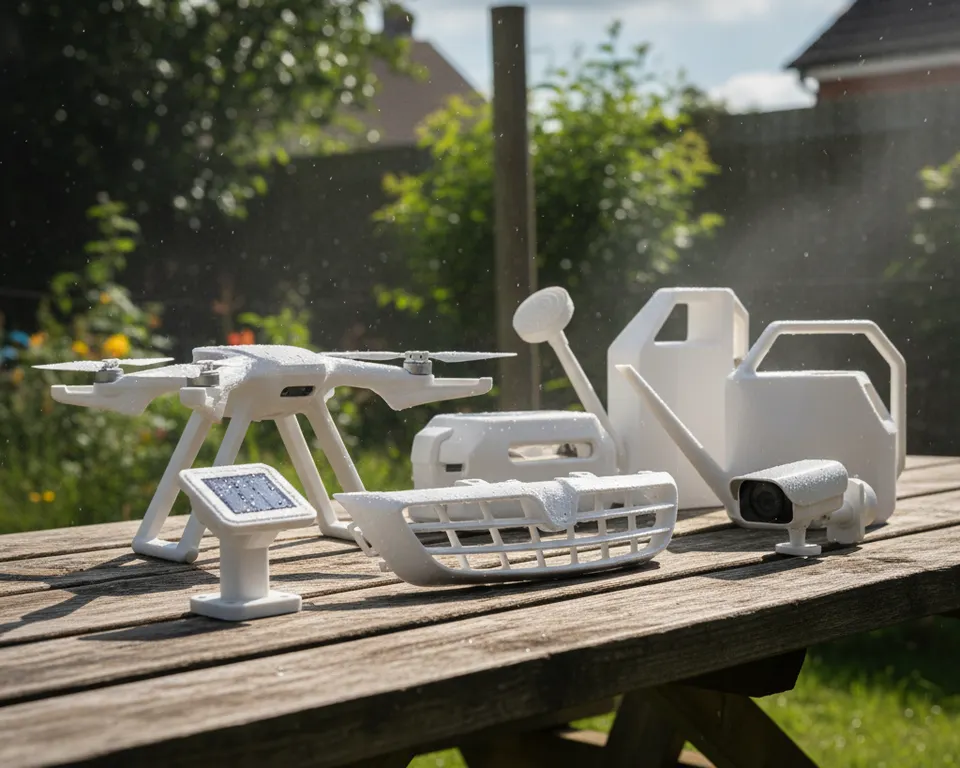
ASA is a material for parts that are meant to stay outdoors for months or years. Compared with PLA and PETG, it handles UV radiation, higher temperatures, and weather better. In practice, it is suitable for outdoor covers, camera and light holders, signs, caps, greenhouse parts, irrigation components exposed to sunlight, and car accessories.
The biggest disadvantage of ASA is printing. It requires a higher nozzle and bed temperature, a stable ambient temperature, limited cooling, and ideally an enclosed chamber. With larger parts and no chamber, there is a risk of corner warping, layer cracking, and poorer adhesion. Ventilate the area during printing or use filtration, because ASA is one of the technical materials you do not want to breathe in an unventilated room.
If you are printing on an open-frame printer, start with smaller ASA parts: a cap, sign, sensor holder, or spacer. For large surfaces, a brim, a clean and properly prepared bed, rounded model corners, and slower printing can help. When it comes to a part for a car or one exposed to all-day sunlight, the more demanding printing process is usually worthwhile.
For the garden, first determine whether the part will be exposed to direct sunlight. In a planter, flower bed, or near a hose, water and mechanical resistance are often the deciding factors, so PETG is a very sensible choice. For simple plant labels, you can also use PLA if you do not mind them being more of a seasonal consumable.
Choose ASA for long-term holders, outdoor covers, sturdy attachments, above-ground irrigation components, and parts near a greenhouse. A greenhouse can be deceptive: it is often humid inside and overheats in summer, so PLA often fails there quickly. PETG may work, but ASA is a safer choice for dark parts or components under constant load.
A balcony is a milder environment than a garden if it is covered. PETG is usually ideal for hooks, cable holders, shade-cloth clips, pads under flower pots, and planter clips. It is sufficiently water-resistant, not excessively difficult to print, and handles normal stress.
Use PLA for decorations, name tags, and parts kept out of the sun. ASA is worthwhile when the balcony faces south or west and the part will be exposed to sunlight all day. Typical examples include sturdy holders, electronics covers, outdoor light attachments, or parts you do not want to replace after one season.
A car is a harsh environment for 3D printing. The greatest risk is not rain, but high temperatures behind the glass. PLA does not belong in a car unless it is only a short-term shape test. PETG may work for less-stressed parts low in the interior, but on the dashboard, near the windshield, or in a phone holder, it is risky.
ASA is a more suitable choice for common car accessories: cable holders, caps, organizers, adapters, non-load-bearing interior parts, or attachments away from safety components. Do not print parts related to steering, brakes, airbags, seat belts, seat mounting, or any other safety function from hobby filaments. In a car, a simple rule applies: if its failure could endanger someone, do not print it as an ordinary home project.
The material helps, but a poorly designed part will still fail outdoors. For functional outdoor prints, use 4 to 6 perimeters rather than an extremely high infill percentage. Increase wall thickness, round off sharp corners, and add ribs where the part carries a load. Design screw holes with enough material around them, and use stainless steel screws for outdoor installation.
Also think about layer orientation. If a hook is pulled in a direction that separates the layers, it will crack sooner regardless of the material. For hose holders, hooks, and attachments, it is often better to print the part so that the main tension runs across the perimeters, not between the layers.
Parts that will be outdoors in the rain should not retain water in pockets. Add drainage holes, avoid deep trays, and allow for a seal or an overlapping lid on boxes. Light colors heat up less in the sun than black ones, which can be especially important with PETG and PLA.
If you want a quick rule, use this:
The most common mistake is printing the final outdoor part from PLA simply because the prototype turned out well. Feel free to prototype with PLA, but before final use, ask yourself three questions: will the part be in direct sunlight, will it carry a load, and can it become significantly hot? If so, move up to at least PETG. If it is for a car or long-term exposure to sunlight, choose ASA.


