Free shipping from 1 999 Kč
Fast shipping
Verified store
Thousands of customers




Free shipping from 1 999 Kč
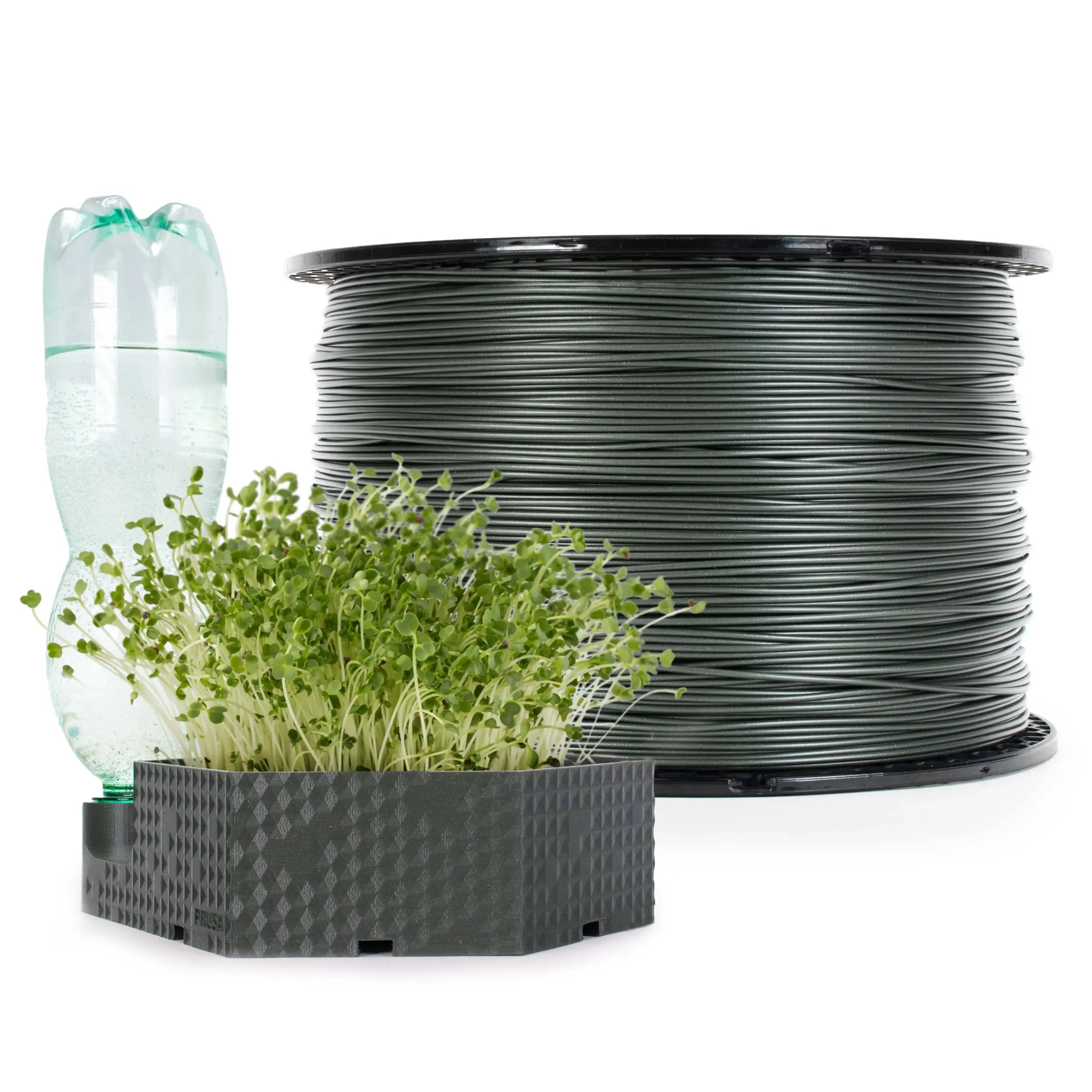
Recycled filament is no longer just an experiment for enthusiasts. Materials made from clean manufacturing waste are becoming increasingly common for PLA and PETG: from failed batches, trimmings, leftovers from color changes, or spools that did not pass the manufacturer's internal inspection. This is an important distinction. Filament made from controlled manufacturing waste is usually significantly more predictable than material mixed from random prints collected from users.
However, not every spool labeled recycled is automatically the more eco-friendly choice. It makes the most sense when the manufacturer clearly states the material's origin, the percentage of recycled content, the technical parameters, and ideally also calculates the environmental impact. It is good for customers to know exactly what they are buying: cheaper material for prototypes, properly reused waste, or simply regular filament with vague green marketing.
Higher-quality recycled filaments often use post-industrial waste. This means waste generated during manufacturing, not a mixture of unknown plastics from municipal collection. Typically, it is the same polymer from the same manufacturer, but it has already passed through part of the manufacturing process once. The material is shredded, reprocessed, and extruded into a new strand.
This is essential for printing. PLA and PETG have different processing temperatures, different viscosities, and different printing behavior. If PETG gets into PLA, or vice versa, it can cause unstable flow, lumps, partial nozzle clogging, or weaker layer adhesion. Clean manufacturing waste significantly reduces this problem because the manufacturer knows the source and composition of the input material.
Recycled filament made from manufacturing waste is therefore not the same as recycling all supports and leftovers at home into a single bucket. Home or community recycling can work, but it requires very careful sorting, drying, grinding, filtration, and diameter control. When buying regular filament, it is safer to look for material where the manufacturer describes a closed and controlled waste stream.
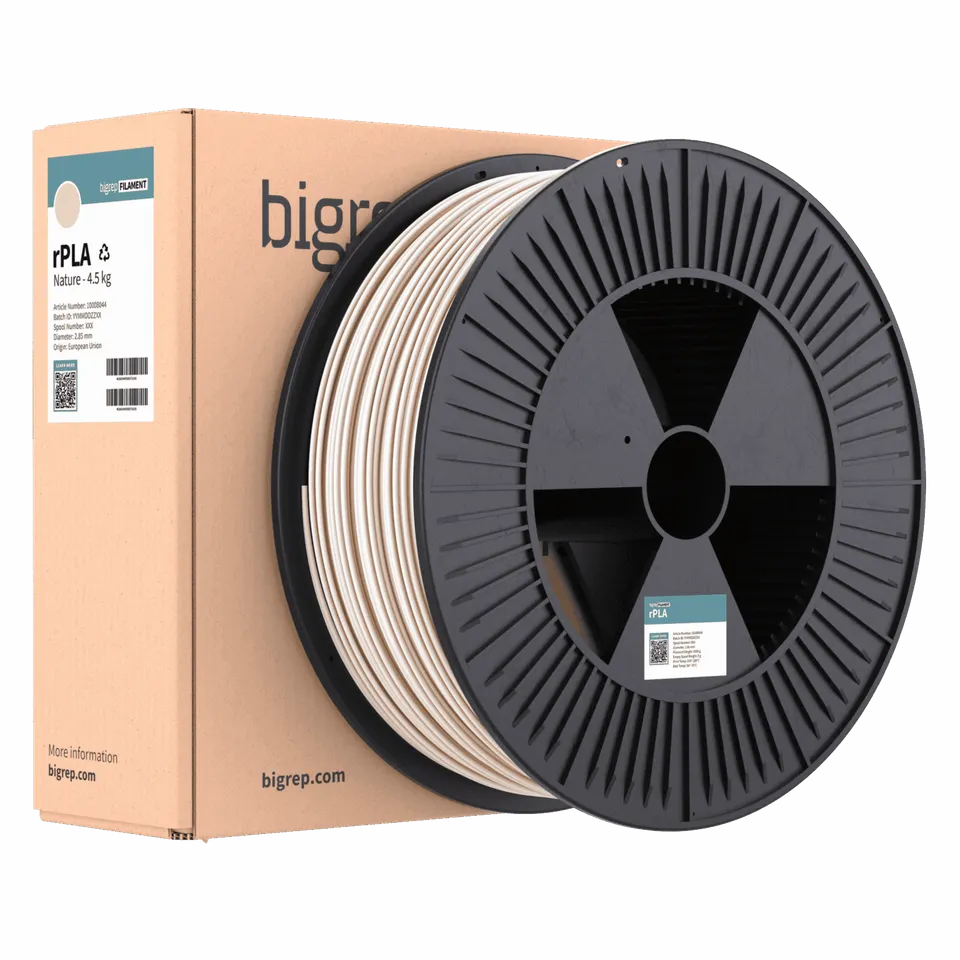
The greatest environmental benefit occurs when recycled filament replaces virgin granulate. With regular PLA or PETG, the primary raw material must be produced, transported to the manufacturing facility, and processed. When a manufacturer uses its own clean waste, part of this chain is eliminated. Published LCA calculations for recycled PLA and PETG variants show reductions in carbon footprint of tens of percent compared with regular material of the same type.
This does not mean that recycled filament has no impact. It still needs to be ground, dried, extruded, wound, packaged, and transported. The result is affected by the energy mix used in manufacturing, the type of spool, packaging, transportation, and whether the material ends up as a functional part or as more waste after a failed print. The best environmental choice is still to print the right part successfully the first time, with a reasonable infill and without unnecessary waste.
Recycled filament therefore makes the most sense for prototypes, fixtures, holders, internal parts, large models intended for sanding and painting, or parts where an exact color shade is not critical. If you are printing a decorative product in a precise corporate color, recycled material may not be ideal, even if it is environmentally interesting.
Good recycled PLA or PETG can print very similarly to regular filament. With materials made from clean manufacturing waste, it is often enough to use the standard profile for the given material type and fine-tune only the temperature or retraction. Customers should not expect recycled filament to automatically be worse.
However, differences may appear in diameter tolerance, winding, color, and consistency between batches. Some recycled materials have a slightly looser manufacturing tolerance than premium regular filaments. This usually does not matter with a standard 0.4 mm nozzle, but with very fine details, long high-speed prints, or printers sensitive to feeding, it is worth monitoring the extruder's behavior.
Before an important print, perform a short test: a small cube, a temperature tower, or a part with overhangs and thin walls. With PETG, watch for stringing, surface gloss, and possible bubbles. With PLA, watch the cleanliness of the edges, corner blobs, and brittleness of thin sections. If the filament pops or leaves a rough surface, dry it first; only then change the slicer profile.
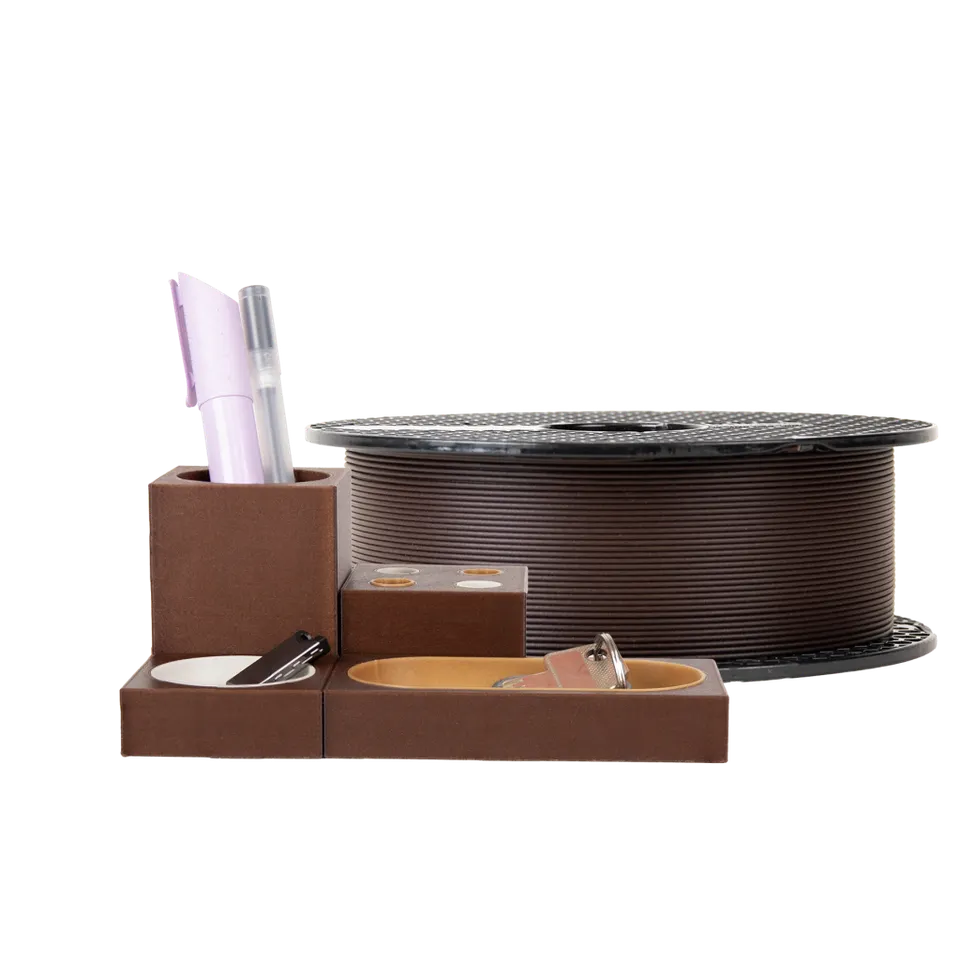
Color is often the biggest difference between recycled filament and regular material. When a mixture of manufacturing leftovers in different colors is processed, the resulting shade is determined by what was in the input batch. That is why each batch may be slightly different. PETG often produces darker tones, while PLA may show greater variation.
This is not a problem if the manufacturer states it in advance. In fact, it can indicate that the material does not contain unnecessary additional pigment added solely to achieve a perfectly uniform color. For technical parts, fixtures, prototypes, and models intended for painting, a variable shade is usually no problem. For sets of parts that need to match in color, it is better to buy enough material from one batch or choose regular filament with a guaranteed color.
A practical example: an electronics enclosure, assembly fixture, or large cosplay part that will be covered with primer and paint is a good candidate for recycled PLA. A visible product display stand in an exact brand green is less suitable. Recycled PETG can be useful for holders, boxes, workshop organizers, and outdoor or more mechanically stressed parts, provided the shade is not important.
The basic difference between PLA and PETG remains the same for recycled variants. Recycled PLA is usually easy to print, has low warping, and preserves details well. It is suitable for visual models, templates, prototypes, decorations, and large parts without high thermal loads. Its disadvantages are lower temperature resistance and greater brittleness. Do not use it in a car behind a window or near an engine.
Recycled PETG is a better choice for parts that need to withstand impacts, bending, moisture, or higher temperatures than PLA. It is suitable for holders, boxes, covers, workshop components, and functional prototypes. Expect a higher printing temperature, more stringing, stronger bed adhesion, and poorer bridges. PETG also more often needs drying, especially if the spool has been left open for a longer period.
Recycling can slightly alter the properties. Each additional thermal cycle can degrade the polymer somewhat, especially if the material was damp or contaminated. With controlled manufacturing waste, the risk is lower, but testing is still sensible for critical parts. If a part carries a load, supports expensive equipment, or has a safety function, verify its strength using a real prototype and do not rely on values from another brand or color.
A strong claim is specific. Look for information on what percentage of the material is recycled, whether it is PLA or PETG, where the waste comes from, and whether it is post-industrial or post-consumer waste. A technical data sheet, stated diameter tolerance, recommended temperatures, batch information, and a clear warning about color variation are good signs.
It is even better when the manufacturer publishes an LCA or at least describes the methodology and what is included in the calculation. The words eco-friendly, eco, or green are not enough. These terms alone say nothing about the percentage of recycled content, sorting quality, or actual carbon footprint. A credible manufacturer is not afraid to state limitations as well: batch-to-batch color differences, availability depending on the amount of waste, the need for testing before production runs, or differences compared with its premium regular range.
Also beware of confusing terms. Recycled content, biological origin, and compostability are three different things. PLA may be biobased, but that does not mean your print will decompose in a home compost bin. PETG may be recyclable as a material, but regular sorting facilities generally do not accept 3D prints as easily identifiable waste. Therefore, do not assess sustainability based on a single word on the label.
Start with the profile for regular PLA or PETG from the same brand unless the manufacturer provides its own profile. For PLA, use relatively conservative speeds for fine details and check the cooling. For PETG, reduce bridge speed, fine-tune retraction, and do not overdo first-layer pressure, as PETG can adhere to the bed far too strongly.
Store the material as carefully as regular filament. A dry box or resealable bag with silica gel will extend print stability. Dry PETG more often than PLA, especially if you notice bubbles, a matte rough surface, or excessive stringing. For large parts, consider a larger nozzle, such as 0.6 mm. This allows you to use recycled material more efficiently, and minor color variation will be less visible.
If you want to compare recycled and regular filament fairly, print the same test part with the same slicer profile, orientation, and infill. Compare the surface, dimensions, strength by hand, layer adhesion, and behavior during a longer print. One failed first layer is not proof that the material is bad. Likewise, one successful decorative model does not mean it is suitable for a stressed holder.
Yes, if you know why you are buying it. Recycled PLA is an excellent choice for easy printing, prototypes, large models, and parts where lower temperature resistance is not an issue. Recycled PETG makes sense for more functional parts, holders, and practical equipment where you appreciate toughness and better heat resistance. In both cases, the safest choice is material made from clean manufacturing waste with a clearly described origin.
For precise color, certified mechanical properties, or safety-critical parts, regular filament with a guaranteed batch and technical data remains the better choice. For everyday workshop printing, prototyping, and a sensible reduction in material impact, however, recycled PLA or PETG is a very practical option. It is not magically a zero-waste material, but when used correctly, it can turn manufacturing waste into high-quality and useful prints.


