Free shipping from 1 999 Kč
Fast shipping
Verified store
Thousands of customers




Free shipping from 1 999 Kč
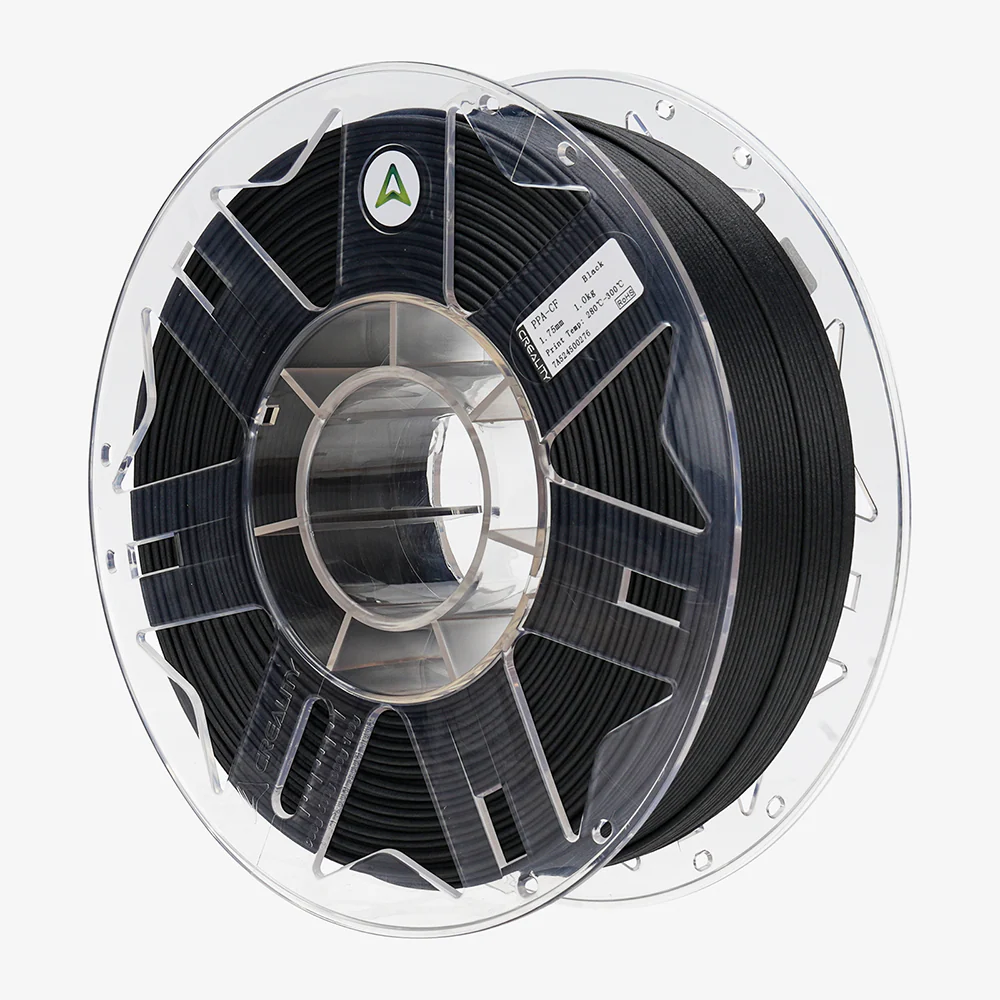
Carbon-filled polyamides are among the materials you reach for when PLA, PETG and ASA are no longer enough. They offer high rigidity, better dimensional stability than pure nylon, good heat resistance and a professional matte finish. However, they are not a universal miracle. They require dry filament, a wear-resistant nozzle, the right build plate and, for larger parts, often a heated or at least enclosed chamber.
You will most often come across three abbreviations: PA6-CF, PAHT-CF and PPA-CF. All of them refer to polyamide with an admixture of chopped carbon fibers, but each is aimed at a slightly different use. PA6-CF is a strong and rigid engineering nylon, PAHT-CF is a more practical option for parts exposed to heat and moisture, and PPA-CF is the highest-performance choice for demanding structural parts.
CF stands for carbon fiber. In filaments, this is not a continuous long fiber as in aerospace composites, but finely chopped fibers dispersed in plastic. Their purpose is to reinforce the material, increase rigidity and reduce shrinkage during printing.
Carbon fibers usually provide the following benefits:
They also have disadvantages. Carbon fibers are abrasive, so they quickly wear out brass nozzles. They also reduce the material's ductility. Parts are rigid and strong, but with a poor design or incorrect layer orientation, they can crack sooner than more ible unfilled nylon.
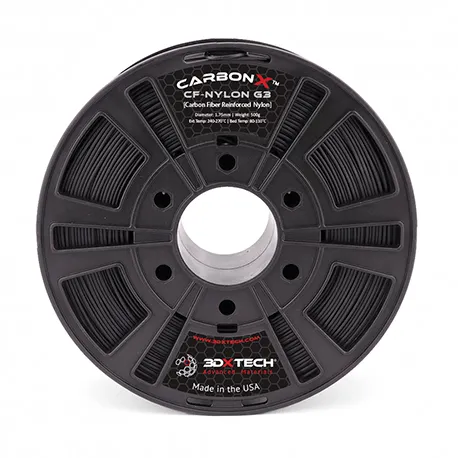
PA6-CF is carbon-fiber-reinforced nylon 6. It is popular for brackets, mounts, jigs, covers, machine parts and functional prototypes where strength and rigidity are important. When dry, it often has very good mechanical properties and high temperature resistance.
Typical applications:
The biggest weakness of PA6-CF is moisture. PA6 is one of the polyamides that readily absorbs water. Wet filament pops at the nozzle, creates bubbles, produces a hairy surface and reduces part strength. In precision parts, absorbed moisture can also change dimensions after printing.
If you want to get good results from PA6-CF, treat drying as a mandatory step. It is not enough for the filament to be new and vacuum-packed. With technical nylons, it is common to dry even a new spool, print directly from a dry box and seal the material again with silica gel after printing.
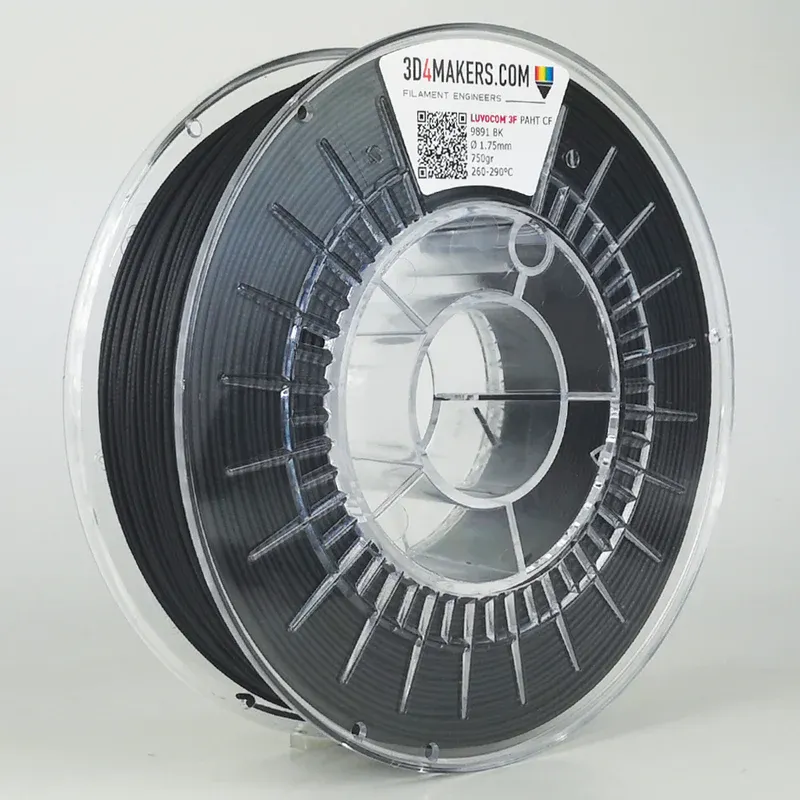
PAHT-CF stands for high-temperature polyamide with carbon fiber. In practice, it is often a blend of polyamides designed to withstand higher temperatures, provide good dimensional stability and be less sensitive to water than conventional PA6.
PAHT-CF is a good choice when you need a part that will function in real-world operation but do not want to move on to the most expensive and demanding PPA materials. It is suitable for workshop jigs, parts around motors and electronics, mounts, covers, clamps or small batches of functional components.
Compared with PA6-CF, PAHT-CF is often more convenient in these situations:
PAHT-CF still requires drying, a hardened nozzle and good first-layer settings. It is not a material for an unmodified, open, inexpensive printer. Compared with PA6-CF, however, it can be more tolerant of normal operating conditions and some blends retain their properties better even after absorbing moisture.
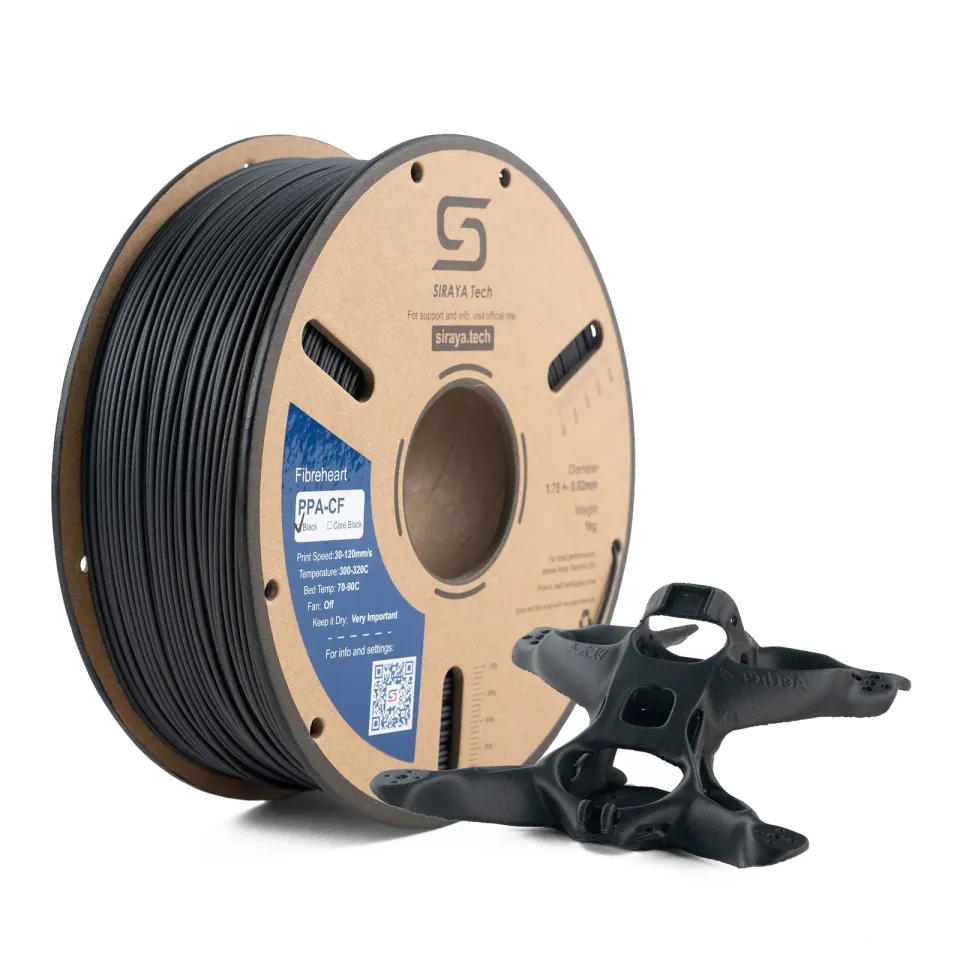
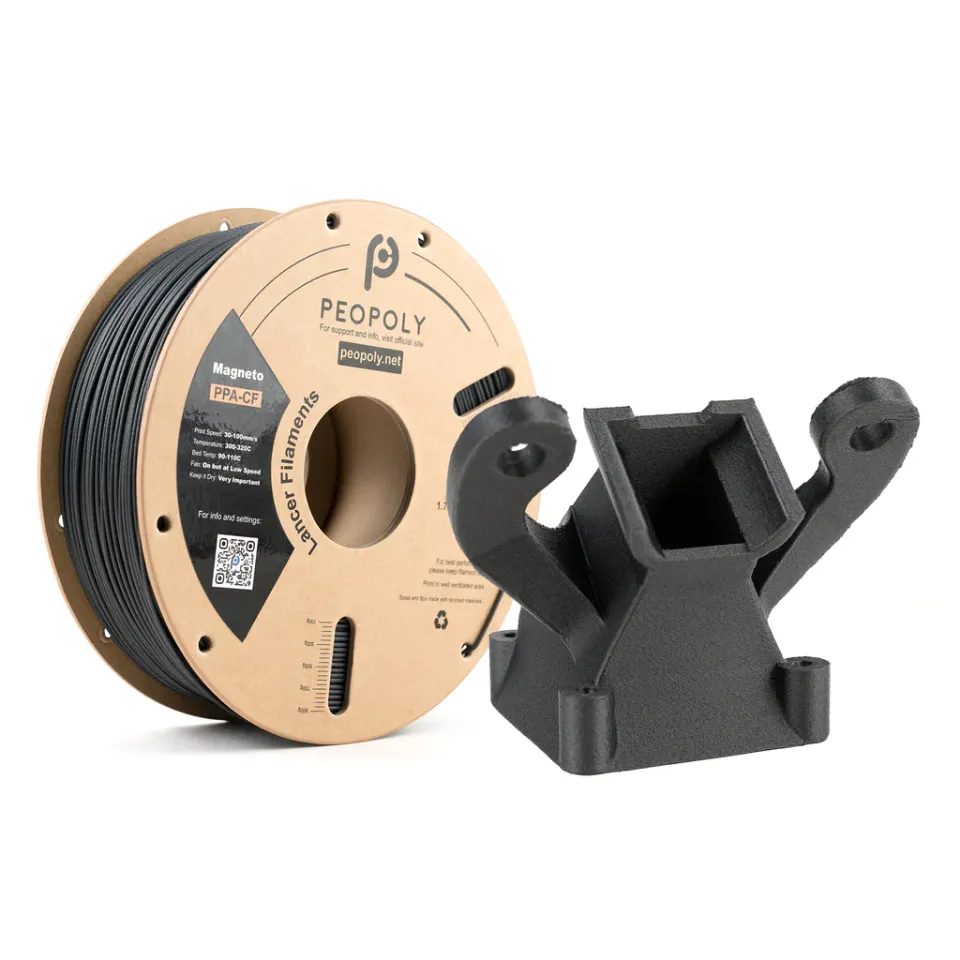
PPA-CF is carbon-reinforced polyphthalamide. PPA is one of the higher-performance polyamides and is used where greater strength, rigidity, chemical resistance and thermal stability are required. In practice, it is a material for parts intended to approach industrial use.
PPA-CF makes sense for:
Compared with PA6-CF and PAHT-CF, PPA-CF can offer higher tensile strength, a higher modulus of elasticity and greater thermal headroom. At the same time, however, it is more demanding on the printer. It requires a high nozzle temperature, a high bed temperature, a stable chamber and careful drying. For larger parts, it is worth planning test prints, because geometry, orientation and annealing have a major impact on the result.
| Material | Strength | Weakness | When to choose it |
|---|---|---|---|
| PA6-CF | Very good rigidity and strength | High sensitivity to moisture | Mechanically stressed parts, jigs, brackets |
| PAHT-CF | Better stability in heat and humidity | Still requires drying and enclosed printing | Functional parts for real-world use, covers, clamps, small batches |
| PPA-CF | Highest performance and thermal headroom | Higher cost and printer requirements | Structural parts, automotive, industrial applications |
If you are choosing your first carbon nylon, PAHT-CF is often the most sensible entry-level choice. Choose PA6-CF when you want high strength and have drying under control. Choose PPA-CF only when you genuinely need its higher performance and have a printer capable of stable high-temperature printing.
Several requirements apply to all three materials.
Use a hardened-steel, stainless-steel, ruby, tungsten or other abrasion-resistant nozzle. A brass nozzle wears out very quickly when printing carbon filaments. This leads to poorer accuracy, a wider extrusion line, material oozing and, ultimately, unpredictable dimensions.
For technical parts, a 0.6 mm nozzle is often worthwhile. It allows filled material to flow more easily, reduces the risk of clogging and enables stronger perimeters. A 0.4 mm nozzle can be used, but it must be high-quality and clean.
Expect temperatures of roughly 260-310 °C depending on the specific filament. PAHT-CF is often printed in the approximate range of 260-290 °C, PA6-CF at around 280-300 °C and PPA-CF at approximately 280-310 °C. Always follow the profile for the specific brand, as blends differ.
Polyamides tend to have specific adhesion requirements. Special nylon surfaces, Garolite, a suitable technical build plate or PEI with a release layer can work well, according to the manufacturer's recommendations. Adhesive is not only for better adhesion; it often also acts as a separation layer to prevent the surface from being damaged when removing the part.
An enclosed chamber significantly increases the chances of producing a straight part without cracking or warping. Smaller parts can sometimes be printed without active heating, but stable ambient temperature is essential for larger technical components. For PPA-CF and larger PA parts, a chamber is practically a necessity.
A dry box is not an optional convenience but part of the process. Dry the material before printing, print directly from the box and store it sealed after printing. The goal is to keep the relative humidity around the filament low, ideally below 20%.
Always fine-tune the specific profile according to the filament brand and printer, but for the first test you can follow these principles:
For technical parts, 4-6 perimeters and 30-50% infill often make more sense than 2 perimeters and 100% infill. Real-world strength typically depends on layer orientation, perimeters and geometry, not just the infill percentage.
With carbon polyamides, the difference between strength in the layer plane and strength between layers is very important. Parts are usually strongest in the direction of the fibers and perimeters. When designing a mount, hook or lever, orient the model so that the main tensile stress does not run across the layers.
Practical example: a bracket subjected to bending should not be oriented so that the force tries to peel the layers apart. A better orientation is one in which continuous perimeters carry the main tension. If the geometry does not allow this, add fillets, ribs, a larger cross-section or a mechanical connection using a screw.
Carbon filament is not a substitute for poor design. Strong material helps, but sharp internal corners, thin necks and tension across the layers will remain weak points.
Annealing can increase thermal stability and sometimes improve mechanical properties. PA6-CF is often annealed at temperatures around 80-100 °C, PAHT-CF at approximately 80-130 °C and PPA-CF at even higher ranges according to the manufacturer's recommendations. The duration is typically several hours.
However, annealing can change dimensions, cause deformation or accentuate internal stresses. Therefore, it is not advisable to start with the final part right away. First print a test sample with a similar thickness and shape, measure it before and after annealing, and only then set compensations.
The most common mistake is printing wet filament. You can recognize it by popping at the nozzle, bubbles, uneven extrusion, a hairy surface and weaker layers. The solution is simple: dry it and print from a dry box.
The second common mistake is using a brass nozzle. Nothing dramatic may happen with a few grams of material, but during a longer print the opening grows and the profile stops matching. Use an abrasion-resistant nozzle for carbon filaments from the start.
The third mistake is overly aggressive cooling. The fan helps with overhangs, but with nylons it can worsen layer bonding and increase deformation. Start with low cooling or no cooling and add only as much as the geometry requires.
The fourth mistake is incorrect model orientation. The material may have excellent values in the data sheet, but if the part is stressed across the layers, the result will disappoint. Plan the orientation of structural parts as early as the modeling stage.
Choose PA6-CF if you want a very rigid and strong part, have a dryer and dry box, and can control moisture. It is suitable for jigs, technical mounts and mechanical parts that will not operate long-term in a wet environment without verification of dimensional stability.
Choose PAHT-CF if you need a reliable functional part with good heat resistance and more practical behavior with regard to moisture. For most advanced users, it is the most versatile option of the three.
Choose PPA-CF if you need maximum performance, high rigidity, chemical and thermal headroom, and are prepared for more demanding printing. It makes sense for parts where material cost is not the main factor and where fine-tuning the process is worthwhile.
PPA-CF, PA6-CF and PAHT-CF are materials for genuinely functional 3D printing. They can produce strong mounts, jigs, covers and structural parts that are used outside the display case and beyond the test bench. The key to success, however, is not just buying an expensive spool. Drying, the right nozzle, stable temperature, a suitable build plate and designing the part according to the load direction are all important.
If you are just starting, choose PAHT-CF as a well-balanced material. If you want maximum strength from nylon and can manage moisture, choose PA6-CF. If you are dealing with truly demanding industrial applications, PPA-CF offers the greatest headroom, but it will also punish an inadequately tuned printing process the most.


