Free shipping from 1 999 Kč
Fast shipping
Verified store
Thousands of customers




Free shipping from 1 999 Kč
Nylon is one of the materials you reach for when PLA or PETG are no longer enough. Not because of its appearance, but because of its function. Nylon parts can be tough, wear-resistant, resistant to friction and impacts, and often able to withstand more chemically demanding environments. Typical applications include gears, sliding bushings, workshop brackets, jigs, covers, hinges, latches, or replacement mechanical parts.
There is, however, a catch: nylon is not a filament that you simply unpack, load into the printer, and print like PLA. It is hygroscopic, meaning that it quickly absorbs moisture from the air. Wet filament pops in the nozzle, creates bubbles, stringing, weaker layers, and a matte or rough surface. With nylon, therefore, it is not just the slicer profile that matters, but mainly drying, storage, and choosing the right specific type.
PA is short for polyamide, commonly called nylon. The number after PA indicates which type of polyamide it is. In FDM printing, you will most commonly encounter PA6, PA12, and variants reinforced with carbon fibers, known as PA-CF.
PA6 is a strong and tough nylon with very good mechanical properties, but it is usually more demanding to print. It absorbs more moisture, warps more during cooling, and often requires an enclosed printing space. It is suitable where it makes sense to sacrifice printing convenience in exchange for mechanical resistance.
PA12 is generally a more user-friendly nylon variant. It absorbs less moisture, warps less, and holds its dimensions better. It is often more suitable for a regular workshop where you want a functional part without excessively long fine-tuning. For many users, PA12 is a better first nylon than PA6.
PA-CF means polyamide with carbon fibers. The base may be PA6, PA12, PA11, PA612, or another nylon copolymer. Carbon fibers increase stiffness, improve dimensional stability, and often reduce warping. At the same time, however, the material causes more nozzle wear, so it requires a hardened, ruby, or other abrasion-resistant nozzle.
Choose nylon when the part has to perform mechanically. Good examples are parts exposed to impacts, bending, friction, or repeated stress. In a workshop, this could be a tool holder, stop, guide, sliding element, lever, lock, clip, or cover that has to survive being dropped on the floor.
Nylon is also interesting for parts that come into contact with metal or slide against one another. It has a low coefficient of friction and good abrasion resistance, so it is used for bushings, gears, spacers, and technical jigs. For such parts, it often outperforms PLA, which is hard but more brittle, and PETG, which can deform more under load.
Nylon, on the other hand, is not the best choice for decorative models, easy prototypes, or parts where ordinary strength is sufficient. If you are printing a cap, a shelf bracket, or a simple organizer, PETG, ASA, or high-quality PLA may be a cheaper, faster, and more reliable choice.
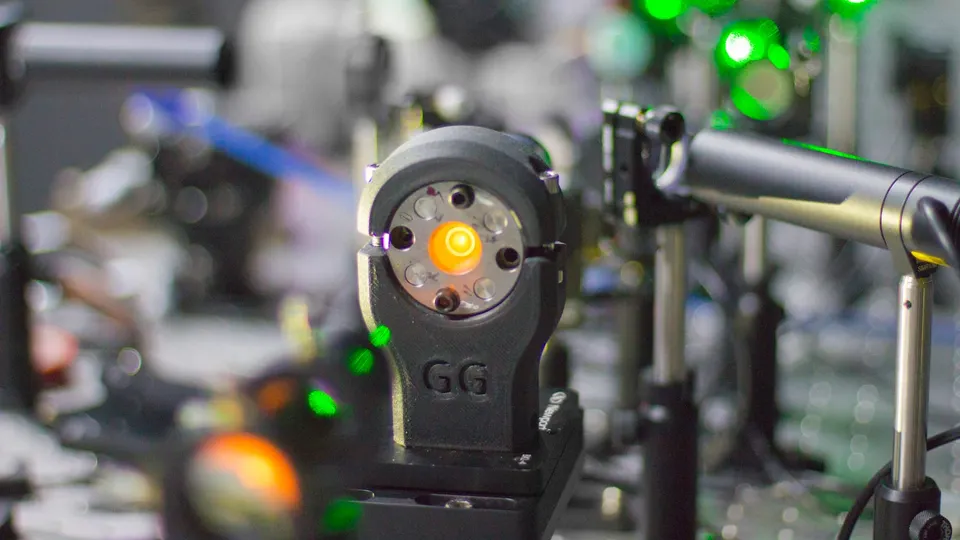
PA6 is a material for technical parts where toughness and mechanical resistance matter. When dry, it can offer very good properties, but moisture can significantly reduce its performance. PA6 is therefore sensitive not only during printing, but also during storage and use.
With PA6, plan on thorough drying before printing. In practice, this is often around 70-90 °C for several hours, depending on the recommendations of the manufacturer of the specific filament. A heavily moistened spool may need to be dried for longer. Ideally, print directly from a dry box, because PA6 can absorb moisture quickly even during a longer print.
PA6 also benefits from an enclosed printer. Larger parts can warp, detach from the build plate, or crack between layers without a stable ambient temperature. Small parts can be printed on an open printer, but for larger technical components, an enclosure is practically essential.
Choose PA6 for stressed functional parts where toughness, mechanical reserve, and wear resistance matter. It is not the ideal first technical filament, but if you already have experience with PETG, ASA, and drying materials, it makes a great deal of sense.
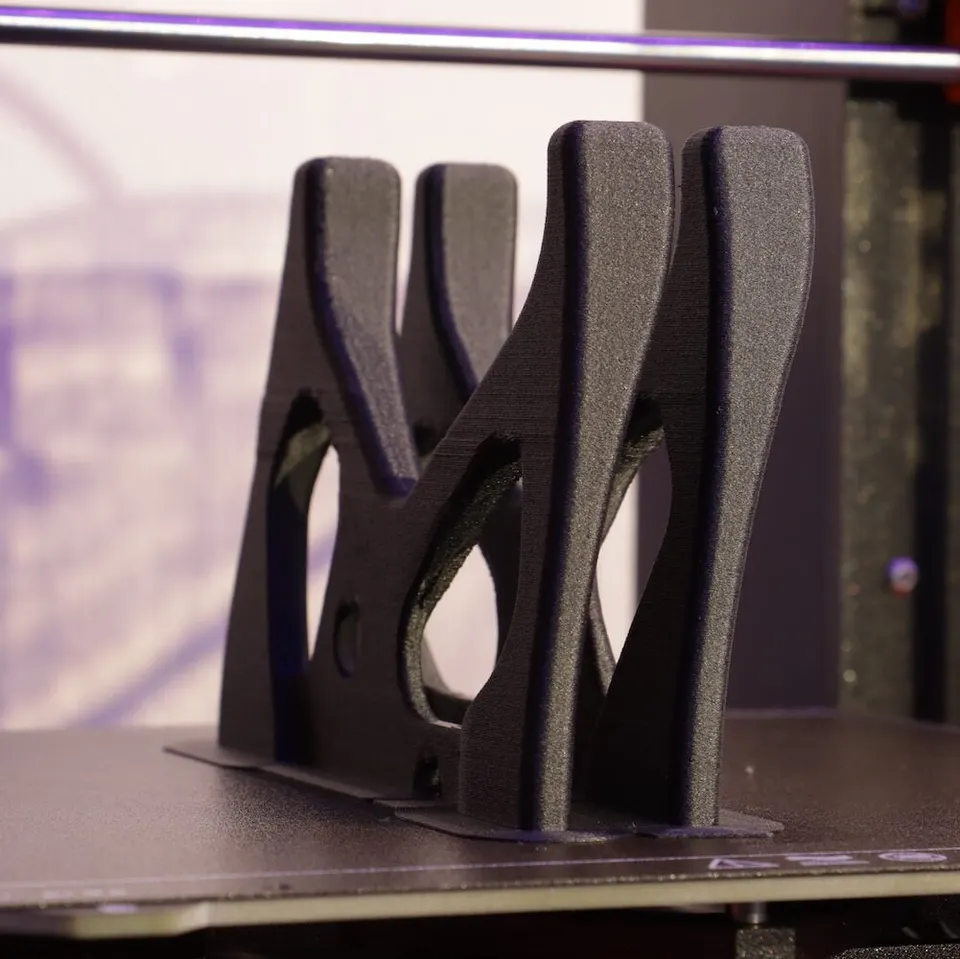
PA12 is generally easier to work with in FDM printing. It is still nylon, so drying is essential, but it usually behaves more calmly than PA6. It warps less, holds its dimensions better, and is less prone to rapid moisture absorption. This makes it suitable for users who want nylon's properties but do not want to turn every print into a laboratory process.
PA12 is a good choice for latches, covers, brackets, slightly ible parts, jigs, and mechanical components where resistance and dimensional stability are important. If a part has to work in a regular workshop, in a car away from extreme temperatures, or in a machine as an unobtrusive auxiliary component, PA12 often offers a very good balance of performance and effort.
A disadvantage may be the higher price and, for some blends, lower stiffness than PA-CF. If you need the part to be as inible as possible, pure PA12 may not be ideal. In that case, it is worth considering PA12-CF.
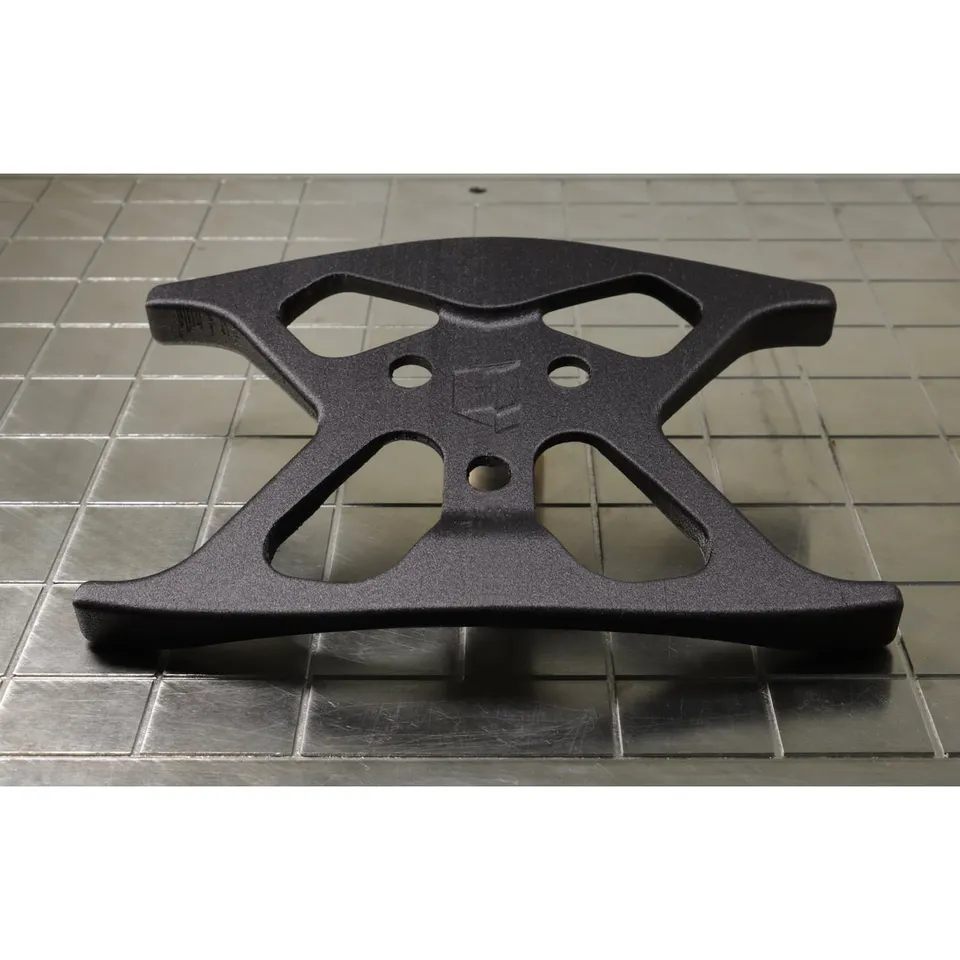
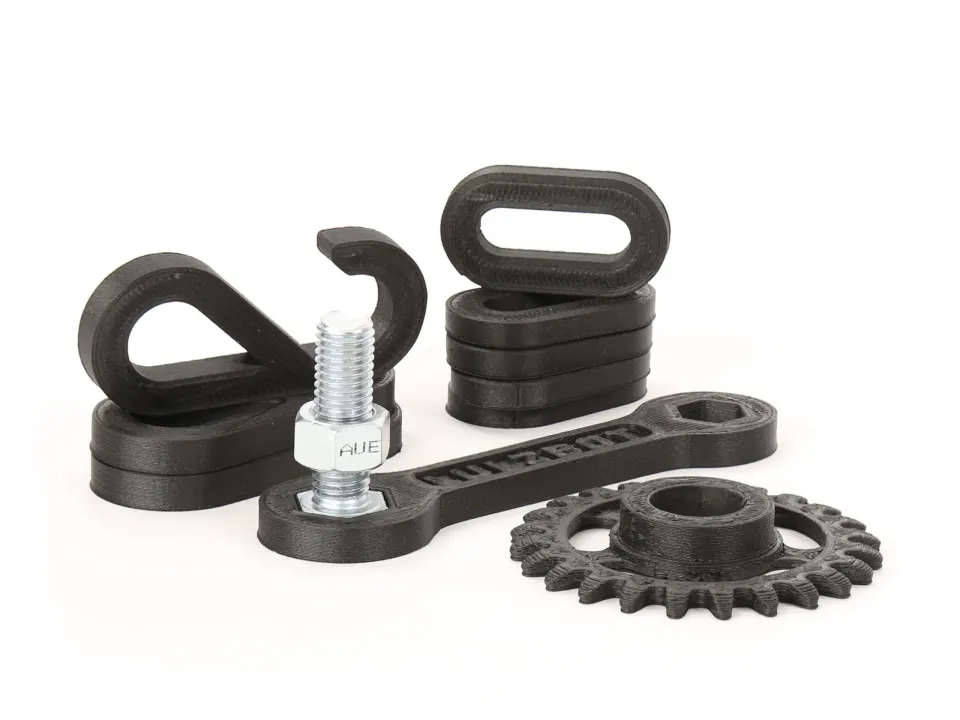
PA-CF is often the most appealing nylon for users of modern enclosed printers. Carbon fibers strengthen the material, increase stiffness, and help reduce warping. The resulting parts often have an attractive technical matte finish, hold their shape well, and look highly professional.
PA-CF is suitable for rigid brackets, arms, jigs, clamping elements, electronics covers, structural parts, and components that need to be stiff. If pure nylon would be too ible, carbon fibers can help. At the same time, do not expect PA-CF to automatically be the best choice for everything. The fibers increase stiffness mainly in the printing direction, while between layers, layer bonding quality, drying, and part orientation still determine the result.
Using the right nozzle is important. PA-CF is abrasive and can gradually enlarge a standard brass nozzle. This reduces extrusion accuracy and worsens the surface and dimensions. For PA-CF, use hardened steel, bimetal, ruby, or another nozzle designed for abrasive materials.
The most common mistake with nylon is printing from a damp spool. It manifests as popping in the hotend, bubbles in the walls, stringing, a poor surface, reduced strength, and sometimes unstable flow. With a technical part, this is a problem because poor appearance often also means poorer mechanical properties.
Dry the spool before printing according to the manufacturer's recommendations. As a general guideline, nylon is often dried at 70-90 °C for 6-12 hours, but always follow the instructions for the specific material and spool type. Some plastic spools cannot withstand high temperatures, so it is also better to check the spool's temperature resistance.
After drying, store the filament in a sealed container with silica gel. For longer prints, print directly from a dry box. With nylon, it is not enough to dry the spool once and leave it on the table for a week. If the air in the room is humid, the material will gradually return to a poor condition.
Nylon usually requires a higher nozzle temperature than PLA or PETG. You will often be somewhere around 250-300 °C, with some blends requiring even more. The build plate is generally around 40-110 °C, depending on the material. The differences between PA12, PA6, and PA-CF are significant, so treat the manufacturer's profile as a starting point, not as an optional detail.
An enclosed space helps with larger parts. It is not just about the maximum temperature, but also about environmental stability. Drafts and rapid cooling increase the risk of warping. Use the part cooling fan carefully. Too much cooling can worsen layer bonding, while too little cooling can worsen overhangs. For functional parts, slightly poorer overhangs are preferable to weak layers.
The build plate is also important. Nylon does not behave like PLA. A special nylon adhesive, a release layer, a suitable build sheet, or a recommended adhesion product can often help. Do not assume that the same surface that holds PETG perfectly will automatically work for PA as well.
If you are new to nylon, choose PA12 or PA12-CF. They tolerate more mistakes, warp less, and are easier to tune. For ordinary functional parts, this is often the fastest route to a usable result.
If you need higher toughness and are prepared to handle drying, an enclosure, and a more precise process, consider PA6. It makes sense for mechanically stressed components where the greater demands are worthwhile.
If you mainly need stiffness, precision, and stability, choose PA-CF. Just make sure you know which nylon the blend is based on. PA6-CF will generally be more demanding in terms of moisture, while PA12-CF will often be easier to print and store.
For a small latch that is meant to bend repeatedly, pure PA12 may be suitable. It retains a certain amount of ibility and withstands mechanical stress better than more brittle materials.
For a rigid camera, sensor, or electronics bracket, PA-CF is often better. The part will less, be more dimensionally stable, and have a technically clean-looking surface.
For a sliding bushing, guide, or gear, nylon makes sense because of its wear resistance and low friction. With such parts, however, proper layer orientation, enough perimeters, and very dry filament are essential.
PA6 is not a good first attempt for a large cover printed on an open printer. If you do not have an enclosure and a dryer, PA12, low-warp PA-CF, or an entirely different material based on the temperature and application would be a more sensible choice.
The first mistake is underestimating moisture. If nylon pops, strings, or has a rough surface, do not look for a magic retraction setting first. Start with drying.
The second mistake is using a brass nozzle for PA-CF. It may work for a while, but the nozzle will wear out and print quality will deteriorate. With abrasive blends, consider a hardened nozzle essential equipment.
The third mistake is incorrect part orientation. For functional components, design the print so that the main forces do not pull the layers apart. This is especially important with PA-CF, because carbon fibers will not perform miracles along the Z axis.
The fourth mistake is putting too much faith in one universal temperature. Nylon filaments differ according to the manufacturer, filler, and base polymer. Treat the profile as a starting point and fine-tune the temperature, flow, speed, and cooling for your specific printer.
Nylon is an excellent material for functional 3D printing, but it requires discipline. PA6 offers high performance, but punishes moisture and poor printing conditions. PA12 is more practical and often the better first choice. PA-CF adds stiffness, stability, and a technical appearance, but requires an abrasion-resistant nozzle and consistently dry filament.
If you want to get good parts from nylon, start by choosing the right material, dry it before printing, store it in a dry environment, and print with layer orientation in mind. Nylon can then become one of the most useful filaments for genuine mechanical components, rather than just another item on the list of materials.


