Free shipping from 1 999 Kč
Fast shipping
Verified store
Thousands of customers




Free shipping from 1 999 Kč
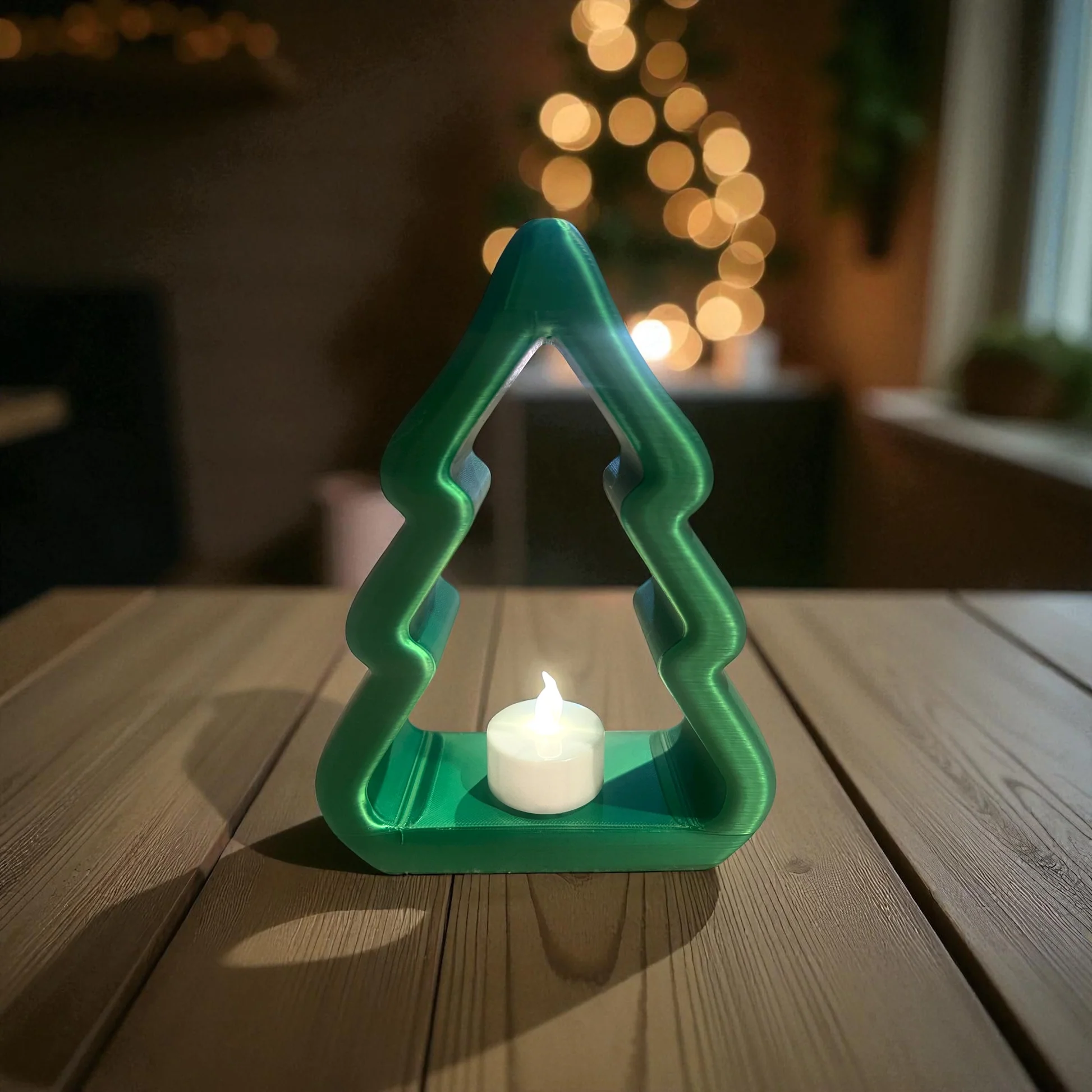
It pays to plan your winter decorations before Advent begins. In June, that may sound premature, but with 3D printing, having extra time is an advantage: you can choose models, coordinate filament colors, test tolerances, fine-tune the surface and print a larger set of ornaments without having to watch the printer overnight at the last minute.
For winter 2026, the latest community trends suggest that models combining decoration and practicality will work best: tree ornaments, small LED candle holders, mini trees, gift tags, cookie cutters, gift card boxes and small fidget gifts. Below, you will find ten types of prints that make sense for home decoration, corporate gifts and small batches for family.
For a Christmas look, the simplest option is silk PLA. The glossy surface highlights stars, snowflakes, baubles, bows and reliefs even without painting. However, keep in mind that PLA is not suitable for heat: for candle holders, lamps and parts near heating, use LED lights instead and keep the print away from heat sources.
Translucent PETG is suitable for lampshades, diffusers and ornaments that are meant to let light through. It looks best with thinner walls, a higher number of perimeters and without unnecessarily dense infill. PETG is tougher than PLA and handles temperature better, but it is still not a fireproof material.
When it comes to candles, one simple rule applies: only put LED tea lights in 3D-printed plastic candle holders. A real flame, a metal tea-light cup and an enclosed plastic shape are a bad combination. If you want to use a real candle, treat the print only as decoration around a separate non-flammable holder that does not touch the plastic.

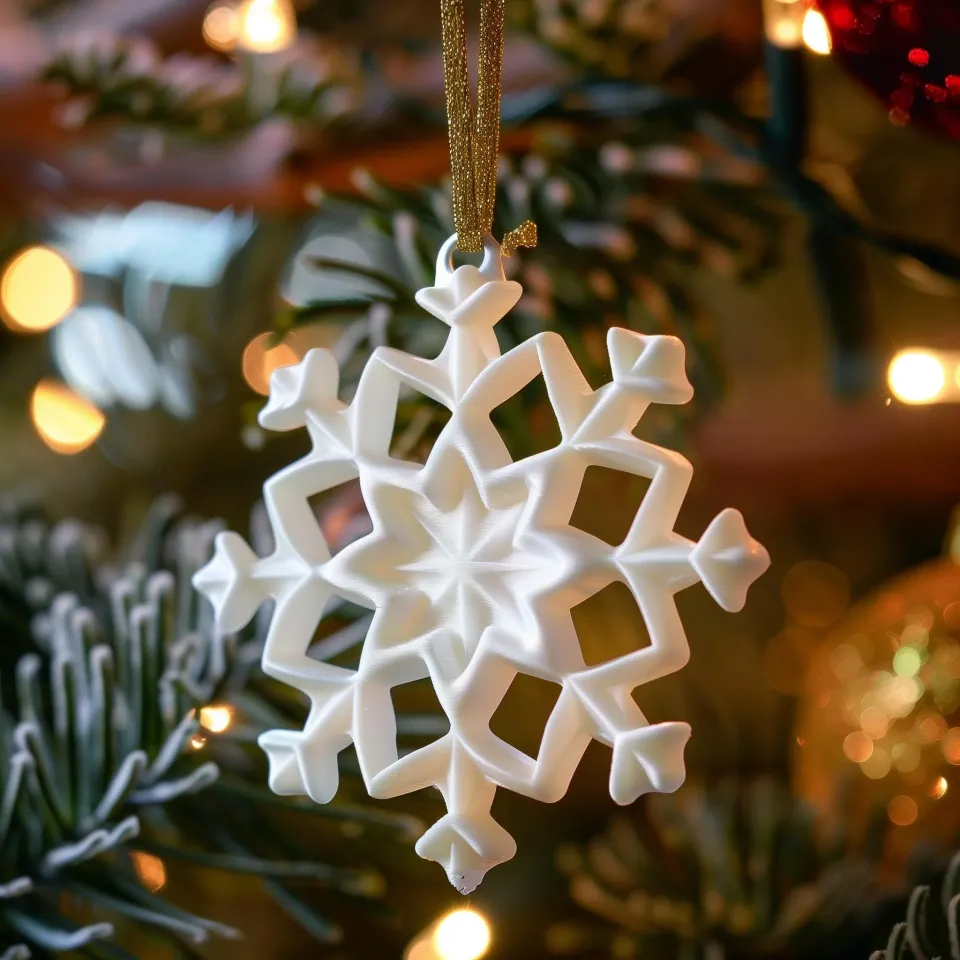
The most rewarding winter prints are tree ornaments: snowflakes, stars, baubles, houses, reindeer, angels or simple geometric shapes. They print quickly, use little material and are easy to personalize with a name, year or short dedication.
For a small home batch, set a layer height of 0.16 to 0.20 mm, 2 to 3 perimeters and low infill. For flat ornaments, the build plate texture can help, because the underside will often be visible. Silk PLA in gold, silver, pearlescent or dark red creates a festive effect without painting.
Practical tip: it is better to add a larger loop for the string to the design. Small hooks tend to break, especially when you take the ornament off the tree after several weeks.
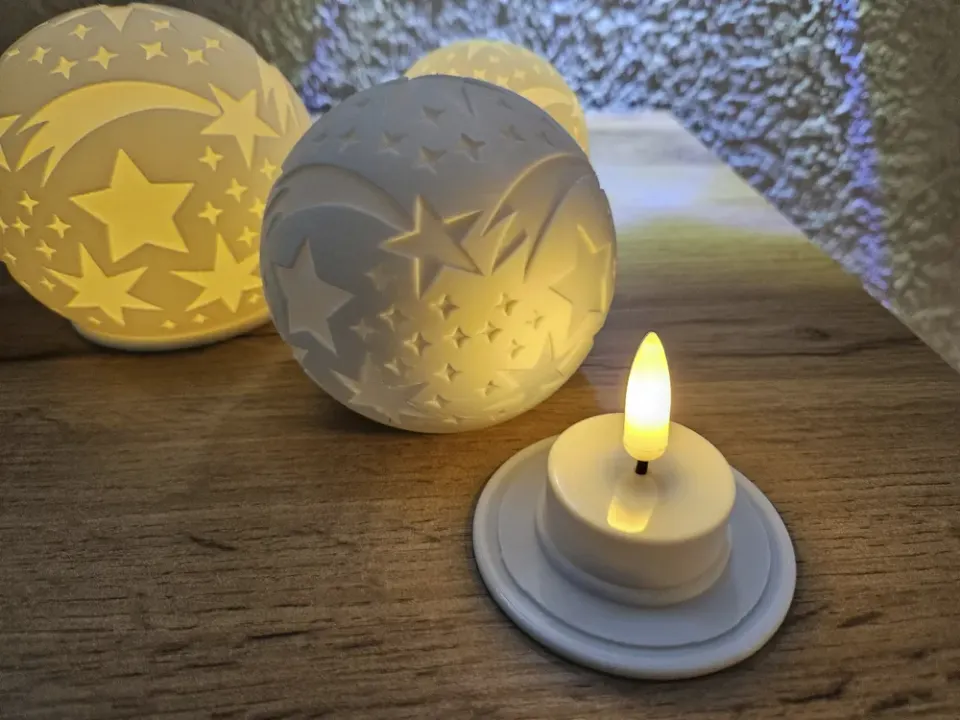
An LED candle holder is a winter classic because it combines decoration, light and safer use. Lantern shapes, snow-covered houses, snowflakes, stars or low cylindrical covers with cutouts all work well.
Use translucent PETG for the translucent parts, ideally in natural, amber, ice blue or smoke colors. A wall thickness of 0.8 to 1.2 mm will often let through more light than a solid model. If you want a softer diffusion, try vase mode for a simple shell, or choose a more matte filament.
Important: design the opening for the LED candle with some extra clearance. Inexpensive LED tea lights do not all have the same diameter, so it pays to add 0.5 to 1 mm of clearance and provide easy access to the switch from underneath.
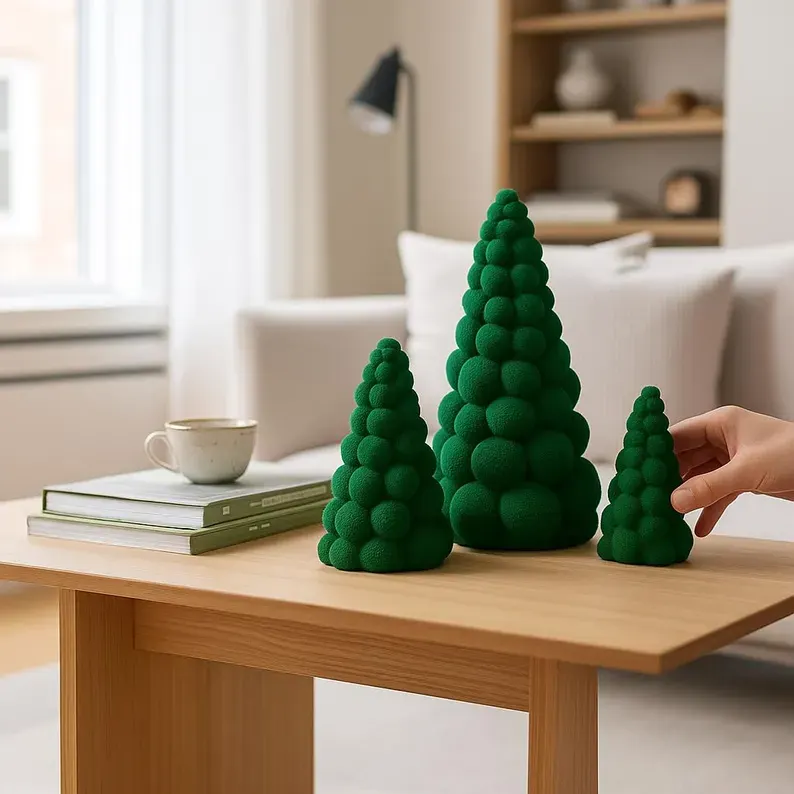
A mini tree is an ideal decoration for an office, children's room or festive table. It can be spiral-shaped, modular, assembled from flat parts or made from repeating segments. The advantage is that you do not need supports and can print it in multiple colors.
For an attractive look, combine green PLA with gold or white accessories. For a larger tree, a model with interchangeable ornaments is a good choice, because each family member can print their own color. If you have multi-color printing, save filament changes for small ornaments; leave the tree itself single-color to avoid unnecessary waste.
Gift tags are quick, useful and look more personal than a paper tag. The base can be a simple plate with a hole, a raised name and a snowflake, tree or bow motif. If you do not want to modify the model for every name, prepare one universal tag and write the name with a thin permanent marker in the printed frame.
PLA is suitable for gift tags because they do not need mechanical durability. Feel free to use a 0.20 mm layer and print several pieces at once. For raised text, use a simple font without thin lines. Small decorative fonts look nice on a monitor, but they can merge when printed with a 0.4 mm nozzle.
Cookie cutters are among the most useful seasonal prints, but they need to be approached sensibly. Choose shapes with a sufficiently thick upper edge for gripping and a thinner lower cutting edge. A snowflake with many small protrusions may look beautiful, but the dough will be difficult to press out of it.
For food contact, use new or thoroughly cleaned filament, a clean nozzle and a model without deep gaps. After use, wash the cutter by hand in lukewarm water, not in the dishwasher. If you are printing for someone else, include a short instruction to wash it by hand and not use it with hot food.
A gift card in a plastic box feels more thoughtfully presented than an envelope. Popular options include sliding boxes, small safes, bow-shaped boxes, puzzle containers or themed cases shaped like books, sleds or packages.
Tolerance is important here. With sliding lids, first print a small joint test and only then the whole batch. For PLA, allow around 0.2 to 0.4 mm of clearance depending on the printer; with PETG, allow slightly more. If the box is to remain reusable, give hinges and snap-fit locks larger radii so they do not break.
Fidget trees, clicky ornaments, spinning rings, mini puzzles and print-in-place toys are good little items for an Advent calendar or as an addition to a main gift. Their biggest advantage is that they are fun immediately after printing.
With moving models, the first layer and clean bridges are crucial. Before printing ten pieces, make one test and check that the part moves after cooling without force. For children, choose larger shapes without sharp points or small detachable parts.
Clips are not as photogenic as ornaments, but they save time when decorating. You can print cable holders, railing clips, shelf hooks, connectors for string lights or small window mounts.
If the clips will be outdoors or by a window, choose PETG. PLA can soften in the heat behind glass and become brittle in freezing temperatures. Design the clip so that it holds the cable without pinching it. Sharp edges and an overly tight grip can damage the insulation.
Small houses, forest silhouettes, nativity scenes, reindeer teams and snowy scenes work well as a set. Print them modularly: one base, several houses, trees and accessories. If one part does not turn out well, you do not have to repeat the entire large model.
For illuminated villages, thin walls and an LED strip or small battery-powered lights outside direct contact with the plastic work well. Leave the inside of the model accessible so you can change the battery and clean away dust. White matte filament creates a snow effect, while translucent PETG gives the windows a soft glow.
If you are printing a larger quantity, personalization provides the greatest value: a name on an ornament, a year on a tag, a logo on a stand, initials on a box or a short message on the back. It does not have to be a complicated model. A clean shape with clearly readable text often looks more professional than an overloaded decoration.
For a batch, prepare a template in which you only change the text. You will save time, maintain a consistent style and reduce the risk of errors. Before the final print, check diacritics, font thickness and the orientation of the part on the build plate.
Start with a list: how many pieces you need, in which colors and by when. Then separate quick prints from risky ones. You can fine-tune ornaments and tags as you go, but boxes, moving toys and candle holders deserve a test piece.
Recommended procedure:
For classic ornaments, use gold, silver, red or white silk PLA. For a modern winter style, ice blue PLA, pearlescent white and gray work well. For LED candle holders, house windows and illuminated elements, choose translucent PETG. For functional clips and holders, use PETG, especially if they will be under load or near a window.
Glow-in-the-dark filament looks tempting, but use it thoughtfully. It is often more abrasive than standard PLA and may not glow as long as you expect in delicate ornaments. It is excellent for small stars or details; for an entire large batch, standard filament with LED lighting is more practical.
The best winter 3D prints for 2026 are not just last-minute ornaments. The models that bring the most joy are useful, well printed and safely designed: tree ornaments, LED candle holders, mini trees, gift tags, cookie cutters, gift card boxes, fidget items, clips for string lights, winter villages and personalized gifts.
If you start preparing in summer, you will have time for testing, choosing colors and calm batch printing. And that is precisely what makes the difference in holiday projects between a rushed emergency decoration and a gift that feels truly personal.


