Free shipping from 1 999 Kč
Fast shipping
Verified store
Thousands of customers




Free shipping from 1 999 Kč
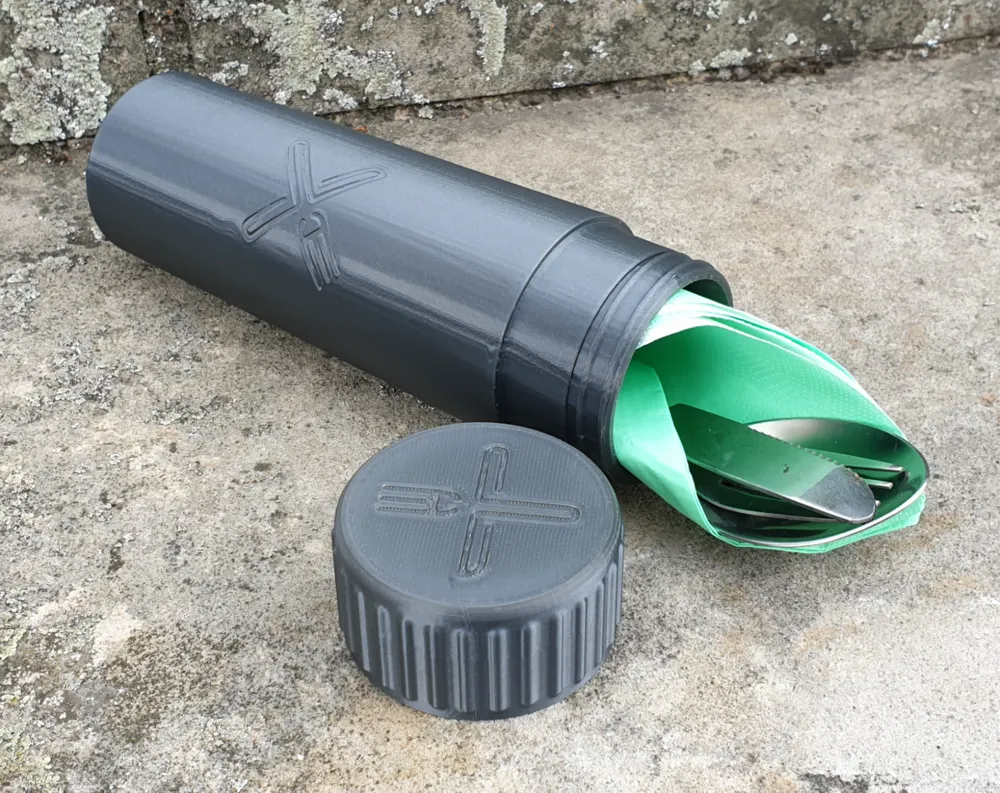
Camping and festivals are exactly the kind of situation where 3D printing makes sense: you do not need a big project, but small parts that improve packing, organization, lighting, drying things, or making quick repairs in the field. The best models for summer 2026 have three things in common: they are simple, lightweight, and take up almost no space in your backpack.
Before you start printing equipment for the outdoors, treat 3D prints as auxiliary accessories, not certified outdoor equipment. FDM printing has layers, a layer direction, and quality depends on the material, slicer settings, and ambient temperature. A 3D-printed carabiner can be great for a mug, keys, or a towel. But it must not hold a person, a hammock, a suspended stove, a heavy backpack above someone's head, or anything else where failure could injure someone.
For most camping accessories, choose PETG. It is more resistant to moisture, less brittle than PLA, handles impacts better, and withstands higher temperatures. For parts that will spend a long time in the sun, in a car, or outdoors for the entire season, consider ASA. For ible seals, straps, sleeves, and cushioning inserts, use TPU.
PLA is still excellent for prototypes, templates, and lightweight organizational parts, but it has limitations in summer. In a hot car, direct sunlight, near a stove, or in a dark box on a table, it may start to warp. Parts under long-term load also suffer more from creep, meaning slow deformation over time. If you are unsure, print the first piece in PLA only to test the dimensions, and make the final piece from PETG or ASA.
Recommended settings for practical outdoor parts: 4 to 6 perimeters, 0.2 mm layer height, at least 35% infill for standard holders, and 50 to 80% for loaded pegs, hooks, and clips. For parts with holes, orient the model so that the tension does not act directly between the layers. Before your trip, load-test every part at home with at least twice what it is expected to carry in real use.
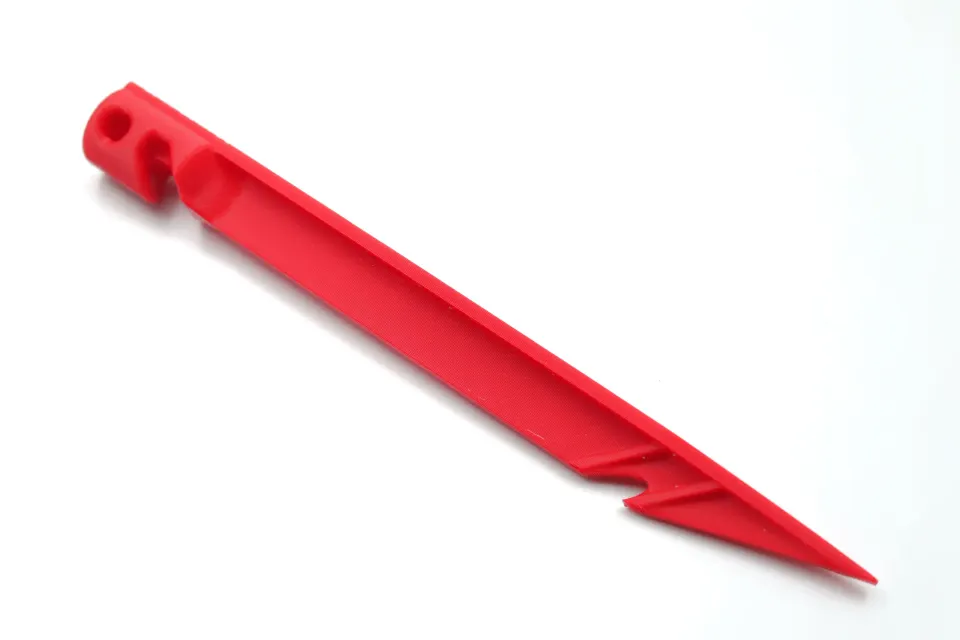
A printed tent peg is a good accessory for soft ground, a beach tent, a tarp in the garden, or as an emergency backup. Wider profiles with reinforcing ribs, a tip, and a hole for a cord work best. For hard, rocky ground, however, a metal peg is still the better choice, as plastic can break or bend.
With PETG, expect light to medium loads: a small tent, sun shelter, net, or lightly loaded guyline. For storms, strong winds, and the main load-bearing points of a tent, use aluminum or steel. A peg pusher is also a practical print that protects your palm and can also be used to pull pegs out of the ground in the morning.
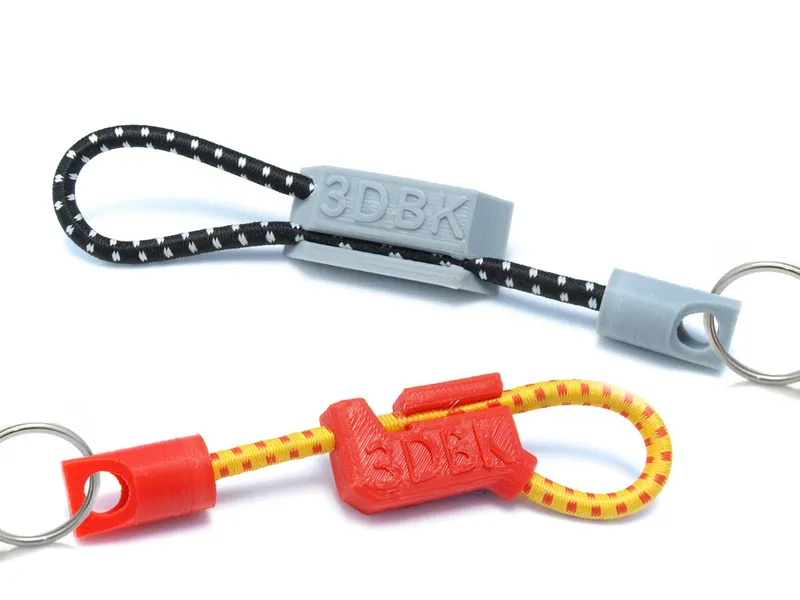
A cord tensioner is one of the most rewarding prints. It helps tension a tarp, dry a towel, run a clothesline between trees, or organize cordage around a tent. Look for models with rounded edges, a sufficiently large radius for the cord, and no sharp corners that could cut the paracord.
For 3 to 4 mm cord, PETG with 4 perimeters and 40 to 50% infill is sufficient. Without your own testing, treat the tensioner as an auxiliary part for loads in the low single-digit kilogram range, not as an anchor component for a heavily loaded tarp. For spring versions, a combination of a PETG body and a ible TPU section may make sense.
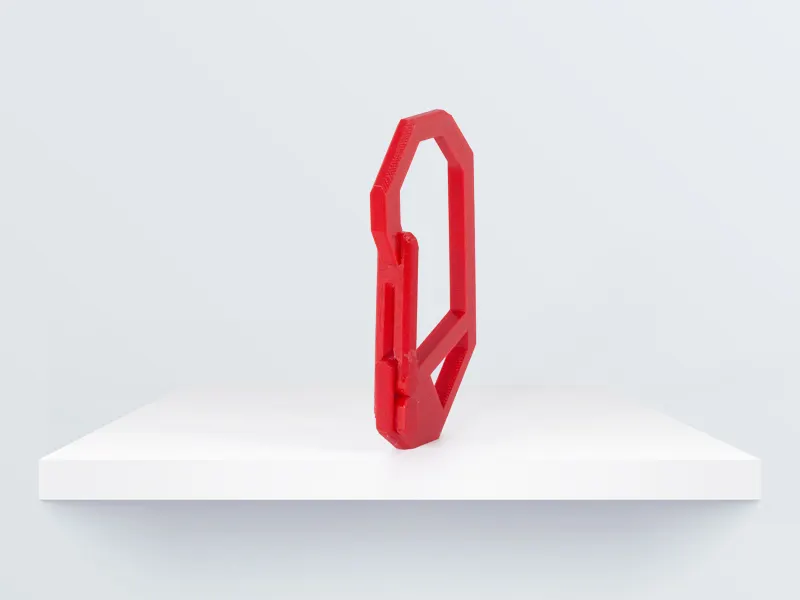
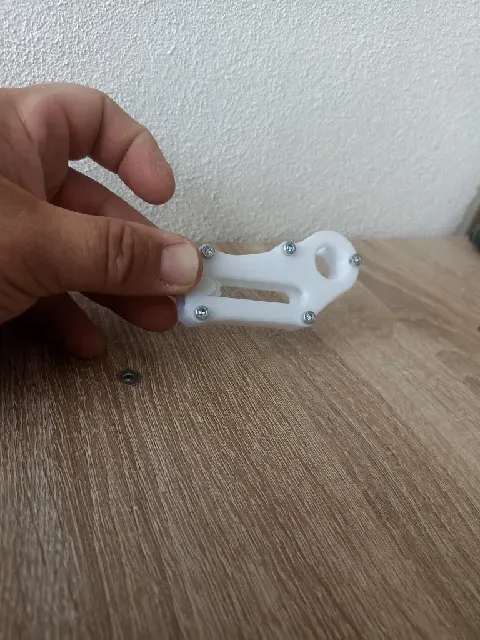
A 3D-printed carabiner is suitable for keys, a headlamp, a mug, a lightweight jacket, a towel, a bag of pegs, or cables. It is not suitable for climbing, belaying, swings, suspending a person, or heavy objects above a place where someone is sitting or sleeping.
For a robust printed carabiner, use 5 to 6 perimeters, a thick body, and an orientation that minimizes tension across the layers. Without destructive testing, keep the conservative limit at 1 to 3 kg for standard clips and 3 to 5 kg for truly massive models intended for organizing gear. If you want to carry more, use a metal carabiner with a clearly stated load rating.
A box for matches, medication, earplugs, cash, or spare batteries is an excellent camping print. For water-resistant parts, the design is more important than the material itself. Choose models with a thread, a groove for an O-ring, and a sufficiently thick wall. A simple lid with a seal is usually more reliable than a complicated snap-fit mechanism.
PETG is a good choice thanks to its layer adhesion and resistance to moisture. For better sealing, use 5 to 6 perimeters, a lower layer height, and preferably wider walls instead of high infill. Even so, test the box before your trip: put a paper napkin inside, close it, submerge it in water for 10 minutes, and check for moisture. Put electronics or documents in a printed box only as a second layer of protection, not as the sole barrier against rain.
At a festival, you often do not want to carry another lamp. A printed diffuser for a headlamp, a cover for a phone flash, or a stand that turns your phone into a desk lamp is lightweight and practical. Transparent PETG or matte light-colored PLA can be used to diffuse light, but watch out for heat from more powerful LED flashlights.
Do not print parts that touch a hot flashlight head or remain in a car from PLA. For phone holders, allow some margin: a phone in a case can weigh over 250 g, and dropping it on the concrete in front of the stage hurts. Print the holder from PETG, add wider support surfaces, and test it at home with sharper hand movements as well.
A holder for a cup, can, or bottle solves a simple festival problem: where to put your drink when you are sitting on a blanket or in a camping chair. Good models have a wide base, a hook for the chair frame or a clamping collar, and a drain hole for condensation.
For a can or cup, expect a weight of around 0.3 to 0.7 kg; a full bottle can easily weigh 1.5 kg. PETG can handle this if the holder is sturdy and the load is not carried by a thin tab. Use PLA only for a prototype or for a holder that will not be in the sun and will not carry a full one-liter bottle.
Clips for food bags, spice packets, a towel on a line, or lightweight clothing are among the fastest prints. For a trip, it is worth having several sizes: small ones for bags, longer ones for towels, and one sturdier clip for hanging lightweight gear in the tent vestibule.
PLA can work here if there is no heat or long-term tension. For festival conditions, however, PETG is a safer choice because it handles bending and moisture better. With ible clips, test whether the jaws return slowly or crack in the layer after several openings.
Paracord, charging cables, string lights, and tarp cords have a habit of turning into a knot in your backpack. A printed winder is lightweight, flat, and easy to adapt to a specific cord length. Practical shapes have side cutouts, a lock for the end of the cord, and a hole for hanging.
There is no need to overdo the infill here. 3 to 4 perimeters and 20 to 30% are sufficient. Rounded edges are more important so that the cable does not bend sharply and the cord does not chafe. For power bank cables, choose a smoother material and check that the cutouts are not sharp.
An emergency whistle, tick remover, or small bandage organizer are small prints with great utility. A whistle should be loud, lightweight, and brightly colored so it does not get lost in the grass. Print a tick remover with a fine layer height and check after printing that the edge is not rough.
For medical aids, a simple rule applies: use them as auxiliary equipment and keep them clean. The surface of an FDM print has layers where dirt can accumulate, so wash parts that come into contact with skin regularly and do not use them as replacements for sterile medical devices.
The best camping print is often an inconspicuous adapter: a hook for a tent pole, a cap for a sharp end, an adapter for a PET bottle, a spice holder, a replacement knob for a stove, a loop for a zipper, or a simple key for a container lid. Before leaving, it is worth going through your own gear and printing exactly the parts that solve your recurring minor problems.
With repairs, however, distinguish between convenience and safety. A printed cap, hook, or cable holder is fine. A printed replacement for a load-bearing part of a chair, a gas stove, a bicycle brake component, or an element holding a hot container above a flame is a bad idea.
Do not print load-bearing carabiners, hooks under long-term load, parts for a hot car, holders near a stove, dark boxes in direct sunlight, main tent pegs for windy conditions, tableware for direct contact with food, waterproof cases for important documents as their sole protection, or anything where failure could cause injury from PLA.
Keep PLA for prototypes, tags, lightweight organizers, templates, caps, and parts that will not be exposed to heat or significant force. As soon as a part needs to carry a load, , remain outdoors, or survive a festival weekend in a backpack, choose PETG, ASA, or TPU according to its function.
3D printing is at its best in camping when it improves comfort and organization. Print smart little accessories, test them at home, and use them with a safety margin. You will then have lightweight, customized gear that really saves you stress at both festivals and weekend trips.


