Free shipping from 1 999 Kč
Fast shipping
Verified store
Thousands of customers




Free shipping from 1 999 Kč
If the CoreXZ kinematics on Creality’s new Ender 3 V3 model caught your attention, consider converting your old Ender 3 model into a Voron Switchwire.
In February, Creality finally released its new Ender 3 V3 3D printer, priced at $390 and distinguished by its CoreXZ kinematics. But what if you could upgrade your old Ender 3 Pro or V2 into a similar machine?
Well, you can, thanks to open-source-inspired conversion projects for the Voron Switchwire CoreXZ 3D printer, one of our favorite DIY 3D printers and a machine we consider a relatively beginner-level introduction to building open-source 3D printers.
Let’s pause for a moment; what are CoreXZ kinematics, and why would you want them?
Simply put, CoreXZ replaces the screws typically used for a 3D printer’s Z axis with belts. This can help your 3D printer achieve more uniform layers by eliminating variations that can occur on the Z axis due to imperfections in lower-quality screws. Great, right?
Creality intends to release the Ender 3 V3 as fully open source, including the hardware and Creality OS firmware, to preserve the open tradition of the Ender series, they told All3DP. But it may also simply be compliance with the GPL-3.0 licensing requirement for Switchwire – if the V3 is actually based on the Voron design. So far, Creality has released only its Klipper clone and the “Appendices” files for the V3, which contain a basic guide and the V3 board pinout, and they said the rest is coming soon.
Without hardware plans for the V3, we can only speculate, but there are probably similarities between Creality’s new CoreXZ Ender and those from Voron. Ender 3 conversions to Switchwire are already quite popular, with several kits we have seen priced at around $350, making it an appealing project if you have an old Ender 3 on hand.
There are several repositories and guides to help you with your conversion, such as the Ender_SW project by Dark_Dog for the Ender 3 V2 and Pro models, which appears to be popular. But in the spirit of true open source, there are plenty of others that emerged from it, such as the Enderwire project by FizzysTech, which is based on Dark_Dog’s build, with FizzysTech providing a number of updates on social media.
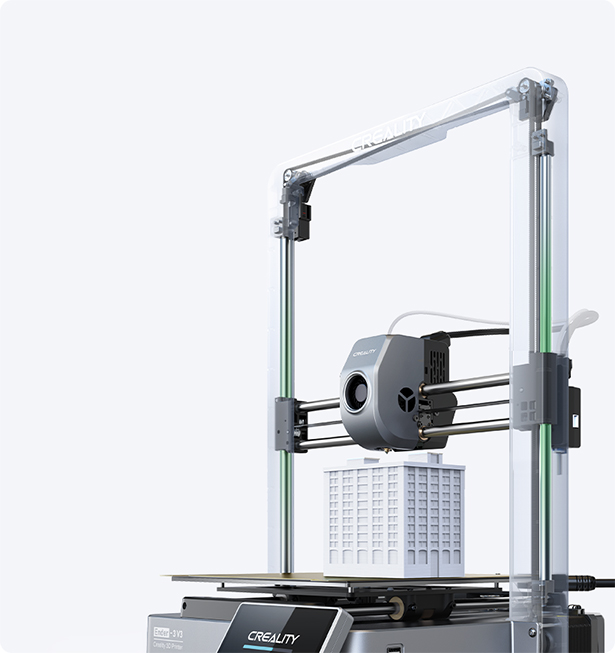 Creality’s marketing preview of the Ender 3 V3’s CoreXZ linear rod kinematics (Source: Creality)
Following Dark_Dog’s guide for the conversion allows you to reuse a considerable number of parts from your original Ender 3, but the printer will still need to be disassembled, and the guide emphasizes that cheaper parts can lead to printing problems and safety risks, so it recommends that creators use parts from the official Switchwire bill of materials.
In other words, the parts that Dark_Dog’s guide identifies as important to transfer from the original Ender 3 are: the frame (probably shortened to 310 mm on the X axis), the MeanWell power supply (make sure you know the type of power supply your Ender uses), the print bed assembly, the Creality V4.2.2 mainboard, stepper motors, cables “that do not pass through cable chains,” and the 4010 print head cooling fan. It would probably be possible to transfer several other parts as well, but these will likely make up the main portion.
At the time of writing, unfortunately, Dark_Dog’s Git does not contain its own bill of materials and directs users to the CAD files to identify details such as screw lengths. The safest approach without a bill of materials is to determine what you need from the CAD files included in the project you decide to follow. However, if you want an idea of the parts you will need, FizzysTech mentioned using RobotRogue’s unofficial bill of materials as a rough guide. And of course, you can always turn to the Voron Discord community and its Switchwire channel if you need answers to any questions.
Does this sound like a project for you? Let us know in the comments whether you are willing to take on this conversion, or if you have any useful tips for those considering it, and share your final result with us!


