Doprava zdarma od 1 999 Kč
Rychlá expedice
Ověřený obchod
Tisíce zákazníků




Doprava zdarma od 1 999 Kč
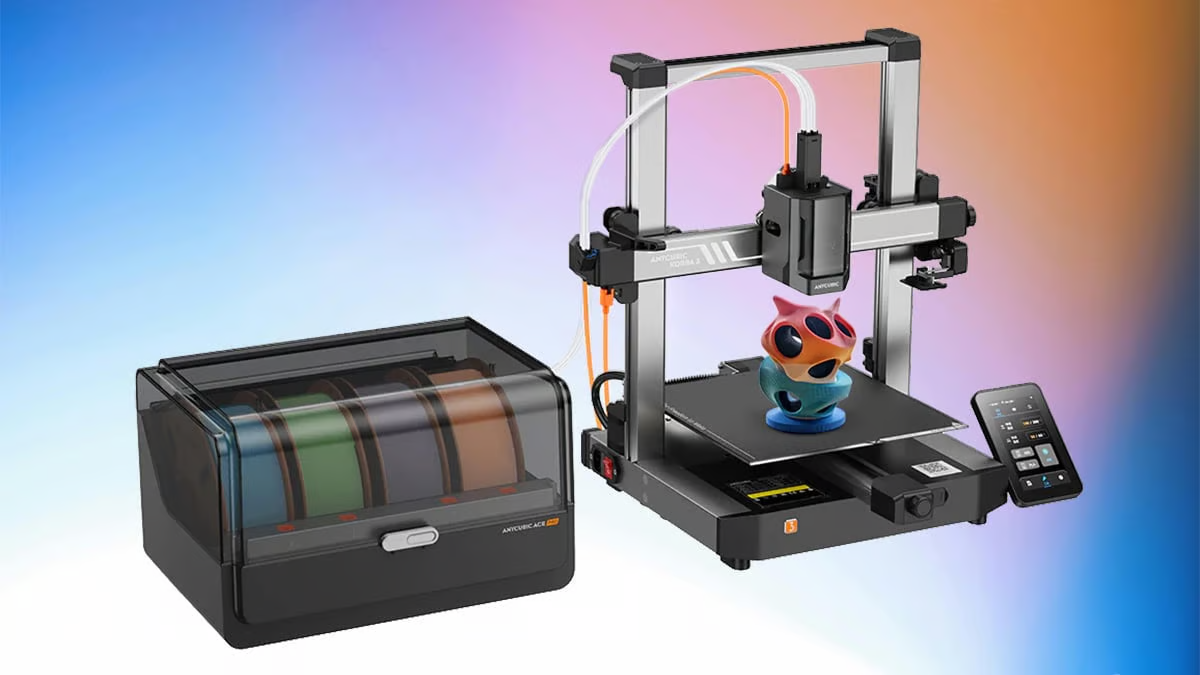
Anycubic’s latest release appears to be clearly aimed at competing with the Bambu Lab A1 for our attention. Although we have not tested it yet, based on the available clues, we can start to form an idea of how it works.
The Anycubic Kobra 3 is a new-generation 3D printer that appears to replace the relatively new Kobra 2 model. With a build volume of 250 x 250 x 260 mm, it falls between the Kobra 2 Pro and Kobra 2 Plus in size, but differs from them through many new and different features.
First and foremost, it is exclusively compatible with the Anycubic Color Engine Pro (ACE Pro), the company’s material changer that holds four filament spools. This system was introduced in April and has been available to order since May 7, 2024. This is new territory for Anycubic, meaning that the Kobra 3 Combo (the name the company gives to the printer and ACE Pro bundle) will be able to produce 3D prints in up to four colors.
It is worth noting that the company mentions only multicolor printing, not printing with multiple materials, and the lack of footage showing the machine in operation raises questions about whether Anycubic’s software will allow users to configure multi-material prints.
Anycubic claims that the ACE Pro will dry filament during printing, eliminating moisture-related problems that could affect any older filament. This goes a step beyond Creality’s recently announced CFS, which only provides temperature and humidity information, and Bambu Lab’s open-air AMS Lite.
ANYCUBIC KOBRA 3 / ACE PRO – OVERVIEW:
Judging by the “sizzle-reel” style videos (which barely show the Kobra 3 and ACE Pro in action), the system appears to automatically detect and load filament when it is inserted, similarly to the Bambu Lab AMS. Instead of feeding and retracting each filament strand as needed, it uses independent feed tubes from the ACE Pro to a splitter on the print head. It is not unfair to say that Anycubic modeled the ACE Pro’s body after the AMS and the print head after the AMS Lite. Anycubic says this is intended to ensure that the filament does not tangle during loading and unloading.
Anycubic also states that two ACE Pro units can be combined to provide up to eight colors in a single print, although how they will achieve this when the splitter on the print head accommodates only four feed tubes—a limitation of the Bambu Lab AMS Lite system—remains a question.
The basic design of the Kobra 3 3D printer is not entirely new, with some elements from the Kobra 2 remaining, including the use of steel rods and V-groove bearings for the motion system. However, the print head has been upgraded with the introduction of “tool-free,” quickly replaceable “all-metal” nozzles. The company claims it will offer “various nozzles in different diameters,” improving ibility when printing details of different sizes.
All the hallmarks of a modern Klipper-like system are also present, including integrated accelerometers for measuring and reducing vibrations at high speeds, as well as nozzle pressure detection to “ensure smooth extrusion.” The Kobra’s alleged print speed is up to 600 mm/s, which is slightly faster than the 500 mm/s stated for the Kobra 2 Pro and Bambu Lab A1. However, always treat this figure as a maximum speed (achieved only under certain conditions); the implication is that the Kobra 3 will be fast.
The hot-end and build-plate temperatures are in line with most printers of this type today: up to 300°C for the hot end and 100°C for the build plate.
We can also see two new elements on the Kobra 3’s print head and X-axis gantry. There is a solid arm that closely resembles the Bambu Lab A1 and its controlled filament-cutting mechanism—in simple terms, spring-powered blades located inside the print head and pushed by the movement of the X-axis during filament changes. There is also a “Purge Wiper” component, listed on the box and positioned on the right side of the X-axis gantry. This element suggests that the Kobra 3 will work similarly to the Bambu Lab A1, requiring off-plate purging for clean color transitions during printing.
Of course, there are ways to prevent this. In addition to choosing an entirely different technology, such as a tool changer, adjustable volumes and strategies for purging and cleaning objects give you some ibility in managing waste. Anycubic has introduced no particular innovation here, so it does not appear that the company has solved this widely criticized aspect of single-nozzle multicolor printing.
Under the hood, the Kobra 3 will run firmware called Anycubic KobraOS. We have few details about this firmware, other than the company’s plan to make it open source after printer shipments begin. This could mean several things: fully releasing the source code to the community and users for further development and contributions to improving the system, something we have not seen with previous Anycubic products; or merely superficially complying with licensing requirements and publishing the open-source components used for KobraOS—which is the most likely scenario if KobraOS is derived from Klipper.
The expected USB and Wi-Fi connectivity is available, as is the option to connect to the printer and send jobs through the Anycubic Cloud platform. The leveling process is claimed to be automatic, including the Z-offset, placing the Kobra 3 among Anycubic’s latest additions to its range of FDM 3D printers.
Overall, the hardware appears decent on paper. However, we have seen very little of the machine in action, not even during the one-hour livestream at the launch of pre-orders, which should give anyone with a finger hovering over the “buy” button pause for thought. Ultimately, from our perspective, the success or failure of the Kobra 3 and ACE Pro will depend on the software. We know that previous Anycubic printers were shipped before their integration with the company’s software platform and app was complete, so the company has work ahead of it to connect all the parts before delivering the Kobra 3 Combo in the summer.
The Anycubic Kobra 3 Combo is available for pre-order on the Anycubic website.


