Spedizione gratuita da 1 999 Kč
Spedizione rapida
Negozio verificato
Migliaia di clienti




Spedizione gratuita da 1 999 Kč
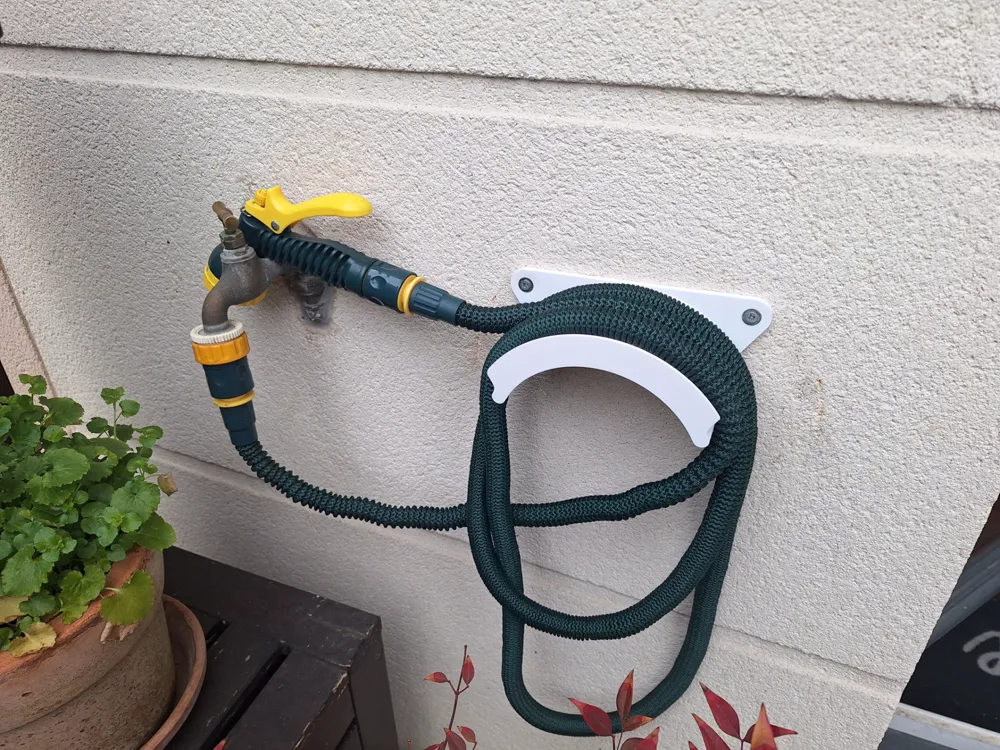
In summer, outdoor prints are exposed to conditions they would never experience on a shelf indoors. The sun heats dark plastic significantly more than the surrounding air, UV radiation gradually changes the polymer’s surface, rain and morning dew add moisture, and the part is often tightened with a screw or loaded by a cable, flower pot, or tool. That is why a bracket that looked sturdy in the workshop may warp after a few weeks on the terrace.
The short answer is: use PLA outdoors only temporarily or in the shade, PETG is a sensible and easy-to-print choice for many garden and terrace parts, and ASA is the best common filament for long-term exposure to sunlight, cars, and technical outdoor applications. The difference is not just strength. The key factors are the combination of UV resistance, temperature resistance, deformation under load, and what your printer can handle.
An outdoor part does not age in just one way. In practice, four factors add up:
The biggest summer trap is direct sunlight. The air may be 30 °C, but a black part on a windowsill, dashboard, or metal fence can easily reach much higher temperatures. That is why it is not enough to say that a filament is strong at room temperature.
PLA is excellent for rapid prototypes, decorations, models, and parts that will not be exposed to heat for long. For functional outdoor components, however, it is the riskiest choice. Standard PLA begins to soften at roughly 55 to 60 °C. That is a temperature an outdoor dark-colored print can easily approach in summer.
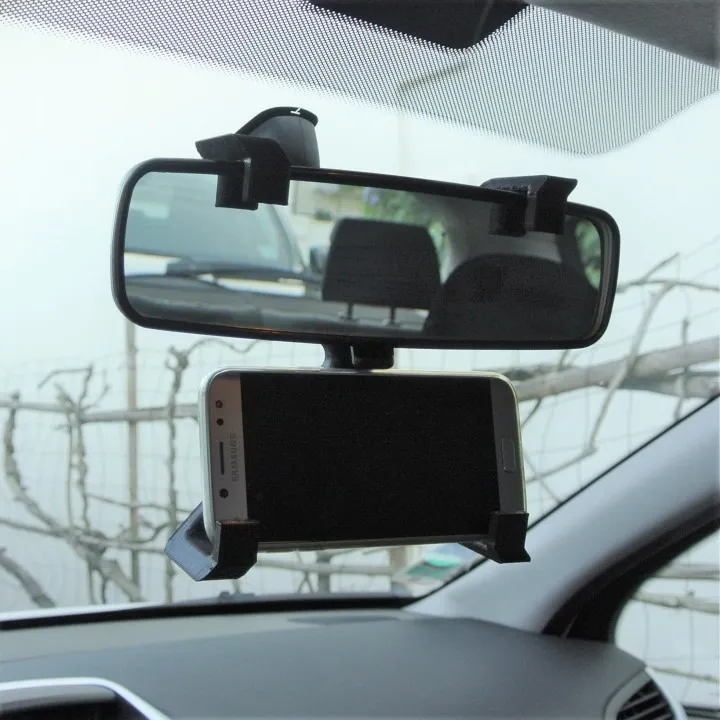
A typical example is a car mount. A phone holder, cable clip, or sensor enclosure made from PLA may soften after parking in the sun, warp around the screws, or lose its precise shape. The same can happen to a hook on a pergola if it carries a load and is exposed to the southern side all day.
PLA can be used outdoors for a short-term decoration, a shape test, a garden sign for one season, or an unloaded part in the shade. If the component has to hold a screw, carry weight, remain precise, or withstand an entire summer in direct sunlight, skip PLA.
For many home and semi-professional printers, PETG is the most practical step up. It prints significantly more easily than ASA, usually does not require an enclosed chamber, warps less, and has a better temperature margin than PLA. It handles rain, normal humidity, and mild chemical exposure well, such as soapy water or contact with a garden environment.
It is suitable for brackets in partial shade, covers under a roof, spacers, hose holders, flower pot parts, terrace organizers, or electronics enclosures that are not exposed to direct sunlight all day. With transparent and light-colored PETG, expect gradual yellowing or clouding. This is often unimportant for functional parts, but matters for visible covers.
PETG’s weak point is long-term direct sunlight combined with heat and load. A large black bracket screwed to hot metal may eventually loosen or deform slightly. For a car interior, dashboard, greenhouse, or engine compartment, use PETG with caution. In these locations, switching to ASA or another technical material is worthwhile.
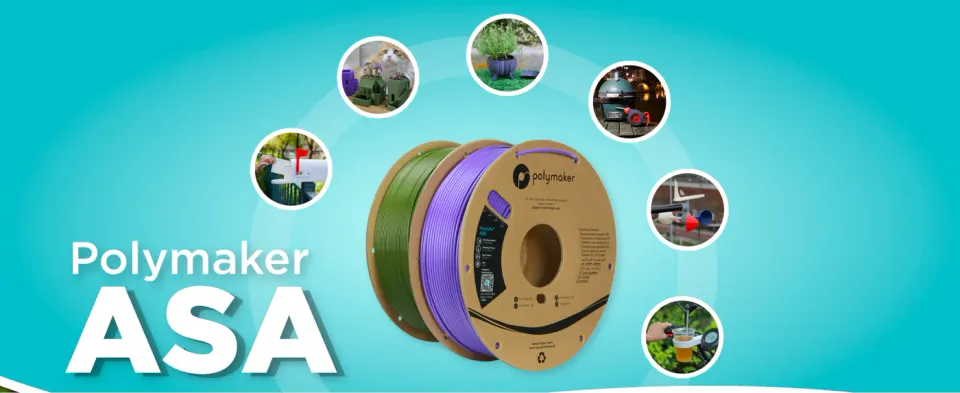
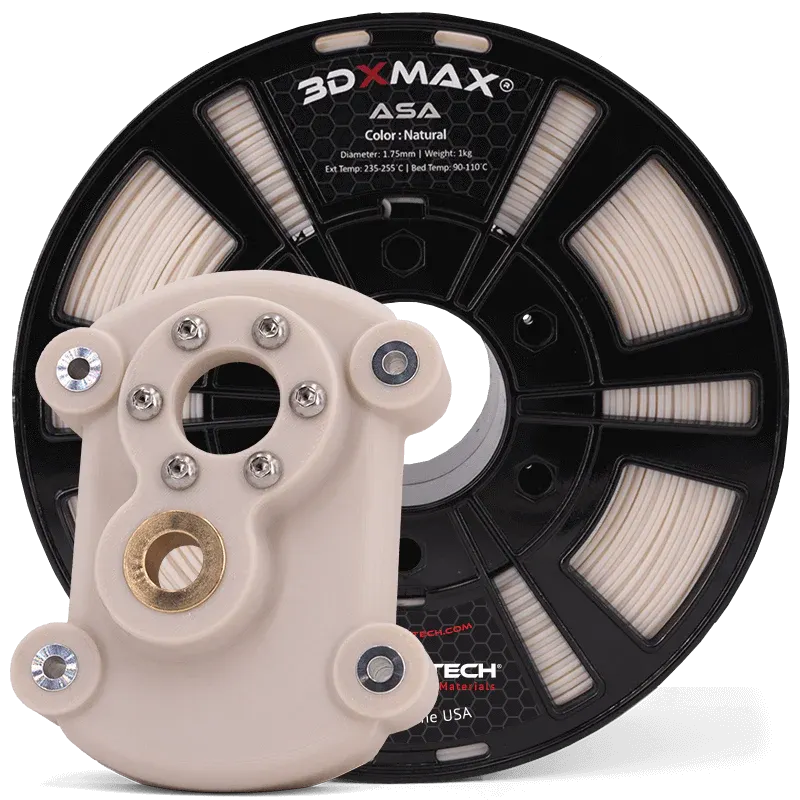
ASA is a material developed specifically for outdoor resistance. In practice, it is the most reliable common FDM filament for parts that need to withstand UV radiation, rain, and summer temperatures. It is suitable for outdoor light brackets, sensor covers, pool parts away from direct contact with chemicals, fence mounts, terrace components, car accessories, camera covers, and mechanical parts that need to work for more than one season.
Compared with PETG, ASA offers better stability in sunlight and a higher temperature margin. Compared with ABS, it has better UV resistance, so it becomes brittle less readily outdoors and its surface is less prone to chalking. If you already print with ABS, ASA is usually a logical replacement for outdoor parts.
The disadvantage is printing. ASA requires a higher nozzle temperature, a heated bed, and ideally an enclosed printer. With larger parts without a chamber, corners may warp, layers may crack, and the print may lift from the bed. Also expect a stronger odor during printing and ensure ventilation. ASA can sometimes be managed on an open printer for small parts, but an enclosed chamber is essential for reliable results.
| Material | Outdoor sunlight | Summer heat | Printing difficulty | When to choose it |
|---|---|---|---|---|
| PLA | weak | low margin | very easy | prototypes, decorations, shade, short-term use |
| PETG | moderate | good margin | easy to moderate | garden, terrace, parts in partial shade, covers under a roof |
| ASA | excellent | high margin | more demanding | direct sunlight, car, technical outdoor parts, long service life |
This table does not mean that PETG is bad or that ASA is always necessary. It means you need to assess the environment. A garden hose holder under a roof overhang may be perfectly fine when made from PETG. The same holder on a south-facing facade, tightened with screws and exposed to sunlight all day, is better printed from ASA.
For garden signs, light plant clips, and seasonal decorations, PLA is sufficient if you accept a limited service life. If you want the sign to last for several seasons, choose PETG or ASA.
PETG is a good starting point for hose holders, fence hooks, spacers under outdoor furniture, and cable clips. If the part will be in direct sunlight, increase the wall thickness, round the corners, and do not subject it to long-term tensile loading.
For an outdoor sensor cover, camera mount, lighting components, car accessories, and terrace parts with a long service life, choose ASA. Avoid PLA entirely for car parts, and use PETG only where there is no extreme heat. The interior of a parked car is a significantly harsher environment for plastics than a typical terrace.
For a greenhouse, roof, dashboard, dark metal structures, and locations without shade, consider ASA the minimum. If the part must carry a safety-critical load, assess the material, design, and testing even more rigorously.
The right filament is only half the battle. Design an outdoor part more robustly than an indoor one:
Color also plays a role. Black often masks UV changes better, but it heats up more in the sun. Light colors heat up less, but some shades may visibly fade sooner. For a loaded part, suitable material and design are more important than the color itself.
For PETG, start with the filament manufacturer’s profile. Dry filament, a clean bed, a reasonably slow first layer, and less cooling than with PLA typically help. PETG tends to string and stick to the nozzle, so it is worth fine-tuning retraction and flow. For outdoor mechanical parts, do not use an unnecessarily low nozzle temperature, because weak layer adhesion will quickly become apparent outdoors.
With ASA, the key is to limit drafts and thermal shock. Preheat the bed, allow the chamber to warm up, use a brim around corners and on tall parts, reduce cooling, and do not rush. Split large flat parts into smaller sections or adjust the geometry so they warp less. After completion, let the print cool gradually, ideally inside the closed printer.
Ask yourself three questions. Will the part be in direct sunlight? Will it heat up above the normal outdoor temperature, for example in a car, on sheet metal, or in a greenhouse? Will it carry a load over the long term?
If the answer is no three times, PLA may be sufficient for a non-demanding or temporary part. If sunlight or moisture is only occasional and you want easy printing, choose PETG. If the answer is yes at least once for direct sunlight, high temperatures, or long-term loading, start with ASA.
For a Czech summer, PETG is an excellent all-rounder for the garden and terrace, but ASA is the safe choice for parts you do not want to reprint at the end of August. The best choice is not the most expensive material, but the material suited to the location, temperature, sunlight, and printer you actually have.


