Livraison gratuite à partir de 1 999 Kč
Expédition rapide
Boutique vérifiée
Des milliers de clients




Livraison gratuite à partir de 1 999 Kč
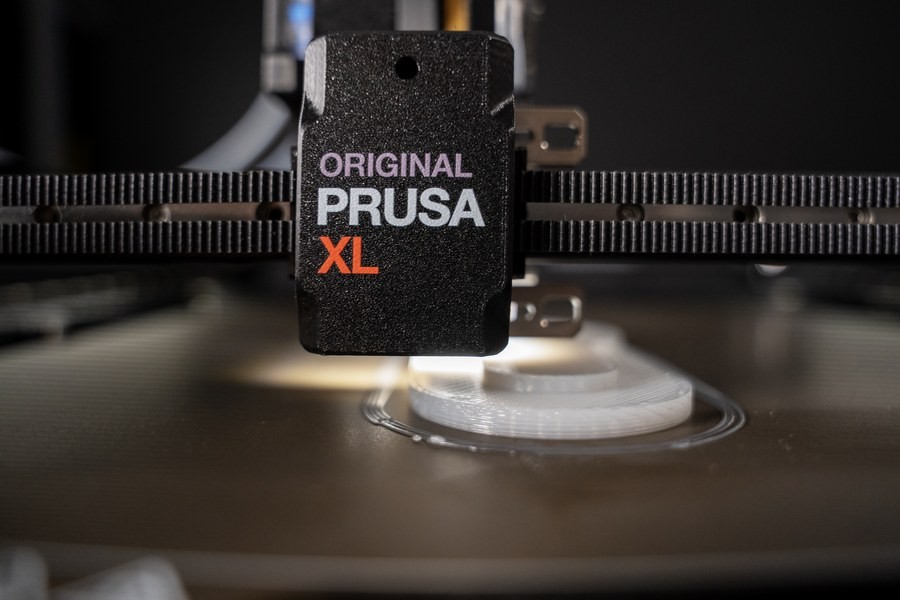
The Original Prusa XL has long positioned itself as a large-format, modular FDM printer with interchangeable toolheads. In 2026, however, it received an upgrade that moves it from conventional plastic printing into the world of truly industrial materials: a new Silicone Printing Toolhead, developed by the startup Filament2 exclusively for the Prusa XL.
This plug-and-play toolhead enables the printing of two-component, temperature-resistant silicone and other similar liquid materials. What does this mean in practice for Prusa XL users, how does silicone printing work, and what applications does it make sense for? Let’s take a detailed look.
Until now, most “ible” parts on desktop printers have been printed from TPU / TPE filaments. Although these are ible, they:
By contrast, silicone elastomers (especially two-component RTV / LSR systems):
The possibility of 3D printing real silicone therefore opens the door to producing parts that were previously practically unattainable through desktop 3D printing – you either had to move to very expensive industrial LAM systems or use indirect methods (printing a mold and casting silicone).(innovatiq.com)
Prusa Research officially introduced the Silicone Printing Toolhead for the Original Prusa XL as one of the key elements expanding the XL tool ecosystem.(blog.prusa3d.com)
Key features from the user’s perspective:
Unlike a conventional FDM extruder, here you do not print filament, but controlled extrusion of two components of a liquid material into the nozzle, where mixing takes place, followed by depositing the material layer by layer.
Standard RTV2 / LSR silicones are two-component systems that begin to cure chemically after mixing. For printing to be stable and repeatable, it is necessary to:
This is precisely what the mixing nozzle is for: the two components are extruded separately and meet only in the static mixer in the nozzle, where a homogeneous mixture is created.(lynxter.fr)
The extruded silicone is relatively viscous – it holds its shape and enables layering upward. Depending on the mixture used, it may undergo:
This makes it possible to print:
One of the most natural applications is the production of seals and ible joints:
3D printing saves both time and money here, because you do not need to manufacture a mold or order tooling for injection molding.(stratasys.com)
Another common use is the creation of silicone molds for casting resins or low-melting-point metals. In addition to traditional casting into manually prepared molds, an approach is also gaining ground in which you:
This method is already used today for the efficient production of silicone parts from 3D-printed molds and complements direct silicone printing synergistically.(cn.3dsystems.com)
Thanks to the biocompatibility of some silicone systems, it is possible to consider:
In practice, it is of course necessary to verify regulatory and material certification, but from a design and prototyping perspective, this is a highly attractive area.(stratasys.com)
Silicone printing is ideal for pneumatic actuators, soft joints, membranes, and ible hinges. Combined with rigid plastics (printed using another XL tool), it is possible to create hybrid assemblies:
A current trend in both research and industry is the combination of multiple materials in a single process – and the modular XL ecosystem with different toolheads fits well into this vision.(sciencedirect.com)
Not every two-component silicone is suitable for 3D printing. Look for systems that the manufacturer identifies as:
Materials with a very short pot life may cause etching and clogging of the mixing nozzle, while mixtures that are too thin may have problems holding their shape.
Although the silicone head is plug-and-play, it is worth considering several points:
Static mixing nozzles are consumables in two-component systems – after a certain period, the material cures inside them. The general procedure is:
Silicone behaves differently from rigid plastic. When designing:
In many cases, it is advantageous to combine silicone with another material in the assembly – for example, design a groove or seat in a plastic part and print or insert silicone into it.
The Original Prusa XL is designed as a multi-toolhead platform – from standard extruders and high-temperature hotends to specialized modules. Adding the Filament2 silicone toolhead fits into the overall trend in 3D printing:
Industrial silicone printers using LAM technology or specialized IDEX machines still cost an order of magnitude more and target large companies.(innovatiq.com) The silicone toolhead for the XL represents a more accessible entry point into the world of real silicone printing for development departments, smaller manufacturers, designers, or university laboratories.
The new Filament2 silicone toolhead for the Original Prusa XL represents a significant expansion of the capabilities of desktop 3D printing:
If you already use the Prusa XL for prototyping, fixture production, or small-batch manufacturing of plastic parts, the silicone toolhead may be precisely the step that turns your printer into a multi-material production workstation – without the need to acquire another specialized machine.
For a deeper understanding of the topic, it is worth following general trends in 3D printing of liquid and paste-like materials and thinking about projects not from the perspective of “what FDM plastic can do,” but rather what functional part you need – and which material (plastic, silicone, or a combination) is truly ideal for it.


