Livraison gratuite à partir de 1 999 Kč
Expédition rapide
Boutique vérifiée
Des milliers de clients




Livraison gratuite à partir de 1 999 Kč
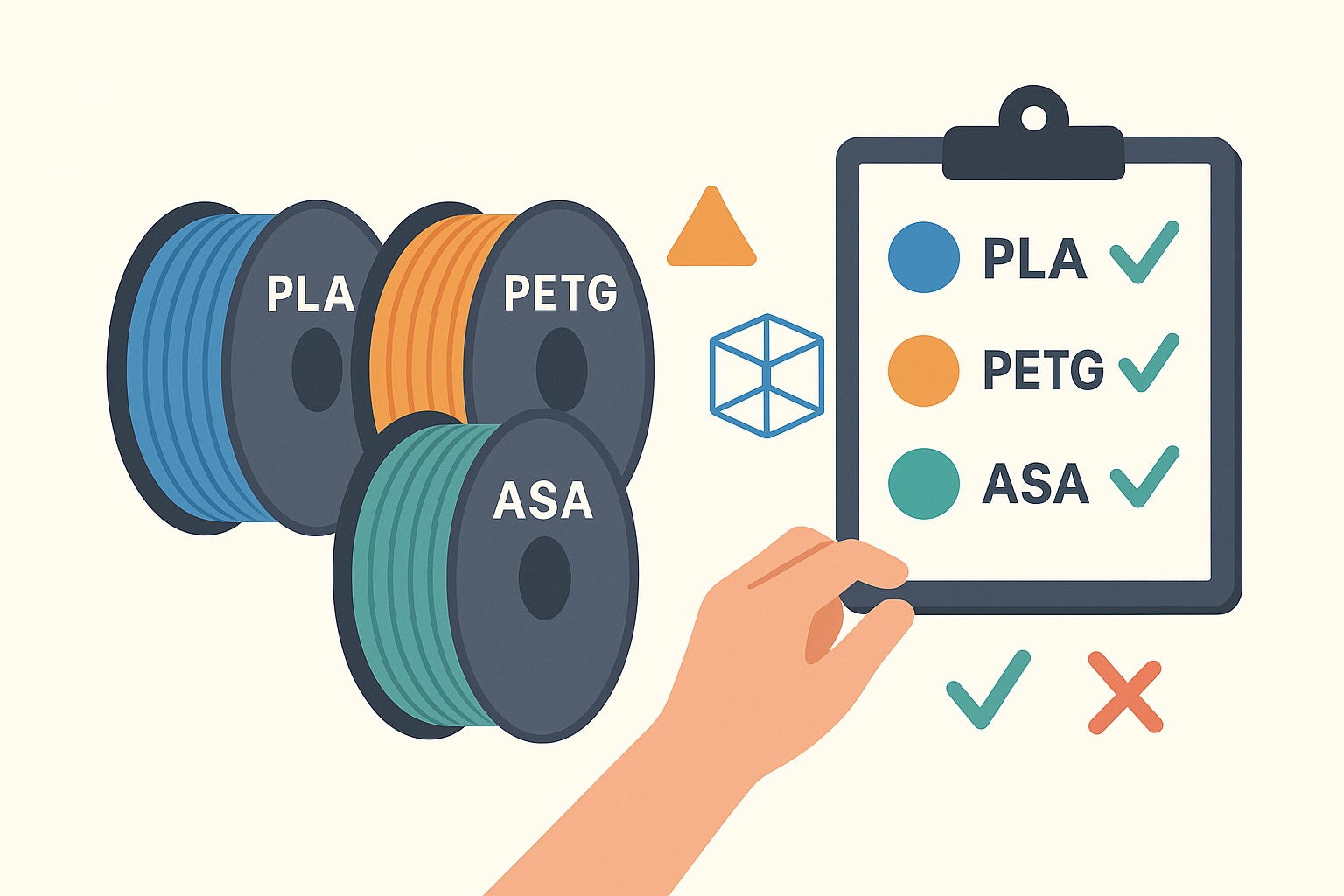
Choosing a filament is not just a matter of color and price. The same model made from PLA, PETG, and ASA can behave completely differently: one will have beautifully sharp details, another will survive a fall from the table, and the third will withstand summer on a balcony. The quickest rule is: choose PLA for easy, attractive prints, PETG for everyday functional parts, and ASA for outdoor or heat-stressed components.
Below you will find a practical comparison without unnecessary theory. Treat the values as approximate, because the specific brand, additives, filament color, and printer settings can affect the result. Nevertheless, they will help you choose a material before you lose several hours printing the wrong part.
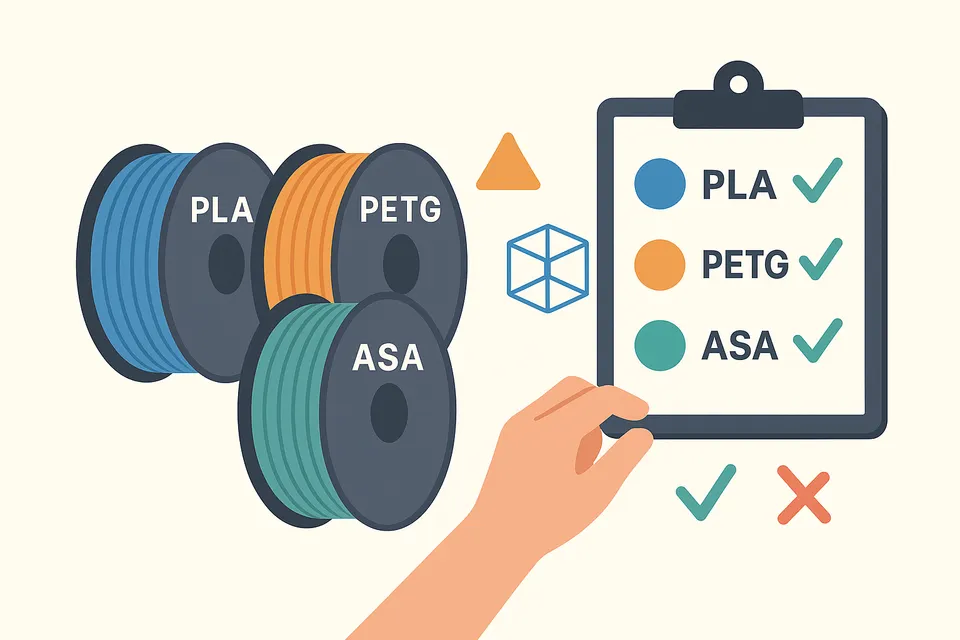
| Need | Best choice | Why |
|---|---|---|
| First prints, decorations, figurines, prototypes | PLA | It is the easiest to print, holds its shape, and has minimal warping. |
| Brackets, covers, workshop parts, impact-loaded parts | PETG | It is tougher than PLA, bonds better between layers, and withstands higher temperatures. |
| Outdoor brackets, car parts away from extreme temperatures, sun-exposed covers | ASA | It has high resistance to UV radiation, weather, and heat. |
| Fine details and sharp edges | PLA | It usually oozes and strings less than PETG. |
| Large technical part without an enclosed printer | PETG | ASA tends to warp on larger parts without an enclosure. |
| Part exposed to direct summer sunlight | ASA | PLA softens too soon, PETG is better, but ASA is the safer choice. |
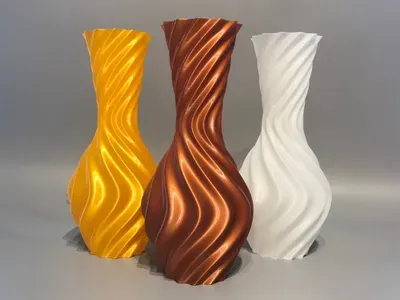
PLA is the material I would recommend to every beginner as their first spool. It prints at lower temperatures, has low shrinkage, and usually adheres to a properly prepared print bed without a struggle. This makes it suitable for decorations, figurines, vases, templates, prototypes, organizer boxes, desk mounts, or parts where appearance is more important than long-term mechanical durability.
Typical settings are approximately 190-230 °C at the nozzle and 50-60 °C on the bed. With modern printers, a slicer profile and a basic first-layer check are often enough. PLA is also useful for quickly verifying dimensions: print a prototype, try the assembly, adjust the model, and only then print the final piece from a more durable material.
PLA's weakness is heat and brittleness. In a car, behind a window, or on a black surface in the sun, a part can start deforming at temperatures that are not particularly extreme for a person. PLA also often cracks cleanly rather than bending. This is not a problem for a decoration, but it is a problem for a latch, hinge, or bracket that experiences impacts.
Practical example: an electronics cover for indoor use, a cable holder next to a computer, or a designer stand for a figurine are excellent PLA projects. A bicycle camera mount, car clip, or outdoor bracket is not suitable.
PETG is a good compromise between ease of printing and durability. Compared with PLA, it is generally tougher, less brittle, and better able to withstand impacts. It also offers better resistance to moisture and chemicals in ordinary environments. That is why it is popular for brackets, covers, boxes, workshop tools, spacers, sensor mounts, assembly jigs, or replacement plastic components around the home.
Typical settings are often around 220-250 °C at the nozzle and 70-90 °C on the bed. Some brands and high-speed profiles may require higher temperatures. PETG prefers a clean, properly selected print surface. On smooth PEI, it can adhere too strongly, so a release layer is often used according to the bed manufacturer's recommendations. Textured sheets are generally easier to work with, but the first layer still determines the result.
PETG can string. If there are fine hairs between parts of the model, focus mainly on drying the filament, nozzle temperature, retraction, and travel speed. Wet PETG can be identified by cracking during printing, a poorer surface, bubbles, and a larger amount of stringing. It is worth storing the spool in a bag or box with silica gel and drying it before printing demanding parts.
Unlike PLA, PETG is more suitable for parts that slightly. This moderate ibility is an advantage for snap-fit covers and brackets. However, it is not ideal for very fine sharp details, because the surface may be glossier and the edges less crisp than with PLA.
Practical example: a workshop tool holder, aquarium sensor cover, spacer, electronics box, or sturdier assembly template are typical PETG projects. If the part will remain outdoors in the sun for many months, consider ASA instead.
ASA is a technical material similar to ABS, but with better resistance to UV radiation. It makes sense where PLA would soften and PETG would suffer from prolonged sunlight. It is suitable for outdoor brackets, covers, garden parts, components for photovoltaic systems, roof caps, parts for models used outdoors, or technical components that need to better withstand heat.
Typical settings are approximately 250-270 °C at the nozzle and 90-110 °C on the bed. With ASA, a stable warm environment is essential. Small parts may sometimes succeed on an open printer, but larger pieces without an enclosure often crack, lift at the corners, or warp. An enclosed printer, brim, suitable print surface, and slower cooling significantly increase the chances of success.
ASA releases fumes during printing, so it should not be used in a small, unventilated room. Ideally, use an enclosed printer with filtration or ensure good ventilation after printing is complete. At the same time, avoid direct drafts across the model, as they increase the risk of deformation. This is a common difference from PLA: with ASA, you need to manage not only nozzle temperature but the entire thermal environment around the print.
Another advantage of ASA is its surface finishability. It can be sanded, glued, and smoothed with acetone if you know what you are doing and work safely. For a typical e-commerce selection, however, the most important question is simple: will the part remain outdoors for a long time or be near a heat source? If so, ASA is often the right answer.
Practical example: a facade-mounted sensor holder, outdoor camera cover, garden equipment adapter, or cover for a sunny location is better printed from ASA than PLA. For a large flat cover, however, plan on using an enclosure and testing adhesion.
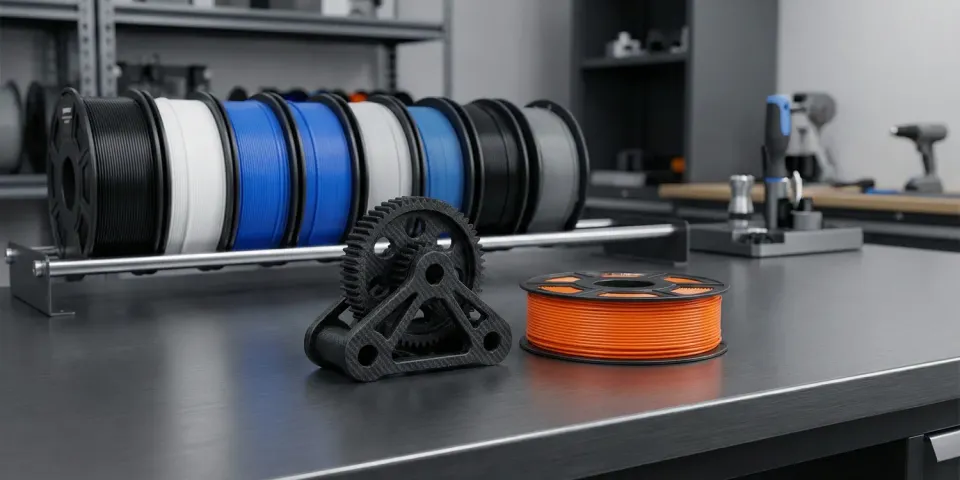
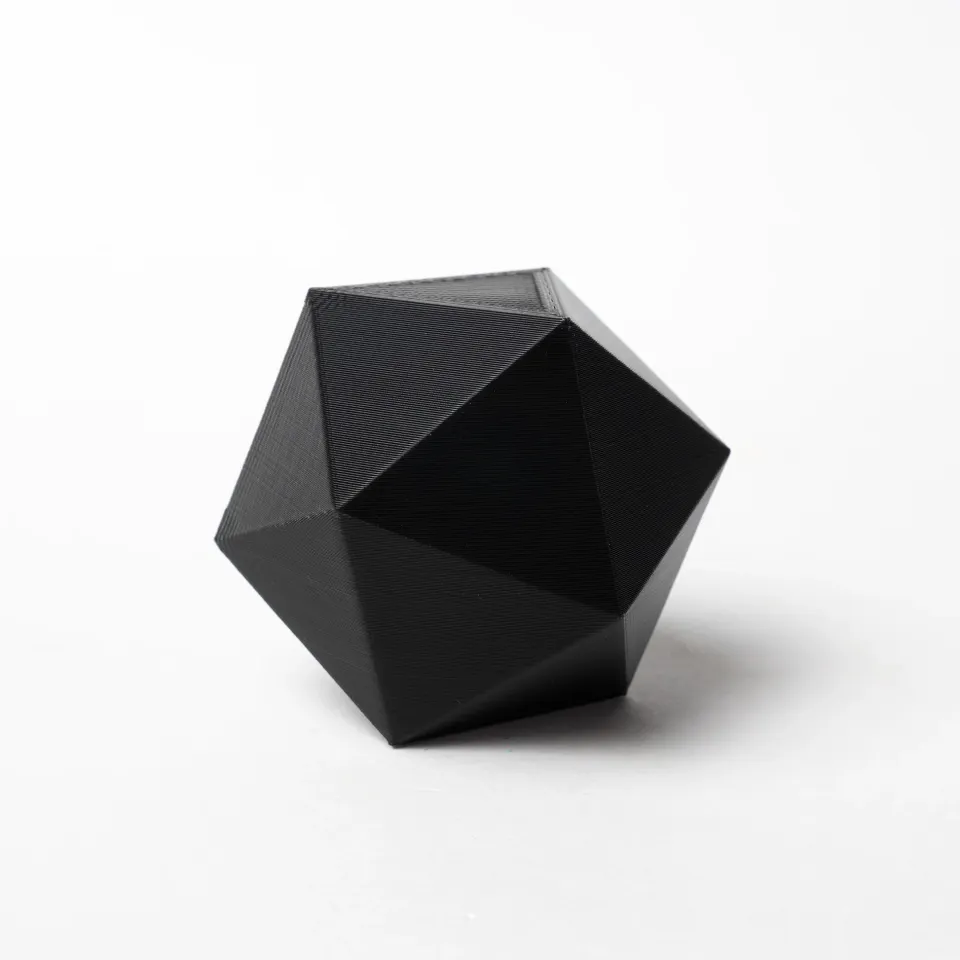
PLA is the easiest. PETG is still manageable, but requires better control of the first layer, moisture, and stringing. ASA is the most demanding, mainly because of shrinkage, warping, and the need for stable heat.
Order for beginners: PLA, PETG, ASA.
PLA is the weakest. It can still work for parts in a warm interior, but in a car or in sunlight you risk deformation. PETG is noticeably better and is sufficient for many practical parts. ASA goes even further and holds its shape better in environments where PLA would already soften.
Order for heat: ASA, PETG, PLA.
PETG can work for short-term outdoor use, but ASA is better for long-term exposure to sunlight. Use PLA outdoors only for items where faster aging, deformation, or replacement is not an issue.
Order for outdoor use: ASA, PETG, PLA.
PLA is rigid and dimensionally accurate, but more brittle. PETG is tougher and often better for parts that should slightly or absorb impacts. ASA is good for technical parts, especially if mechanical stress is combined with heat or outdoor exposure.
For purely mechanical loads, however, do not forget about layer orientation, the number of perimeters, infill, and model design. A poorly designed ASA part can crack sooner than a well-designed PETG part.
Choose PLA. You will save time, the print will be more trouble-free, and the surface will usually look better. If you want a stronger option, consider PLA+ or tough PLA, but still do not use it as a material for high temperatures.
Start with PETG. It is more practical than PLA when the part may occasionally be hit, carry a load, or come into contact with moisture. PLA makes sense only if you want the easiest possible print and know that the part will not be stressed.
Be careful. A car interior can heat up to very high temperatures in the sun. PLA is not suitable. PETG may be sufficient for less critical parts away from direct heat, but choose ASA for a better thermal margin. For parts that could affect safety, avoid using 3D printing without professional design and testing.
Choose ASA if you have a printer capable of printing ASA reliably. If not, PETG may be a temporary or less demanding option, but expect less reserve in sunlight and UV radiation.
PETG is usually a better starting point than PLA because it does not crack as easily. With ASA, it depends on the shape, layer direction, and usage environment. If you need genuine ibility, look for TPU rather than PLA, PETG, or ASA.
The first mistake is printing everything from PLA simply because it prints nicely. PLA is excellent on a desk, but outdoors and in a car it quickly reaches its limits.
The second mistake is switching straight to ASA without preparing the printer. ASA is not simply stronger PLA. It requires heat, adhesion, ventilation, and patience. If you have an open printer and are printing a large flat part, PETG may be a more realistic choice.
The third mistake is ignoring moisture. PETG and ASA can absorb moisture and then print worse. When a new profile suddenly produces bubbles, strings, and a rough surface, do not look for the problem only in the slicer.
The fourth mistake is relying on the material instead of the design. For a strong part, it often helps to add perimeters, round the corners, increase the contact area, use the correct layer orientation, and add local reinforcement. The material is only one part of the result.
Start by asking where the part will live. Indoor use and appearance mean PLA. Everyday functionality, moisture, and impacts mean PETG. Sunlight, outdoor use, and higher temperatures mean ASA.
Then print a small test. For technical parts, it is worth printing only the critical section: a clip, hole, thread, latch, or corner of a large cover. You can verify the dimensions and material behavior in a few dozen minutes rather than after an eight-hour print.
Finally, fine-tune the profile for the material. With PLA, monitor cooling and the first layer. With PETG, address moisture, stringing, and separation from the bed. With ASA, focus on the enclosure, brim, minimizing drafts, and safe ventilation.
PLA is the best choice when you want easy printing, an attractive surface, and a quick result. PETG is a universal material for functional parts that need to withstand more than a decoration. Choose ASA when the part will face outdoor conditions, UV radiation, or higher temperatures.
If you are unsure, use PLA for the prototype, PETG for the first functional version, and ASA for the final outdoor part. This reduces the risk of a failed print and means you will not unnecessarily use a more demanding material where you do not need its advantages.


