Doprava zdarma od 1 999 Kč
Rýchla expedícia
Overený obchod
Tisíce zákazníkov




Doprava zdarma od 1 999 Kč
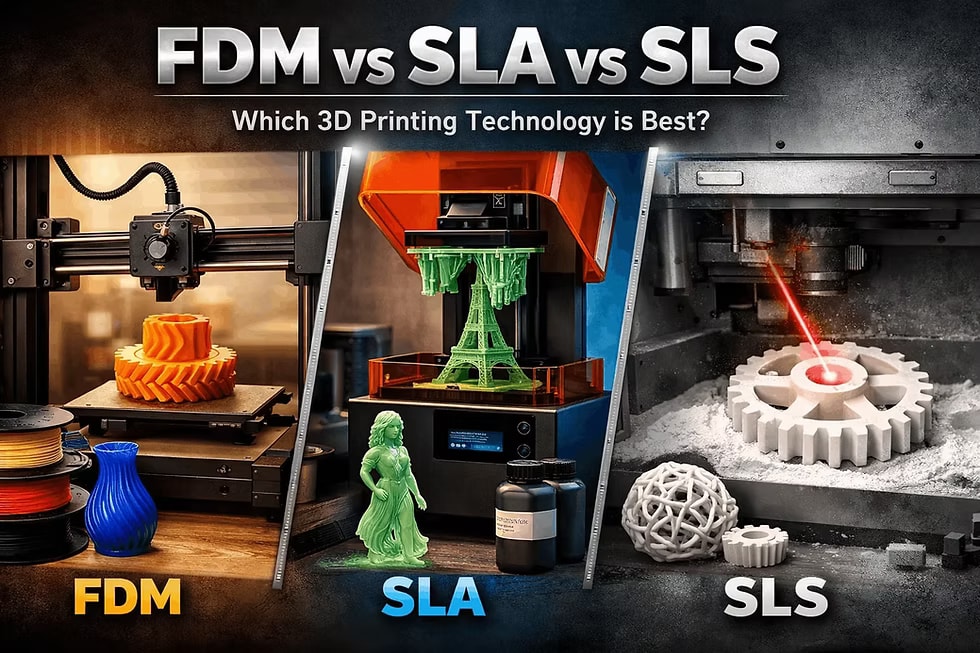
Choosing a 3D printing technology has a greater impact than choosing the material itself. The same model can be cheap and fast to print on an FDM printer, beautifully smooth when made from SLA resin, or strong and more geometrically ible when made from SLS nylon. The best choice therefore does not come down to the question "which technology is best", but to what the part needs to do.
If you need an inexpensive prototype, bracket, cover or part for verifying dimensions, FDM often wins. If fine detail, a smooth surface or a visual model is the priority, SLA makes sense. If you want a functional plastic part with complex geometry, clips, hinges, grilles or a small support-free production run, SLS is usually the strongest candidate.
| Part requirement | Most suitable technology | Why |
|---|---|---|
| Low-cost dimensional prototype | FDM | Low cost, fast iteration, wide range of filaments |
| Larger cover or fixture | FDM | Good availability, reasonable strength, option to use PETG, ASA or technical filaments |
| Miniature, jewelry, figurine, detailed model | SLA | Very fine details and a smooth surface |
| Transparent or visually premium prototype | SLA | Better surface than FDM, less visible layers |
| Functional nylon part | SLS | Strong PA12 or PA11, good toughness, no supports |
| Complex geometry and internal channels | SLS | The powder supports the part during printing, so a conventional support structure is not needed |
| Small series of identical parts | SLS | Good use of chamber space and repeatability for functional plastic parts |
FDM printing builds a part from molten plastic filament. The nozzle gradually lays down layers of material, most commonly PLA, PETG, ABS, ASA, TPU or technical blends. Its advantages are low cost, a wide choice of materials and quick setting adjustments. The disadvantages are visible layers, poorer detail and strength that depends on layer orientation.
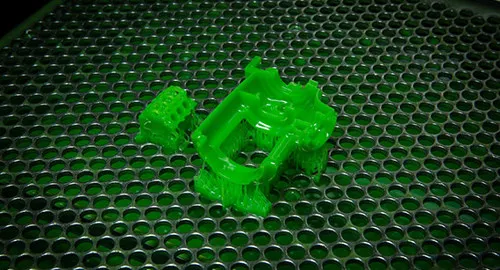
SLA cures liquid photopolymer resin with light. Parts have a very fine surface and can reproduce small details that would be lost on a typical FDM printer. After printing, however, they must be washed, post-cured and have their supports removed. Resins can be strong, ible, more heat-resistant or castable, but in general you need to expect a higher cost and a more sensitive workflow.
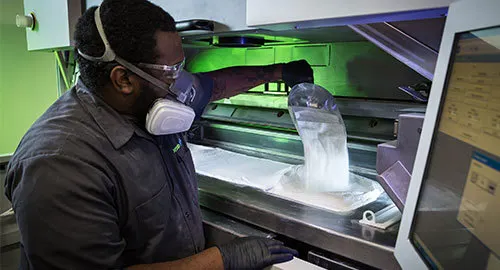
SLS sinters powdered plastic with a laser. Nylon PA12 is used most often, with PA11 or filled blends also available. During production, unprinted powder supports the surrounding geometry, so SLS does not need supports like FDM or SLA. This makes it suitable for complex shapes, movable assemblies, grilles and small series. The surface is usually matte and slightly grainy, but mechanically it is a very practical technology.
FDM is the best first choice when you need to verify shape, dimensions and function without unnecessary costs. Typical examples include sensor brackets, assembly fixtures, electronics enclosures, product prototypes, workshop templates or larger decorative models.
PLA or PETG is sufficient for ordinary indoor parts. For parts in a car, outdoors or near a heat source, ASA, ABS or another material with higher temperature resistance is better. TPU is used for soft caps, bump stops or ible inserts. For functional parts, it is important to consider print orientation: a part is usually weakest between layers, so tensile forces should not easily separate the layers.
FDM is not suitable if you need a perfectly smooth surface, very fine text, sharp miniature details or complex overhangs without support marks. It can be sanded, filled and painted, but this work increases both cost and time.
Choose SLA when the part primarily needs to look good or carry fine detail. It is suitable for figurines, product mock-ups, small design parts, dental and jewelry models, casting molds, transparent prototypes and precise small components.
SLA's greatest advantage is its surface quality. Layers are significantly less noticeable than with FDM, and the edges of small details can be very clean. For a visual prototype of a button, controller or small cover, SLA often looks closer to the final product.
Its weaknesses are the workflow and material durability. After printing, the part needs washing, post-curing and support removal. Some resins are more brittle than thermoplastics, and prolonged UV exposure or heat may not suit them. Technical resins labeled tough, durable, high temp or ible are available, but it is still a good idea to verify the specific material and not automatically assume the same toughness as nylon or PETG.
SLS is a strong choice for parts that need to work in practice, not just demonstrate a shape. It is suitable for snap-fit covers, brackets, hinges, clips, lightweight structures, grilles, robotic parts, pipe adapters, ergonomic handles or small series of end-use components.
The main advantage is the combination of strength and geometric freedom. Because the part is surrounded by powder during printing, it does not need conventional supports. You can design shapes that would require many supports with FDM and would leave marks with SLA. SLS also works well when producing a larger number of smaller parts in a single production batch.
However, expect a grainier surface and remember that enclosed cavities must allow the powder to be emptied. If you are designing a hollow part, add sufficient escape holes. For moving assemblies and snap-fit elements, consider clearances; otherwise, the parts may fuse together after printing or bind.
FDM is usually the least expensive, especially for larger prototypes and simple shapes. SLA is more expensive because of the resin and post-processing. SLS may be more expensive for a single small part, but for a small series of complex parts the difference quickly decreases because support production is eliminated and more pieces fit into one batch.
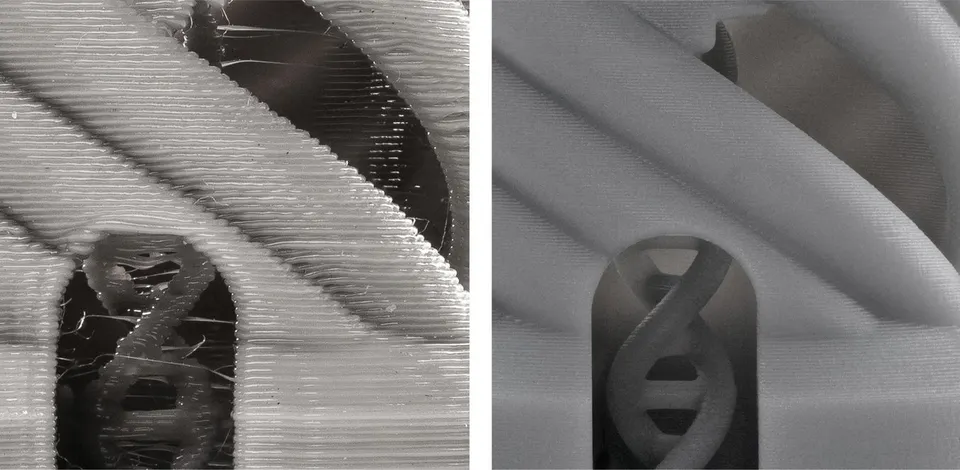
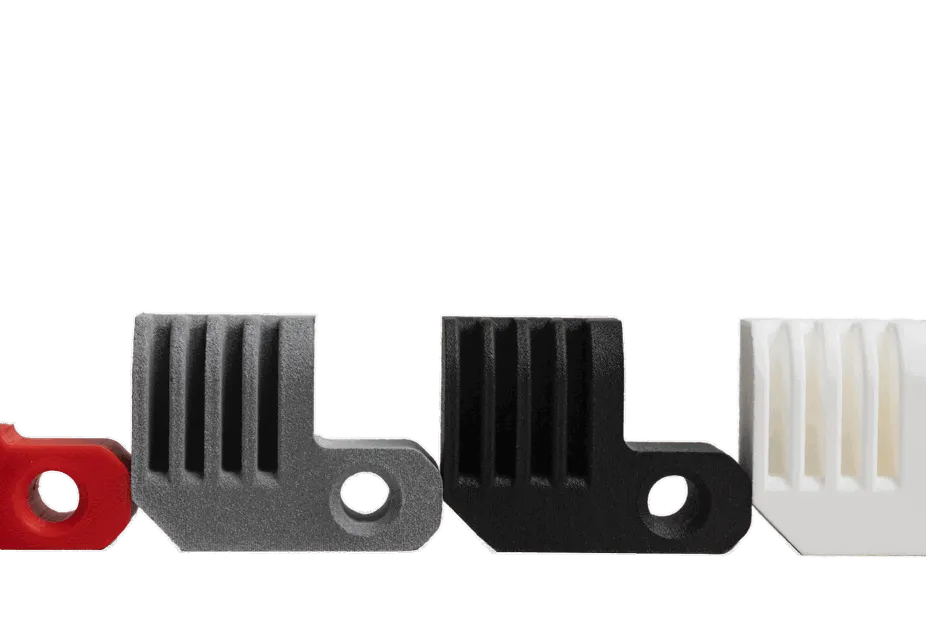
SLA usually provides the smoothest result. SLS has a finely grainy, matte surface. FDM shows layers the most, but with a properly configured print it can be entirely sufficient for technical applications. If the part is meant to represent the final appearance of a product, SLA or additionally finished SLS often looks more professional.
For simple mechanical parts, FDM is very good when the material, infill, number of perimeters and orientation are selected correctly. SLS nylon is excellent for tough functional parts, clips and small series. SLA can be precise and strong under compression, but for impacts, bending and long-term stress, it is necessary to choose a suitable technical resin.
SLA can usually handle very fine details. SLS is accurate for functional plastic parts, but the powder-based process and subsequent cleaning affect small holes and gaps. FDM depends most on the nozzle, layer height, material and calibration. For assemblies, always design in clearances: generally larger for FDM, smaller for SLA, and for SLS according to the part size and required movement.
Larger inexpensive parts are often best printed with FDM. SLA is excellent for smaller precise models, but large resin parts can be expensive and more prone to deformation. SLS is limited by chamber size, but it is highly efficient for many medium-sized functional parts.
You need a camera bracket for a workshop. If it is simple and will not be exposed to sunlight, choose PETG on FDM. If it will be outdoors, consider ASA. If the bracket has thin ible latches and a complex shape, SLS in PA12 will be a safer choice.
You need a detailed character model or product miniature. Choose SLA because it captures textures, fine edges and small features better than FDM. If the model needs to withstand rougher handling, choose a more durable resin and adapt the wall thicknesses.
You are designing an electronics enclosure to verify its shape. Print the first version in PLA or PETG using FDM, as this will quickly reveal errors in holes, connectors and assembly. You can move a more final small series to SLS if you need better clips, thinner ribs and a more professional functional part.
You need a transparent cover for an LED module. SLA with clear resin will be more suitable than FDM, but expect to sand, polish or apply a clear coat if the result is to be truly optically clear.
With FDM, bear in mind that overhangs above approximately 45 degrees often require supports, although modern printers can handle more in some cases. For functional parts, design walls generally in the range of 1.2 to 2 mm and replace sharp internal corners with fillets.
With SLA, place supports on less visible surfaces, provide hollow parts with drain holes and verify the dimensions after post-curing. For thin walls and small details, follow the recommendations for the specific resin, as differences between materials can be significant.
With SLS, design escape holes for the powder, leave adequate clearance for moving parts and do not skimp on fillets in stressed areas. Very thin walls can be ible, but for load-bearing parts it is safer to add material where forces act.
FDM is best for inexpensive, fast dimensional prototypes, larger parts and many practical components made from common filaments. Choose SLA for details, a smooth surface and visual models where appearance is important. SLS makes sense for functional nylon parts, complex shapes and small support-free series.
When you are not sure, do not start with the technology. Start with the requirements: size, strength, surface, temperature, accuracy, quantity and budget. The right technology is the one that fulfills the part's function with the fewest compromises.


