Gratis verzending vanaf 1 999 Kč
Snelle verzending
Geverifieerde winkel
Duizenden klanten




Gratis verzending vanaf 1 999 Kč
An open printer on your desk is still a great starting point. For PLA decorations, simple holders, prototypes, and everyday household parts, it is often enough without much thought. But as soon as you start printing larger functional parts, materials such as ASA, ABS, or PA, and jobs that need to be repeated without constant supervision, the limitations of an open design become apparent very quickly.
An enclosed CoreXY printer is not just a more expensive box around the hotend. It provides a more stable thermal environment, a faster motion system, better warping control, and often a workflow closer to a small workshop than a hobby experiment. New machines such as Prusa CORE One L or Bambu Lab H2D show where expectations for desktop 3D printers are heading: larger volume, higher speed, technical filaments, and less manual fine-tuning.
An enclosed printer has a build chamber separated from its surroundings. In simpler models, this is mainly an enclosure that prevents drafts. In more advanced machines, the chamber actively manages temperature, ventilation, and sometimes filtration. This is particularly important for materials that shrink as they cool and tend to warp.
CoreXY is a kinematics system in which the print head moves along the X and Y axes using belts and fixed motors in the frame. Unlike a classic bedslinger printer, the heavy bed does not need to move rapidly back and forth. The result is a lighter motion system, higher acceleration, and a lower risk of vibrations during fast printing. CoreXY alone does not automatically guarantee perfect prints, but in a rigid frame with well-tuned firmware, it makes a great deal of sense.
In practice, this means the printer can move faster, maintain geometry more accurately, and still remain compact relative to its build volume. This is why CoreXY is becoming established in modern enclosed machines for workshops, schools, development departments, and small-scale manufacturing.

An upgrade does not begin with wanting a newer machine. It begins when your current printer costs you time, material, or patience.
The typical signs are clear. Large PETG parts lift at the corners. ASA and ABS work only sometimes and only after profile adjustments. Nylon is sensitive to both moisture and ambient temperature. With multi-part models, you spend too much time cutting, gluing, and sanding joints. You would rather not start the printer overnight because you do not want to risk another failed attempt.
An open printer also has poorer repeatability in a typical room. It behaves differently in summer and winter, near a window and in a workshop where someone opens the door. With PLA, this often does not matter. With ASA, ABS, and PA, it does, because thermal stability directly affects internal stresses, layer adhesion, and dimensional accuracy.
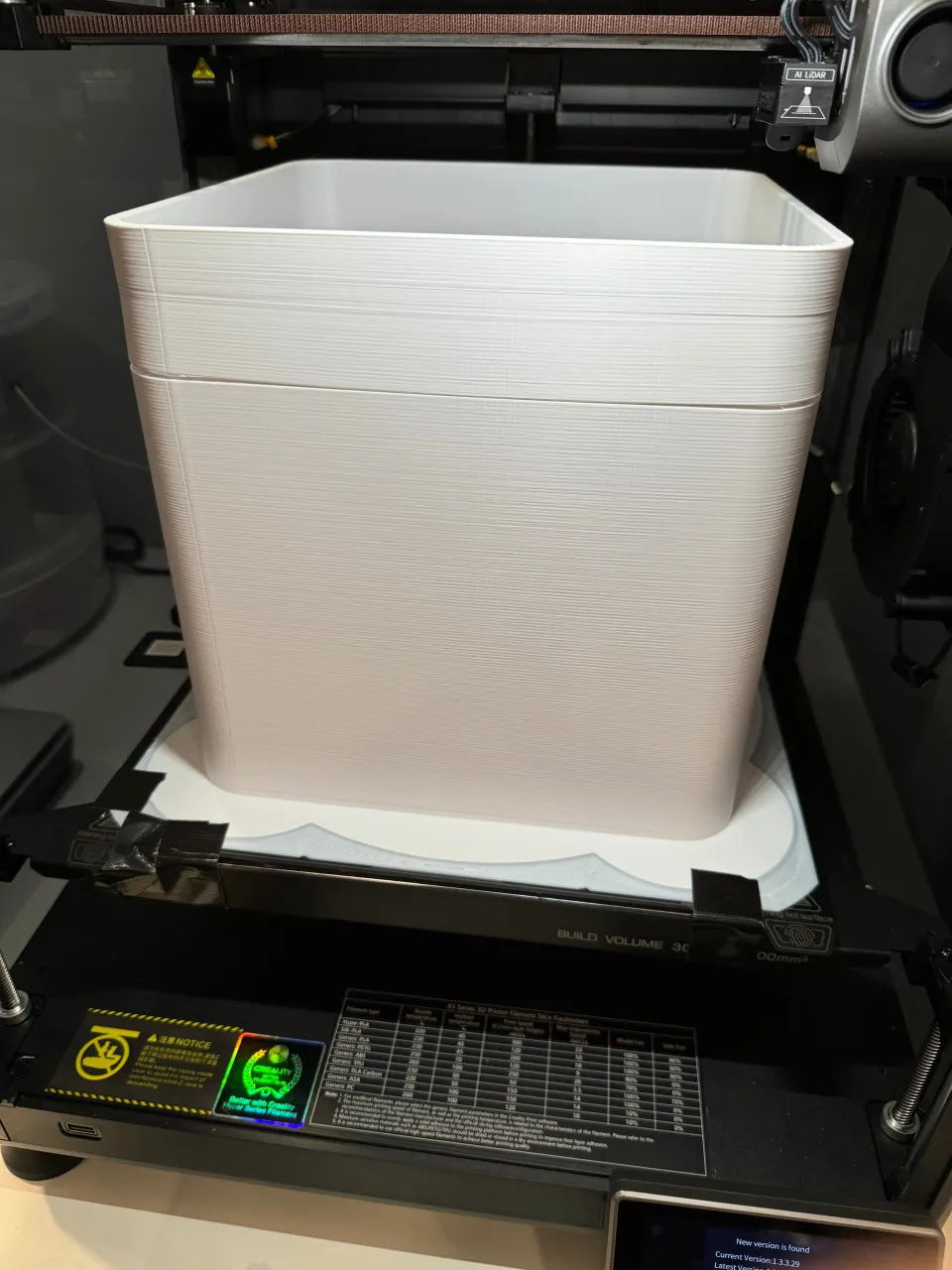
The greatest benefit of an enclosed chamber is control over cooling. When a part does not cool too quickly or unevenly, it warps less, the layers adhere better to one another, and the result is more predictable. This is the difference between one successful piece after three attempts and stable production of several identical parts in succession.
With ASA, you will especially appreciate less corner lifting and better stability of larger parts. This is useful for outdoor holders, covers, automotive fixtures, parts exposed to sunlight, or temperatures higher than PLA can withstand. With ABS, the chamber is important for reducing cracking and delamination. With PA and composite nylons, a stable environment helps with strength and accuracy, but you also need to deal with drying the filament.
A heated chamber is another level. A passively enclosed printer heats up mainly from the build plate, while an actively heated chamber can reach and maintain the target temperature more quickly and reliably. With large technical parts, this makes a difference that shows not only in appearance, but mainly in whether the part remains dimensionally accurate after cooling and does not crack.
Ventilation and filtration are also important. With materials such as ASA and ABS, it is not a good idea to print continuously in a living space without ventilation. For a workshop, school, or company, an enclosed machine with filtration is more practical and easier to integrate into the working environment.
Modern CoreXY printers often promise very fast printing. Maximum speed alone, however, is not what matters. What is important is whether the printer can print quickly and repeatedly, with a usable surface finish, accuracy, and sufficient material flow.
When you have a fast printer, iteration times are reduced. A holder that previously took six hours to print can be finished significantly sooner. This is crucial for prototyping, because you can complete more versions in a single day. In small-scale manufacturing, it also matters how many times the operator has to come to the printer, remove the print, prepare the build plate, and start the next job.
Speed only makes sense with the right material, profile, and nozzle. With technical filaments, the goal is often not the highest possible acceleration, but the right combination of temperature, flow, cooling, and chamber conditions. A good enclosed CoreXY printer gives you a wider operating window in which you can print quickly without every larger part becoming a lottery.
Prusa CORE One L is aimed at users who want a larger enclosed CoreXY machine with a build volume of 300 x 300 x 330 mm, an actively heated chamber up to 60 °C, and an emphasis on repairability, offline operation, and technical materials. The main attraction is the combination of large volume, a rigid construction, and a chamber designed for ASA, ABS, PA, PC, and other more demanding filaments.
Bambu Lab H2D takes a different approach. It focuses on a large working space, a high degree of automation, speed, a heated chamber, and a broader ecosystem for multiple materials and additional tools. For users who want the most integrated solution possible and a fast workflow, it is a typical representative of the new generation of desktop machines.
Not everyone needs to buy these particular models. The more important trend is that the enclosed CoreXY printer is moving from the category of enthusiast luxury into that of a practical work tool. If you use your printer regularly and the result needs to have technical value, the difference compared with an open machine is no longer merely cosmetic.
Economic value is not limited to companies with print farms. All you need to do is calculate the time, failed prints, and value of the resulting parts.
An upgrade starts to make sense when you regularly print functional parts from ASA, ABS, PA, or composite filaments. It also makes sense when you often cut large models into smaller parts simply because they do not fit on the build plate, or when large prints fail after several hours due to deformation. In such a case, you are not only paying for a new machine, but also for fewer repeated attempts and less manual work.
For a school, the benefits may include simpler operation and greater reliability. Students do not have to deal with as many adhesion and enclosure-related tricks, so they can focus more on designing the part. For a workshop, repeatability is key. If you produce fixtures, templates, covers, or spare parts, reliability often has greater value than speed itself.
On the other hand, if you mainly print PLA figures, decorations, small organizers, and the occasional PETG holder, an enclosed CoreXY printer may not be worth it. A better investment could be quality filament, a dry box, a better nozzle, a build plate surface, or more precise calibration of your current machine.
A home user with an open printer mainly prints PLA and PETG. They try ASA once a month, but do not mind spending more time tuning it. An upgrade is not necessary here. It only makes sense once technical materials become a regular part of their work.
A small workshop prints holders, assembly fixtures, and covers for customers. The material often needs to withstand heat, UV radiation, or mechanical stress. Here, an enclosed CoreXY printer saves time because ASA or PA can be printed more consistently and larger parts do not need to be divided as much.
A school or makerspace needs a printer used by multiple people. An enclosed chamber with good profiles and automation can reduce operator errors. At the same time, it is necessary to consider safe placement, ventilation, and clear rules for materials.
A small-scale manufacturer prints batches of dozens of parts. In that environment, not only the speed of a single print matters, but also the operating routine: build plate preparation, remote monitoring, availability of spare parts, repeatable profiles, and simple servicing. A more expensive machine can pay for itself quickly if it reduces the number of failed prints and operator interventions.
Not every enclosed printer is automatically suitable for technical materials. Check the maximum chamber temperature, nozzle temperature, build plate temperature, hotend type, availability of a hardened nozzle, and recommended material profiles. For abrasive filaments containing carbon or glass fibers, a hardened nozzle is practically mandatory.
Also check the dimensions of the entire printer, not just the build volume. An enclosed machine may be taller and heavier, and it needs space for opening the doors, handling filament, and servicing. If the printer has active filtration or the option to connect it to an exhaust system, plan its placement in advance.
The service model is important. With a work machine, you do not want to wait weeks for a standard part. Find out about the availability of nozzles, hotends, build plates, fans, belts, and sensors. In a business environment, it is also valuable to know whether the printer can operate without the cloud and whether multiple machines can be managed easily.
An open printer on your desk is no longer enough when you are no longer just printing models, but repeatedly producing usable parts. If you are dealing with deformation, cracking, unstable ASA, dimensional deviations in larger prints, or lost time due to repeated attempts, an enclosed CoreXY printer is the logical next step.
The point is not to have the most expensive machine. It is to have a printer that matches the work. For PLA hobby printing, an open design may still be a sensible choice. For technical filaments, workshops, schools, and small-scale manufacturing, however, an enclosed chamber, rigid CoreXY mechanics, and well-designed profiles provide a difference that is visible in every completed part.


