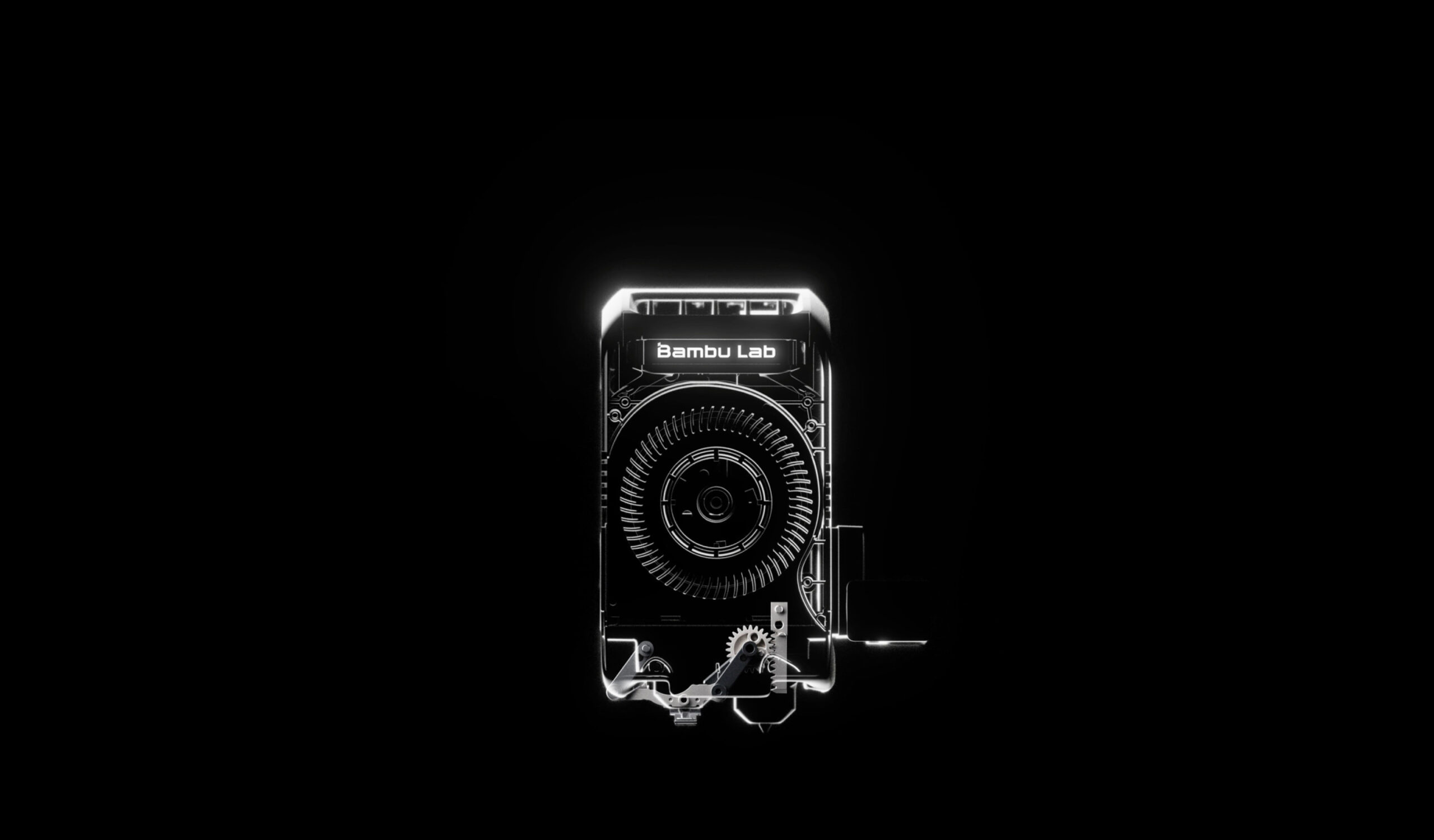
Introduction: 14 April 2026 begins a new chapter
Bambu Lab has officially announced an event dated 14 April 2026, at which a new generation of printers from the X series is expected to be introduced – Bambu Lab X2D. For the 3D printing community, this is one of the most anticipated moments of recent years. The X series (X1, X1C, X1E) set the standard for fast and reliable CoreXY 3D printing, but it has also officially reached the end of its life cycle. The X2D is expected to be its direct successor, drawing on experience from the development of the H2D/H2C and building on the multi-material printing ecosystem.
In this article, I summarize:
- what we probably know about the X2D from official hints and community leaks,
- how the X2D fits into the current product range (H2D, H2C, P2S, P series),
- which equipment and targeting scenarios make technical sense,
- what owners of the X1 / X1C / X1E and P series should prepare for,
- how to think through the purchasing strategy: buy now, or wait for the X2D?
Important: The X2D does not officially exist before 14 April 2026 – everything you read outside the manufacturer's brief teasers is speculation and analysis based on leaked photos, model names in applications, firmware and user discussions. This article therefore clearly distinguishes between what is confirmed and what is a
likely scenario based on trends.
Context: the end of the X1 series and the arrival of the H2D / H2C
Before we get into the X2D, it makes sense to understand where the product line has moved:
- X1 / X1 Carbon / X1E – a groundbreaking generation that popularized high-speed CoreXY, an enclosed chamber and smart features (AI print monitoring, auto-calibration). In 2026, it is officially EOL (end-of-life), although service and spare parts are expected to continue for several more years.
- H2D – the flagship printer introduced in 2025. It brought:
- a large print volume of over 350 mm along both the X and Y axes,
- a true dual extruder (two independent nozzles) with separate feeding,
- higher chamber and hotend temperatures for technical materials (PA-CF, PC, ASA, etc.),
- an emphasis on semi-professional and professional use.
- H2C – a model from late 2025 with a waste-free hotend changer system (Vortek) for multi-material printing without large purge towers. It logically targets efficient multi-material printing and more industrial workflows.
At the same time, more affordable models (P2S, P series) are increasingly fulfilling the role of a “fast home printer” and are gradually taking over some X1C users.
The X2D will therefore very likely be positioned as a new high-end CoreXY machine for demanding users who want:
- the performance and quality of the X series,
- the advantages of dual extrusion,
- but in a simpler package than the H2D/H2C (which target the higher end of the professional segment).
What we know so far and what can be logically deduced
Confirmed: date, size, target market and basic concept
- Presentation date: 14 April 2026, official online launch.
- The name X2D clearly follows on from the X1C/X1E while also referring to the dual configuration (D for “dual”).
- In internal materials for partners and some e-shops, the X2D is already appearing as a premium enclosed CoreXY printer.
- The build volume will be the same as that of the X1C and P2S – approximately 256 × 256 × 256 mm. The X2D is therefore not targeting something “larger than the X1C”, but rather a smarter and more capable machine in the same size class.
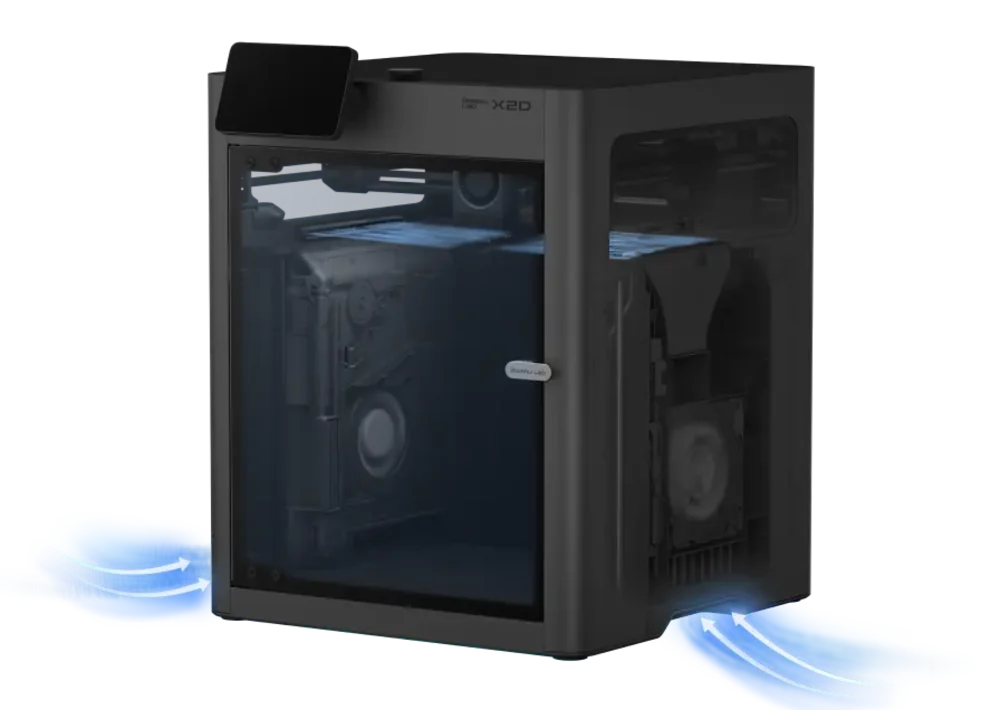
- The official announcement and visuals make it clear that the X2D uses two nozzles. There is only one direct-drive extruder in the head, while the second filament is guided via a Bowden tube from the rear of the printer. This is an important element of the concept – it therefore uses dual nozzles, but not two fully independent direct-drive extruders in a single head.
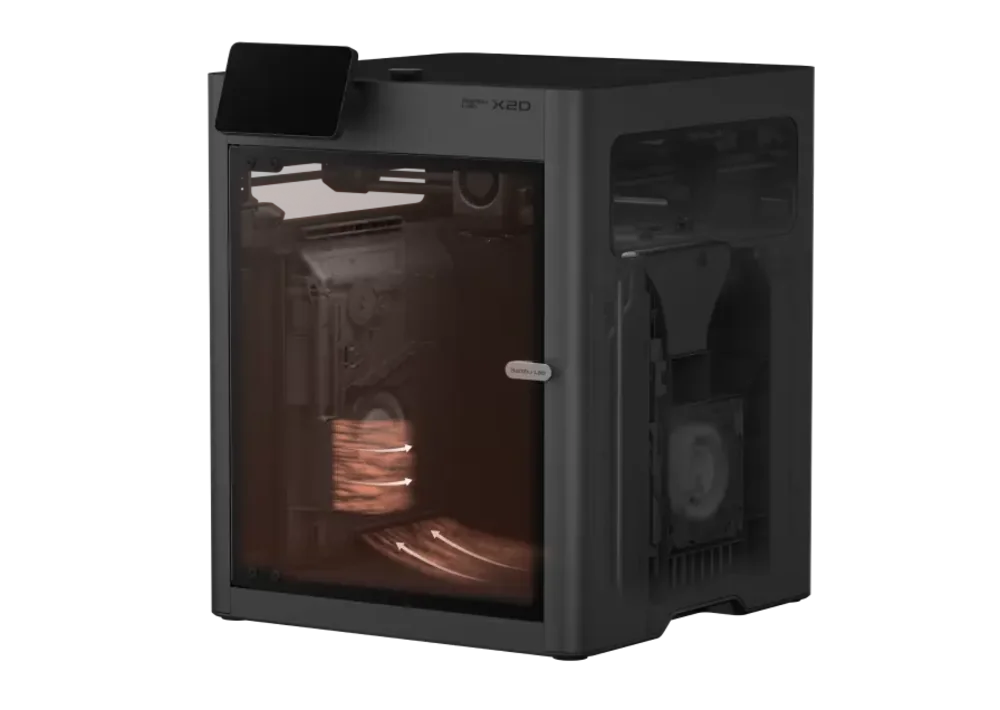
- With the new generation of the X series, it appears that the X2D will also offer a heated chamber – either active heating or highly effective temperature control in the enclosed space. This significantly expands the possibilities for using technical materials.
Highly probable X2D features
Based on the trends set by the H2D/H2C and the direction of the market, the following parameters can be expected:
- CoreXY construction in a rigid enclosed chamber
- The legacy of the X1 and H2D – high speed (on the order of hundreds of mm/s), light head movement and minimized vibrations.
- A fully enclosed frame for materials such as ABS/ASA, PC and technical nylon composites.
- In the case of the X2D, there is also a heated chamber as a key advantage over the older X1 series and less expensive models.
- Two nozzles combined with one direct-drive extruder and one Bowden extruder
Unlike the H2D, which uses two fully independent extruders, the X2D aims for a compromise between complexity and practical value:
- The print head contains one direct-drive extruder for the primary material, ideal for more sensitive polymers (TPU, PA-CF, etc.).
- The second material is fed via a Bowden feed from the rear of the printer to the second nozzle.
- Both nozzles are clearly visible in the official renders; the design shows that this is a dual-nozzle print head, but not a full-fledged IDEX with two independent X axes.
What does this mean in practice:
- Cleaner supports made from another material, than a single hotend with mechanical switching or purge towers allows – the second nozzle can be dedicated to supports.
- Combining materials with different shrinkage – e.g. PA-CF as the main material and PVA or another support filament in the second nozzle.
- Potential for multi-color printing via AMS/AMS-2, where one nozzle can be used for the main material and the other for supports or an additional material.
- The design is simpler than a full-fledged IDEX, so it is realistic to expect a better balance between complexity, price and reliability.
- Build volume at the X1C / P2S level
- The X2D does not confirm a trend toward increasing size as seen with the H2D/H2C; instead, the build volume remains at the X1C and P2S level.
- That means approximately 256 × 256 × 256 mm – an ideal compromise for most prototyping, workshop and hobby applications.
- In practice, this will make the transition easier for X1C users: all proven models and workflows remain dimensionally compatible.
- Printing technical materials as standard
Combined with a heated chamber, the following can practically be taken for granted:
- a hotend of at least 300–350 °C,
- a chamber capable of maintaining an elevated temperature to reduce internal stress in ABS/ASA, PC and composites,
- high-quality air filtration (HEPA + carbon),
- surfaces compatible with PA, PC and CF-filled materials.
- Integration into the existing ecosystem
- Support for current and new versions of AMS/AMS-2.
- Advanced automatic calibrations (flow, pressure advance, vibration calibration) and AI print monitoring.
- A unified interface, including remote control and monitoring options for small farms, can also be expected.
How the X2D may differ from the H2D and H2C
Many users are already asking today: “If the H2D and H2C exist, why is there also an X2D?” The answer will probably lie in the intended use;
H2D / H2C – a personal production center and more industrial tool
- H2D combines 3D printing, laser and possibly other tools; it is a multifunctional platform for designers, workshops and small-scale manufacturing.
- H2C leans more toward efficient multi-material printing with minimal waste (the Vortek system) and a focus on longer continuous operation.
The X2D will very likely target users who:
- do not need a laser or an “everything-in-one” solution,
- want clean, fast and maximally reliable 3D printing with two nozzles for material + supports,
- prefer the proven X1C/P2S size format, so they do not need to reorganize their workspace for a larger printer,
- are moving from the X1C/X1E, or from the P series, and mainly want to improve:
- supports made from another material,
- printing technical parts (functional components, jigs, small batches),
- print stability thanks to the heated chamber.
From a business perspective, it makes sense for the X2D to fill the gap between:
- the more affordable P series (P1/P2S),
- the more expensive and complex H2D/H2C,
- while also becoming a natural upgrade for X1 series users, which has officially been discontinued.
What users are saying: concerns and expectations from discussions
Several topics repeatedly appear in the major discussion threads surrounding the X2D leaks and are worth mentioning from a practical perspective:
- “Should I keep my X1C or wait for the X2D?”
- The X1 series is still highly capable even after all these years. Users who have moved to the H2D often say that the X1C still makes sense for undemanding production batches and farms.
- The main concern is the availability of spare parts and the length of support. The X2D can be expected to begin a new, many-year support cycle, making it the better choice for long-term investments.
- Dual nozzles vs. reliability
- Some in the community are concerned that the dual system could bring more complications than benefits (calibration, clogging, nozzle offsets).
- The key question will be how the chosen concept of one direct-drive extruder and one Bowden extruder performs in practice – the direct-drive extruder for the main material should minimize problems with retractions and ible filaments, while the Bowden setup for supports is typically less critical.
- If the advanced automatic calibrations work well and the profiles are properly prepared, a dual head in this configuration could be a very sensible compromise between convenience and complexity.
- Price
- The X2D is not expected to be cheap – it is the flagship model of the X series.
- Discussions agree that the price should make sense between the P2S and H2D/H2C, allowing it to find a place among demanding hobby users and smaller companies alike.
How users and companies can prepare for the arrival of the X2D
1. Evaluate your typical use
Ask yourself a few practical questions:
- Do I mainly print aesthetic models, cosplay and functional parts from PLA+/PETG?
- Then the P series or an existing X1C, if you already have one, will often be more than sufficient.
- Do I need soluble supports, a combination of hard and soft materials or frequent printing with PA-CF, PC and ASA?
- With its dual-nozzle system and heated chamber, the X2D will be much more interesting.
- Am I a small manufacturer / prototyping office with my printer running most of the week?
- The X2D's higher purchase price may quickly pay for itself through fewer failed prints, less tuning time and fewer limitations when printing technical parts.
2. Wait for the first independent reviews
Although the X2D is extremely appealing, 3D printing best practice dictates:
- With a completely new generation, it is sensible to wait at least several weeks to months before real-world experience becomes available.
- You will see:
- how the dual-nozzle system (one direct-drive extruder, one Bowden) performs in everyday use,
- whether the firmware introduces any “teething problems,”
- what spare-parts and expansion availability looks like.
However, if you are planning to refresh your printer fleet within the next few months and need a new flagship model, it makes sense to put the X2D on your shortlist at least.
3. Prepare for the requirements of dual printing
When the X2D arrives, you will only get the most out of it if you have mastered the basics of multi-material printing:
- Learn to work with support materials – BVOH, PVA or breakaway supports made from another polymer.
- Prepare your own material profile library in the slicer (e.g. for different types of PA-CF, PC blend and ASA), so you can quickly test material + support combinations.
- Think about the design of parts for dual printing – where combining materials is worthwhile (a body + soft seal), where a single filament is enough and where a dual system does not make sense.
How the X2D could change the market (and what it means for 3dstisk.cz customers)
The arrival of the X2D could have several practical effects on the entire desktop FDM printing ecosystem:
- Pressure for faster, smarter CoreXY machines across the industry
- Competitors will be forced to respond – either by significantly improving existing models or by adjusting prices.
- Users will benefit both in terms of performance and value for money.
- Standardization of dual nozzles in the high-end segment
- Dual nozzles (even if they are not always two fully independent direct-drive extruders) could become the “new normal” in the higher-end class, much like we no longer question whether a printer has auto-bed-leveling.
- This means better slicer support, more optimized filament profiles and wider availability of support materials.
- Long-term X2D support
- If the X2D truly replaces the X1 series as the flagship CoreXY, a long life cycle, iterative firmware improvements and a rich aftermarket (nozzles, hotends, build plates, modules) can be expected.
For 3dstisk.cz customers, this means in practice:
- more room to choose between the P series, X2D and H2D/H2C according to budget and requirements,
- another boost for expanding the range of technical filaments and support materials,
- a gradual shift in the “everyday standard” toward higher speeds and quality.
Does it make sense to wait for the X2D, or buy another model today?
From a purchasing-strategy perspective, the situation can be simplified into several scenarios:
When it makes sense to wait for the X2D
- You are planning to invest in one larger flagship printer for several years ahead.
- You often print with advanced materials and know that you want two nozzles for supports or combining materials.
- Your current fleet is still functional, so you can afford to wait a few months for the first real reviews and user experiences.
- The X1C/P2S build volume suits you and you do not want to move to a physically larger machine, but you need better chamber conditions and a more modern platform.
When it is better to buy immediately (P‑series / H2D / H2C)
- You have an urgent capacity problem – you cannot keep up with orders and need a machine now.
- Most of your work can be handled by a single‑extruder CoreXY with standard materials.
- The X2D would be more of a “nice to have” than a necessity for you – in such a case, it often makes more sense to buy a proven model now and possibly add the X2D later as an upgrade.
- You need either a larger build volume than the X1C/P2S, or a full-fledged dual professional system – then it may be more logical to go straight for the H2D/H2C.
Conclusion: Keep a close eye on April 14
The Bambu Lab X2D has the potential to become the new benchmark for fast, precise and technically oriented FDM printing in a format users know from the X1C and P2S. However, it adds several key elements:
- two nozzles in a combination of one direct-drive extruder and one Bowden feed system,
- a heated chamber for more stable printing of technical materials,
- modernized electronics and software within the current ecosystem.
It is the logical culmination of development from the X1‑series through the H2D/H2C to the current P‑series.
Until its official launch on 14 April 2026, however, most information should be treated as well-founded speculation, not definitive facts. Once real specifications and the first independent tests are available, it will be possible to:
- compare the X2D with the H2D/H2C and P‑series more accurately,
- evaluate the price/performance ratio,
- prepare specific recommendations for different types of users – from makers and small businesses to semi-professional production.
If you are interested in modern CoreXY printers, I recommend following the news regularly while also clarifying your own priorities: what materials you print, what volumes you need and whether you will make use of the potential of two nozzles and a heated chamber. The X2D may then be either the ideal choice or a pleasant dream for the future – but in both cases, it will move the entire market another step forward.