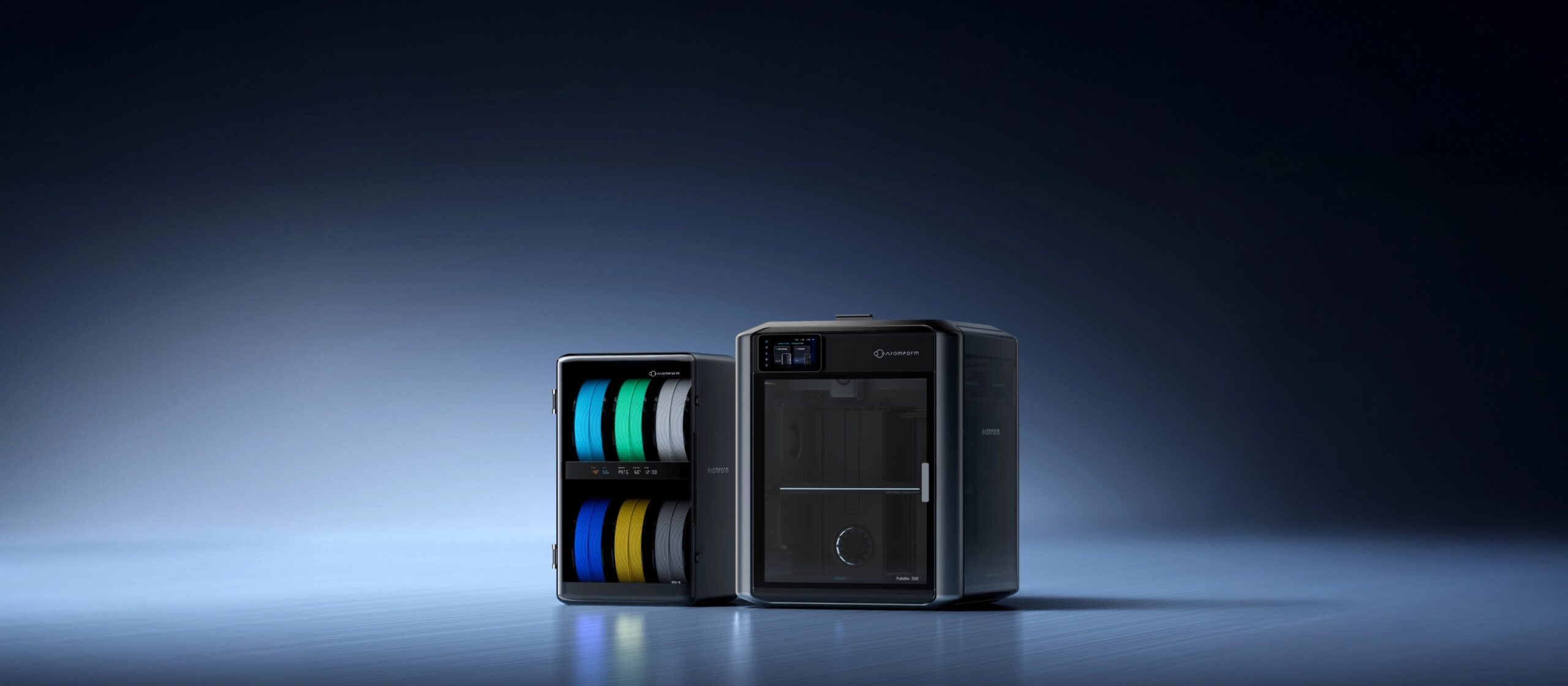
Multimaterial and multicolor FDM printing has long been a compromise between speed, reliability, and print quality. External splicers, slow filament changes, and endless calibrations often caused more frustration than joy.
But a new product appeared at CES 2026 that aims to change this balance – AtomForm Palette 300, a desktop 3D printer with 12 independent nozzles and the ability to print up to 36 colors and 12 materials in a single job. (cadjapan.com)
In this article, we will look at how Palette 300 works, how it differs from conventional AMS/MMU solutions, what its technical specifications are, and which types of users may find it interesting.
AtomForm Palette 300 is an enclosed CoreXY FDM 3D printer, combining:
- 12 independent nozzles, each for one filament
- an automated OmniElement nozzle-changing system
- AI-driven calibration and print monitoring using several cameras
- high print speeds of up to 800 mm/s and acceleration of up to 25 000 mm/s²
- a build volume of 300 × 300 × 300 mm and an enclosed, heated chamber
- support for a wide range of materials, including engineering materials (PC, PPA, composites)
The purpose of Palette 300 is to move multimaterial and multicolor FDM printing from the category of a “hi-tech toy” into the realm of a production tool that can be relied on in everyday operation. (atomform.tech)
Key features: what sets Palette 300 apart
1. Twelve nozzles instead of a filament switcher
Most current multimaterial solutions work either as:
- AMS/MMU (e.g., a combination of a 3D printer and a multifi lament feeder), where different materials are switched through a single nozzle in sequence, or as a
- toolchanger (e.g., multiple hotends on one axis), but usually with only a few tools.
Palette 300 takes a different approach:
- it has 12 permanently ready nozzles, each with its own filament,
- when the color or material changes, the filament is not switched, but the entire nozzle is changed automatically,
- a manufacturer-declared reduction in waste of up to 90% compared with conventional systems that create unnecessary purge waste when changing colors. (cadjapan.com)
The advantage is clear:
- less waste (smaller purge blocks, less wasted filament),
- shorter changeover times – there is no need for lengthy filament retraction and loading,
- each nozzle is optimized for its material (temperature, nozzle, flow).
2. Up to 36 colors and 12 materials in a single print
Palette 300 can combine in a single print job:
- up to 36 different colors,
- up to 12 different materials (depending on the number of nozzles).
This opens up possibilities for:
- full-color figurines and models without the need for manual painting,
- product design (color prototypes, mockups, packaging),
- functional parts made from different materials – e.g., combinations of hard and ible plastic, different levels of hardness in a single part, special supports, seals, and more.
The manufacturer is clearly targeting the segment currently dominated by enclosed ecosystems with AMS/ACE modules – Palette 300 aims to offer greater freedom in colors and materials, without sacrificing speed. (atomform.tech)
3. Speed: up to 800 mm/s without a major drop in quality
The CoreXY design of Palette 300 is intended for high-speed printing:
- a stated speed of up to 800 mm/s (with suitable settings and material),
- acceleration of up to 25 000 mm/s²,
- active vibration compensation (input shaping),
- an enclosed, rigid frame construction that eliminates resonances.
In practice, this means Palette 300 aims to approach the speed of modern high-end CoreXY printers, but with full multimaterial support. (cadjapan.com)
4. AI, cameras, and sensors
One of the major trends in recent years has been automation and smart print monitoring. Palette 300 integrates:
- more than 50 sensors (temperature, flow, movement, and position),
- 4 AI cameras, which monitor the condition of the nozzles and print,
- AI-driven autocalibration (nozzle alignment, flow, PA calibration),
- automatic detection of problems (spaghetti, warping, clogged nozzle), and the ability to pause/resume printing.
The goal is to minimize the need for manual intervention and increase first-print success – which is particularly important for long, multimaterial jobs. (atomform.tech)
Technical specifications at a glance
Based on the available information, the key specifications of Palette 300 can be summarized as follows:
- Type: FDM/FFF CoreXY, enclosed chamber
- Number of nozzles: 12 (automatic changing system)
- Max. number of colors: up to 36 in one print
- Build volume: 300 × 300 × 300 mm
- Max. print speed: up to 800 mm/s
- Acceleration: up to 25 000 mm/s²
- Max. hotend temperature: approx. 350 °C
- Heated chamber: up to ~65 °C
- Supported materials: PLA, PETG, ABS, ASA, PA/nylon, PC, PPA, composites, and other engineering plastics (depending on the specific profiles)
- Filtration: HEPA + activated carbon filter
- Noise level: approx. ≤ 48 dB (according to the manufacturer's internal measurements)
Based on the initial information, the price and availability are in the mid- to high-end professional class, with the official market launch planned for 2026. (atomform.tech)
How Palette 300 compares with AMS/MMU solutions
In recent years, many users have become accustomed to integrated multimaterial systems – filament feeders with multiple slots that automatically switch between spools.
Advantages of Palette 300 over AMS/MMU
- No filament splicing
- This eliminates the risk of a bad splice, varying diameter, or problems passing through the nozzle.
- Significantly less purge waste
- Changing the nozzle means a shorter “purging” period and less unnecessarily consumed material.
- More materials at once
- 12 nozzles allow the combination of, for example, hard plastic, TPU, soluble supports, and special filaments in a single job.
- Faster color changes
- Thanks to the ready-to-use nozzles, lengthy filament retraction and loading are eliminated.
Potential disadvantages and limitations
- More complex mechanics
- 12 nozzles and an automatic changing system mean more parts that need to be kept in good condition.
- Higher purchase price
- Compared with a standard printer plus an AMS/MMU module, a higher initial investment can be expected.
- Ecosystem and software
- For multimaterial printing, a well-tuned slicer and workflow are essential. With a new player on the market, it will be important to see how quickly everything stabilizes and how well it supports common formats (STEP, 3MF) and dividing models into material zones.
1. Design and product studios
For teams that need:
- color prototypes close to the final products,
- realistic mockups of packaging, consumer goods, and electronics,
- rapid design iterations with the ability to change colors and textures,
Palette 300 can significantly speed up the workflow. A full-color print from the printer means less manual painting and the ability to present the client with a very “finished” model immediately after removing it from the build plate.
2. Architects and visualization
Color models of buildings, urban complexes, or interiors often require a combination of different colors and materials (glass, concrete, greenery, roads, water). The ability to have dozens of colors in a single print is a huge advantage for architectural models.
3. Manufacturing companies and functional parts
In industrial applications, the motivation is often multimaterial capability rather than color itself:
- combining hard and soft plastic (mounts, grips, handles),
- integrated seals made of TPU within a rigid body,
- soluble supports for complex internal geometries,
- different degrees of rigidity in a single functional part.
Multiple nozzles with different materials make it possible to build complex assemblies in a single step, without the need for subsequent gluing or assembly.
4. Creative and fan creations
For creators of figurines, cosplay accessories, dioramas, or collectible models, Palette 300 means the ability to print highly detailed, full-color models without an airbrush and lengthy painting. However, this requires:
- quality models divided into color and material zones,
- a well-established workflow in the relevant slicer.
What to consider before deciding to buy
Because Palette 300 is a new product before its release to the wider market, it is worth monitoring several areas:
- Availability and service in Europe
- How quickly spare parts (nozzles, sensors, filters) will be available and what support will be provided in the event of a failure.
- Experiences of early users
- Real reviews from users who have used the printer for an extended period in a production environment are invaluable. Multimaterial systems in particular often reveal whether a solution remains reliable after hundreds of hours of printing.
- Firmware and slicer development
- For systems heavily dependent on automation, it is crucial that the manufacturer actively responds to bugs and improves both the slicer and firmware.
- Comparison with established solutions
- If you already own a 3D printer with AMS/MMU, it may be useful to compare:
- the actual print time for the same model,
- the amount of waste,
- the complexity of setup and calibration,
- the extent of human intervention during printing.
Practical tips for multimaterial printing (also applicable to Palette 300)
Whether you are considering Palette 300 or another multimaterial system, the following principles will help you achieve better results:
- Carefully divide the model into materials and colors
- Already during the modeling stage, consider how the part will be oriented and supported.
- Minimize the number of contacts between very different materials (e.g., hard plastic and soft TPU) where delamination could occur.
- Materials with similar shrinkage
- Combine materials with similar thermal behavior and shrinkage, to prevent cracking or warping.
- Calibration for each material
- Each filament has specific optimal temperature, flow, and speed settings. In systems with multiple nozzles, the advantage is that you can save a profile for each nozzle separately.
- Test prints before a “large project”
- Before printing a multicolor/multimaterial model, print a small sample to verify adhesion between materials, the sharpness of boundaries between colors, and the quality of transitions.
- Regular maintenance of the nozzles and system
- Multimaterial systems require more maintenance – wiping the nozzle, cleaning heated parts, and checking the fans and filtration will pay off handsomely in print success rates.
Summary: a step toward truly practical multicolor FDM
AtomForm Palette 300 brings a new approach to multimaterial FDM printing to the market – instead of external splicers or slow filament switching, it relies on 12 independent nozzles and a smart changing system. Combined with high print speed, AI calibration, and extensive sensor technology, it is an ambitious attempt to move multicolor FDM from an “experiment” to a professional tool.
For Czech users, it will be crucial to monitor how Palette 300 performs in real-world operation, what the availability of service and spare parts will be, and how it performs in practice compared with already established multimaterial systems.
If you are generally interested in multimaterial printing, it is also worth following the development of other technologies and models in the 3D printers category at /kategorie/3d-tiskarny and the current selection of filaments suitable for multicolor and multimaterial printing at /kategorie/filamenty.