Kostenloser Versand ab 1 999 Kč
Schneller Versand
Verifizierter Shop
Tausende Kunden




Kostenloser Versand ab 1 999 Kč
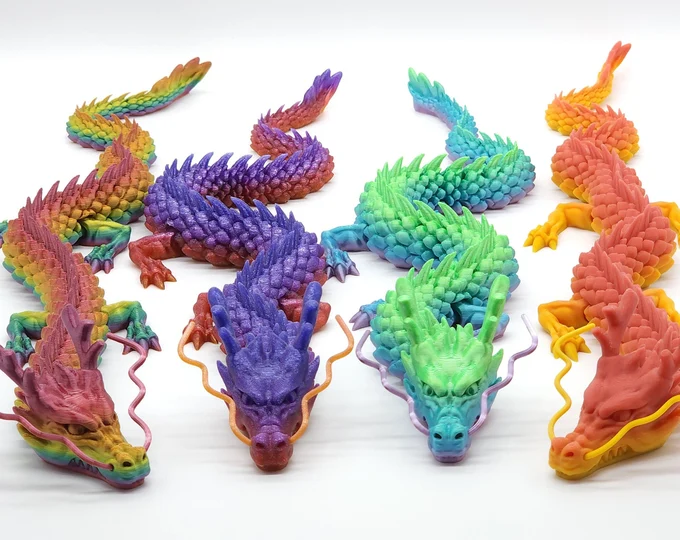
Fidgets, articulated dragons, and i animals are some of the most rewarding showcase prints. They look impressive in photos, can be moved immediately after being removed from the build plate, and quickly show people why 3D printing is different from an ordinary plastic toy from a store. They are not just decorations: a good model has joints, clearance, texture, mechanical resistance, or a pleasant sound.
For an e-shop, a gift, a school demonstration, or the first test of a new printer, it is worth choosing models that are impressive but not unnecessarily risky. Below you will find ten types of prints that make sense in 2026, plus practical tips on material, size, colors, and safety.
A 3D-printed toy is not automatically a children's toy. With small children, focus mainly on three things: the size of the parts, sharp edges, and the possibility of a part breaking off. Anything small, fragile, magnetic, or with thin protrusions does not belong in the hands of children under three. With older children, provide supervision, especially with models featuring joints, gears, or small segments.
After printing, remove brims, strings, and sharp support remnants. Briefly smooth the edges with a knife, file, or fine sandpaper. Do not consider resin prints a suitable choice for ordinary children's play: they are more fragile, may have sharp breaks, and require proper curing. For home fidgets and showcase toys, PLA is the most practical choice, with PETG being an option for more durable pieces.
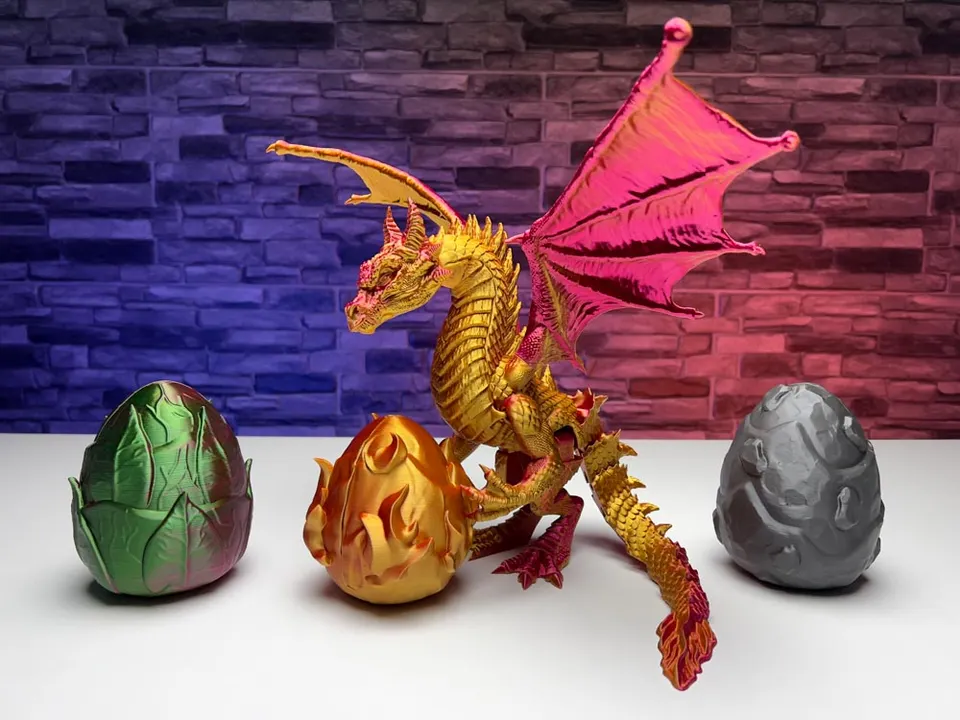
When someone says “3D-printed dragon,” they usually mean a long segmented dragon that is printed in one piece and moves after being removed from the build plate. It is an ideal example of a print-in-place construction: no screws, no gluing, just the right geometry and a properly tuned printer.
For your first print, choose a medium size of around 18 to 25 cm. A dragon that is too small has tiny joints that can easily fuse together or break off. One that is too large takes a lot of time and may expose poor adhesion to the build plate. Silk PLA in a rainbow, two-color, or metallic variant turns the dragon into an instant gift, but monitor the flow at the joints: glossy PLA can sometimes emphasize small overextrusions.
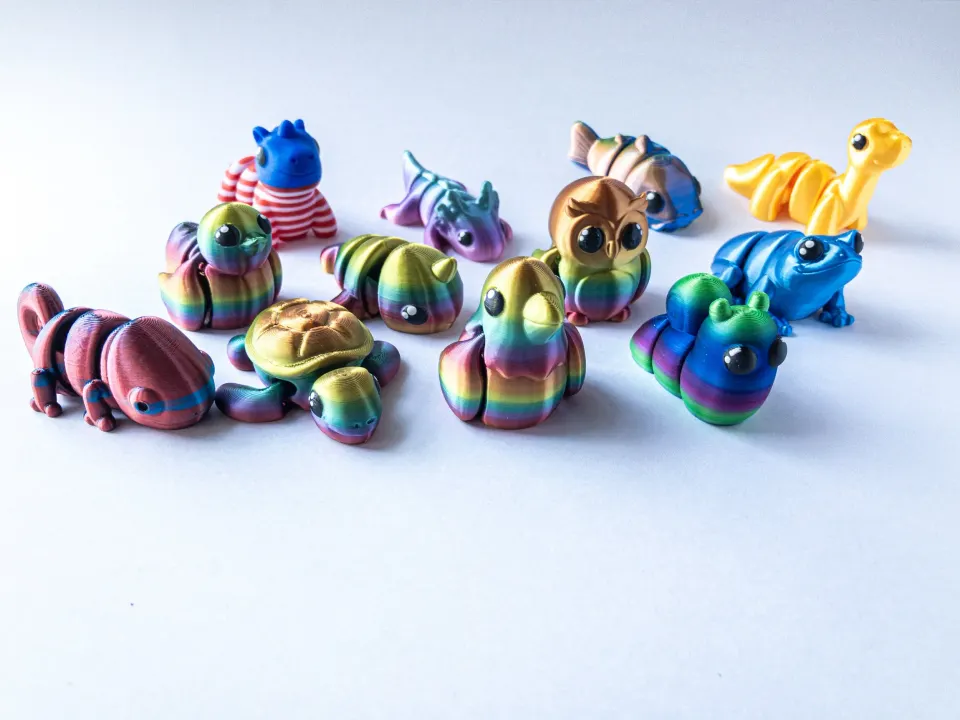
Flexi animals work similarly to dragons, but they are usually shorter, cuter, and less demanding in terms of space. A lizard, snake, fish, or axolotl are good showcase models for children because they have a clear shape and their movement is easy to understand at first touch.
With these models, it pays to print the first layer more slowly and leave a clean gap between the segments. If the links do not move after printing, the problem is often not the model but excessive flow, a squashed first layer, or insufficient horizontal compensation. Gradient PLA is suitable for gift pieces, while matte colors work well for animals inspired by nature: green, gray, sand, turquoise, or orange.
Articulated animals with legs and a head feel more like figurines than pure fidgets. Adults often use them as desk toys, while children use them as small characters. Their advantage is that they are easy to personalize: a different eye color, contrasting paws, a two-color tail, or a name on the base.
When choosing a model, look at the thickness of the legs and tail. Thin parts look impressive in a render, but suffer in practice when dropped from a desk. For children, choose a more robust style with larger joints and shorter protrusions. PLA is sufficient for decoration and gentle play, while PETG makes sense where the figurine will be bent frequently.
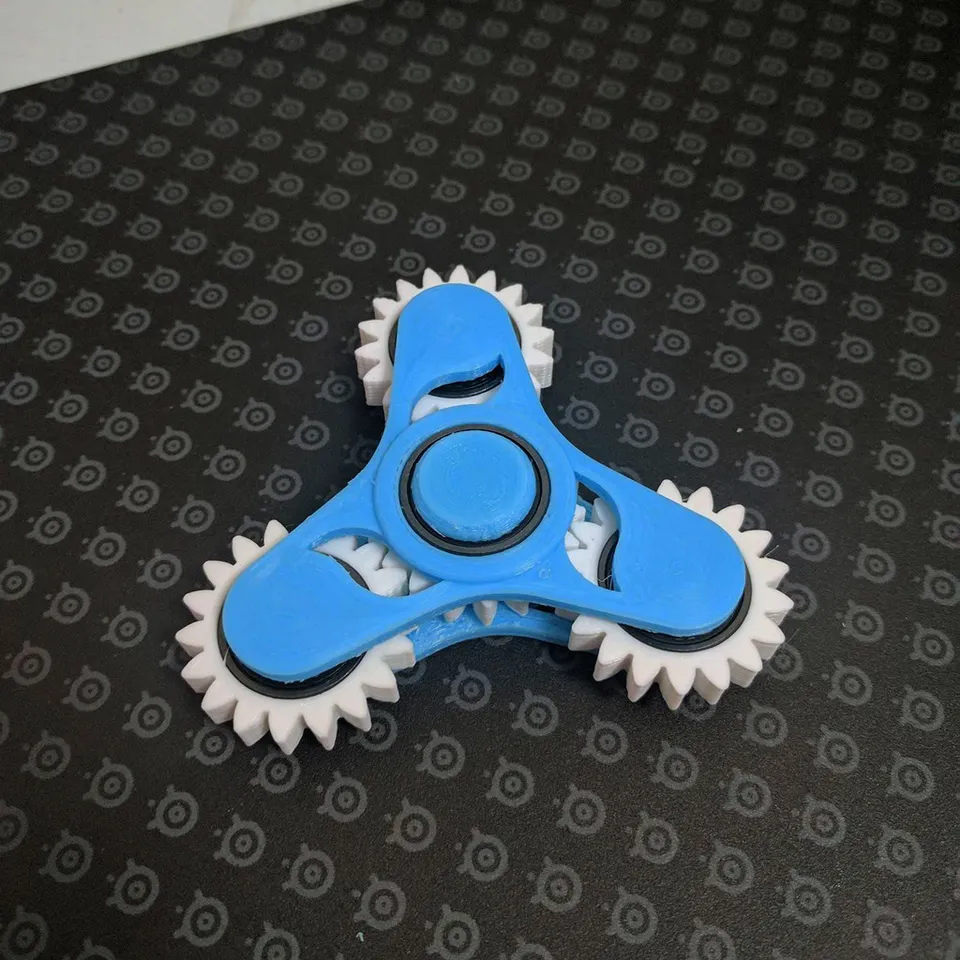
A geared spinner is a fidget for people who like to feel mechanics. Instead of an ordinary bearing, a set of gears rotates inside. When moved, it provides a subtle clicking sound and resistance, so the model effectively demonstrates print precision, clearances, and surface quality.
Clean calibration is worthwhile here. If the printer overextrudes material, the teeth will rub. If the layer is too coarse, the movement will not be smooth. A practical setting is a layer height of 0.16 to 0.20 mm, 3 perimeters, and a stronger infill according to the model's recommendations. Choose contrasting colors: a dark body and light gears will help the movement stand out.
A haptic slider is a small handheld slider. The best versions have a clear travel, a stop, and a pleasant click. Some use magnets, while others rely on the ibility of the plastic or a mechanical latch. For adults, it is a very good pocket fidget, and in an office it is often more pleasant than a loud spinner.
With magnetic variants, consider safety. The magnets must be firmly enclosed in the part, and the model does not belong to small children. If you print a slider as a gift, it is better to mention that it contains small parts or magnets. PLA or PETG are suitable materials. Silk PLA looks nice, but ordinary PLA with a matte surface may be better for friction surfaces.
The infinity cube is a classic: eight cubes connected so that they can be flipped endlessly. It is quiet, compact, and works well for working at a desk, studying, or waiting in line. Compared with dragons, it is not as striking in photos, but it makes immediate sense in the hand.
The joint makes the biggest difference. Some models are printed as one piece, while others use pins or small axles. For children, choose robust versions without tiny separate parts. For colors, try a combination of two contrasts: for example, black and lime, white and blue, or purple and silver. Simple patterns on the top surface also stand out well on the cubes.
An expanding star looks like a flat geometric shape, but when pulled out, it unfolds into a taller structure. The telescopic movement is visually striking and works well with multicolor or gradient filament. It is an excellent model for demonstrating how a printer can produce a movable object without assembly.
However, keep in mind that such fidgets have many thin edges. They are not ideal for small children. For adults, students, or as a store demonstration, they work excellently. Print with clean retraction, because strings between the rings can ruin both the first impression and the movement.
A clicker imitates the feel of a mechanical key: press, resistance, return, sound. It is small, quick to print, and suitable as a pendant, small gift, or test of ible parts. A good version should not rub, fall apart, or produce an excessively sharp sound.
With clickers, it is important not to overdo miniaturization. Parts that are too small are harder to clean and easily get lost. If it is a gift for a child, make a larger version without separate tiny parts. For adults, black, gray, red, or translucent PLA work well. If the model has a cap, try a color contrast between the base and the button.
A ring spinner, gyroscopic ring, or set of concentric spinning rings looks impressive without consuming much material. It is a good “wow” print for visitors: someone picks up the model, spins the ring, and immediately sees how precisely the printer can manage the gaps.
Avoid models with overly thin axles if the toy is expected to survive ordinary carrying in a backpack. With larger rings, check build plate adhesion and even cooling. In terms of color, dual-color PLA, silver, petrol blue, neon green, or a combination of a dark base with a light inner ring work well.
Not every fidget has to click or spin. Tactile stones, textured plates, waves, grids, or small ergonomic shapes are simple, quick, and surprisingly useful. They are suitable for people who want a quieter sensory aid without noise.
The surface is the most important thing here. A sharp pattern is not a pleasant texture. Soft rounding, a larger radius, and a subtle relief are better. For children, make the parts large enough, without breakable protrusions or cavities where dirt could remain. Matte PLA is usually more pleasant to the touch than very glossy silk PLA, but colorful silk variants are excellent for a visual gift.
PLA is the best choice for most of these models. It prints easily, holds its dimensions, and offers the widest selection of colors. Silk PLA is ideal for dragons, stars, and gift figurines because it highlights curves and segments. Matte PLA is suitable for handheld fidgets where you do not want an overly slippery surface. Use PETG for toys that will be bent or dropped more often. TPU is interesting for soft sensory elements, but it requires slower printing and a properly tuned extruder.
With children's prints, pay attention to the material's origin, temperature resistance, and pigments. Colored filament is beautiful, but it does not automatically mean a certified toy. If a child tends to bite things or put them in their mouth, a 3D-printed fidget is not a suitable choice without further assessment and surface treatment.
For dragons and i animals, gradient and two-color filaments work well because the segments change their angle toward the light. For geared fidgets and spinners, contrast is better: use a different color for the gears than for the frame. For sensory toys, choose calmer shades such as mint, gray, lavender, or blue. For children's gifts, a bright color is worthwhile because small parts and any damage are easier to see.
If you are printing several pieces for display, make a small set: one glossy dragon, one matte i animal, one geared spinner, and one quiet tactile fidget. People can then touch different movements and surfaces, and understand the difference between materials more quickly than from a technical description.
The most versatile choice is an articulated i dragon made from silk PLA. For everyday handheld use, an infinity cube, haptic slider, or geared spinner makes sense. For children, choose larger, sturdier, and simpler models without small parts, sharp edges, or magnets. For adults, you can opt for finer mechanics, multicolor PLA, and more pronounced textures.
A well-chosen 3D print should not only look good in a photo, but above all feel pleasant in the hand. That is precisely why fidgets, dragons, and articulated animals are so effective: they demonstrate movement, precision, and color in a single small model.


