Free shipping from 1 999 Kč
Fast shipping
Verified store
Thousands of customers




Free shipping from 1 999 Kč
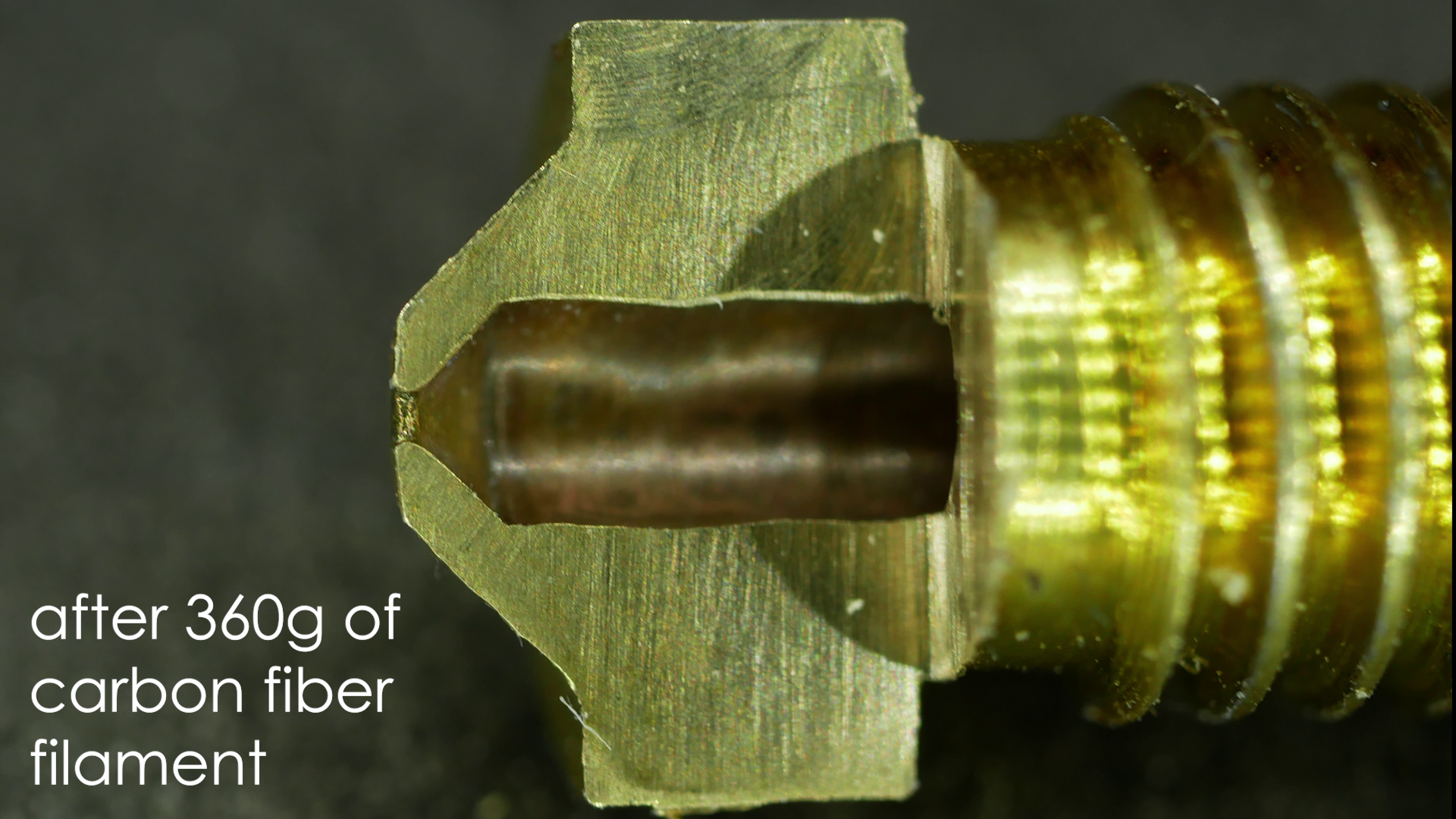
Carbon-fiber filaments look appealing: a matte technical surface, stiffer parts, less warping, and the feeling that your printer can suddenly handle real functional components. However, PLA-CF, PETG-CF, PA-CF, as well as glow-in-the-dark and wood filaments, are not ordinary materials in a different color. They contain hard particles or fibers that wear down the nozzle as they pass through the hotend.
With standard PLA, a brass nozzle lasts a long time. With abrasive filaments, however, the nozzle opening can start to enlarge after just a few hundred grams of material. The result is usually subtle: parts start becoming dimensionally inaccurate, top layers are rougher, the printer extrudes too much material, and a profile that worked last week suddenly no longer makes sense.
This article explains when brass is still sufficient, when a hardened nozzle is a better choice, why a 0.6 mm nozzle is often recommended, and how to adjust the slicer so that carbon-fiber filament prints reliably.
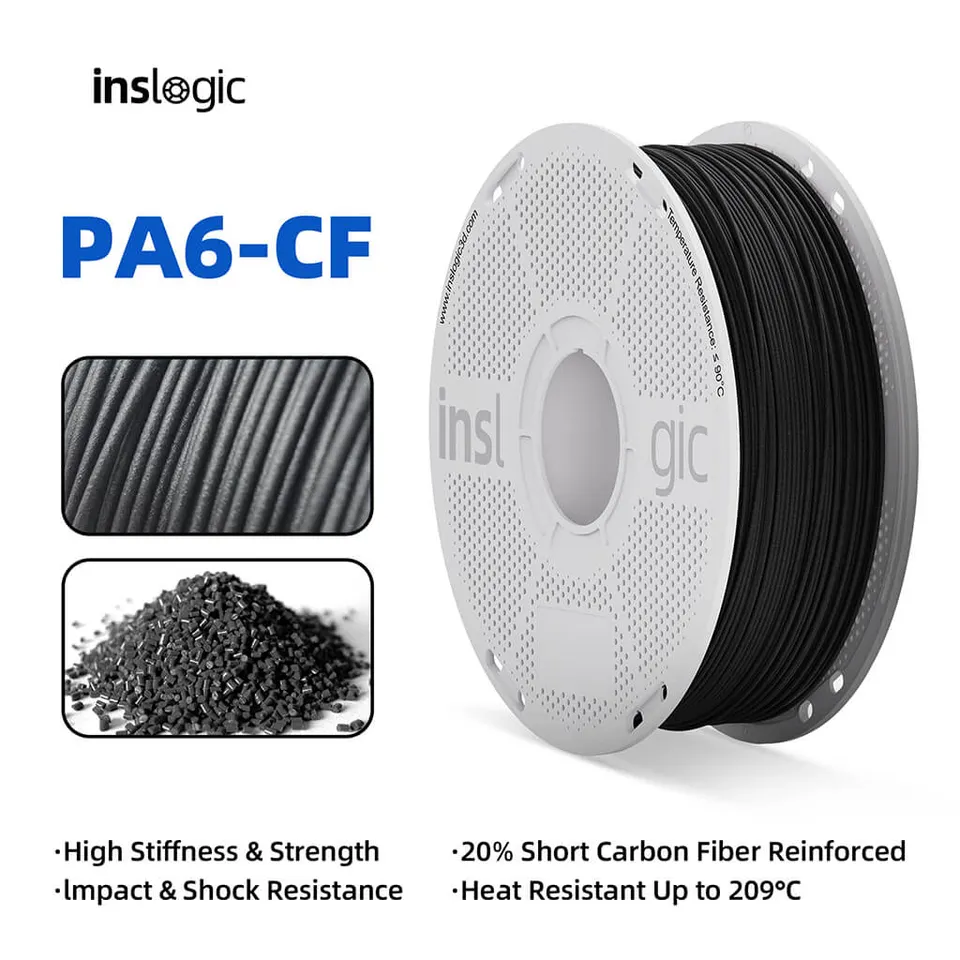
An abrasive filament is a material containing an additive capable of mechanically wearing down the nozzle or parts of the feeder. It is not limited to carbon fiber.
Typical abrasive materials include:
The base plastic still matters. PLA-CF prints and behaves differently from PA-CF. Carbon fiber additives usually increase stiffness, improve dimensional stability, and create an attractive matte surface, but they do not turn PLA into nylon or PETG into an industrial laminate. Always choose the material based on the base polymer first, and only then on the filler.
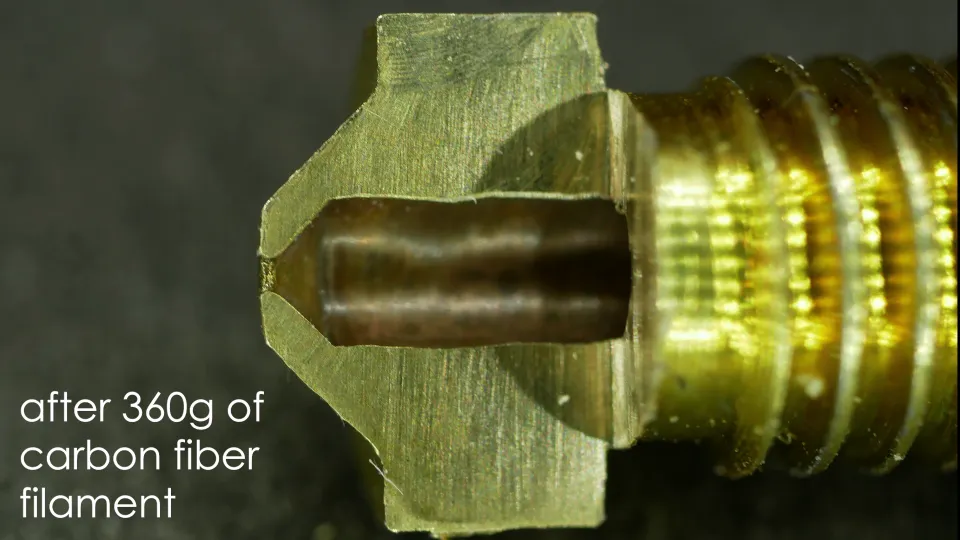
Brass is popular in FDM printers for good reason. It conducts heat well, is inexpensive, easy to manufacture, and works excellently for PLA, PETG, ABS, and ASA. The problem is hardness. Carbon or glass fibers and hard pigments behave like very fine abrasives during extrusion.
A nozzle does not wear out by suddenly stopping printing. Usually, the opening slowly becomes larger. A 0.4 mm nozzle may become 0.45 mm, 0.5 mm, or larger over time. The slicer, however, still calculates with the original diameter. The printer therefore extrudes more material than the profile expects.
Typical signs of a worn brass nozzle:
If you print one small PLA-CF part with a brass nozzle, your printer probably will not be damaged immediately. However, if you plan to print an entire spool of carbon-fiber or glow material, brass is a false economy. A new brass nozzle is inexpensive, but inaccurate parts, lost time, and repeated profile tuning cost more.
Use brass for standard unfilled materials:
Brass can also make sense when printing highly detailed models from ordinary PLA and seeking the best possible thermal conductivity. With small diameters, such as 0.25 mm or 0.2 mm, brass remains a practical choice for non-abrasive materials.
However, once the filament contains carbon fiber, glass, luminous pigment, metal powder, wood, or stone, treat brass as an emergency consumable solution. For regular printing, it is better to switch to a more durable nozzle.
A hardened nozzle is the most common upgrade for abrasive filaments. In practice, it mainly provides a more durable nozzle opening that is not worn down by carbon fiber or glow pigment as quickly as brass.
Advantages of hardened steel:
Disadvantages of hardened steel:
After replacing a brass nozzle with a hardened one, do not expect the old profile to always work perfectly. It is often enough to increase the temperature by 5 to 15 °C, reduce the maximum volumetric flow rate, and recalibrate the flow. On fast printers, the flow-rate limit is more important than the speed itself in mm/s.
A 0.4 mm nozzle is the universal standard, but it is not always the best choice for filled filaments. A larger opening reduces the risk of clogging and allows short fibers or hard particles to pass through more easily. That is why a 0.6 mm nozzle is often recommended for carbon-fiber and glass-filled filaments.
A 0.6 mm nozzle is suitable when:
Compared with 0.4 mm, you lose some detail, but this often does not matter for technical parts. Instead, you gain stronger lines, faster printing of larger components, and smoother material flow. For many service and functional parts, a 0.6 mm hardened nozzle is more practical than trying to push every composite through 0.4 mm.
A 0.8 mm nozzle mainly makes sense for large parts, fast prototypes, and rougher mechanical components. For small, precise parts, it may be unnecessarily large.
Hardened steel is a good starting point, but it is not the only option. If you print abrasive materials frequently, it is worth considering a better nozzle.
Ruby nozzles have a highly durable tip and handle abrasive materials well. They are more expensive, and care is needed during handling because the tip is a precision component, not a tool for mechanical prying.
Nozzles made from tungsten carbide or similarly durable materials combine high wear resistance with better thermal conductivity than standard hardened steel. They are excellent for frequent printing with carbon fiber, glass, or technical composites, but they cost more.
Bimetal and coated nozzles attempt to combine the advantages of multiple materials: good heat transfer, a durable tip, and less material adhesion. With these nozzles, it is worth choosing based on the specific printer and the available profiles.
Practical rule:
The nozzle is not the only part that suffers. Over time, abrasive filament can also wear down feed gears, guide paths, and, in some systems, parts of the automatic material-feeding system. This mainly concerns filaments containing glass fiber, carbon fiber, and hard pigments.
For printers with optional hardened feed gears, it is a good idea to use them when regularly printing composites. If you print through a multicolor or automatic feeding system, check whether the manufacturer recommends that filament. Some brittle or abrasive materials can break, crumble, or rapidly wear the feed components in long paths.
When switching to carbon-fiber or another abrasive filament, do not blindly start with a profile for ordinary PLA. Use a profile for the same base polymer and adjust it according to the filament manufacturer's recommendations.
Carbon-fiber PLA is often printed slightly hotter than standard PLA. PETG-CF is based on PETG and PA-CF on nylon, so they require completely different temperatures, drying, and environmental conditions. Hardened steel also transfers heat less effectively than brass, so you may need to add a few degrees.
Start as follows:
Always print a temperature tower or at least a small test part. Look for a combination of good layer strength, a clean surface, and stable flow.
Composites may flow differently from pure plastic. Calibrate the flow after changing the nozzle or material. On fast printers, reduce the maximum volumetric flow rate until under-extrusion disappears in long straight sections.
If the print looks good at low speed but becomes weak or develops gaps during fast infill, the problem is not necessarily the temperature. It is often the flow-rate limit.
Do not push for maximum speed during the first tests. With PLA-CF and PETG-CF, start somewhat slower than with standard material. With PA-CF, stable temperature, dryness, and layer adhesion are more important than a record printing time.
A good starting point for functional parts is medium speed, more perimeters, and conservative acceleration. Carbon-fiber filament often looks good even at a lower layer height because its matte surface hides the layers better than glossy PLA.
With a 0.6 mm nozzle, a practical range is approximately 0.2 to 0.32 mm. For strong and clean parts, start around 0.24 mm. Use finer layers for appearance, and higher layers for speed and sturdy service parts.
Generally, stay below approximately 80% of the nozzle diameter. With a 0.6 mm nozzle, it therefore makes little sense to push the layer height too high just because the slicer allows it.
Cooling is governed mainly by the base polymer. PLA-CF usually tolerates more cooling, PETG-CF less, and PA-CF often requires a more cautious approach. The carbon additive itself does not mean you can ignore the rules for nylon, PETG, or PLA.
Carbon-fiber nylon is hygroscopic, meaning it absorbs moisture. Wet PA-CF crackles, produces a rough surface, reduces layer strength, and can clog the nozzle. PETG-CF also benefits from drying. PLA-CF is usually more tolerant, but moisture can worsen its surface as well.
If the part is to be functional, dry it according to the filament manufacturer's recommendations and store the spool in a sealed box with silica gel. With PA-CF, printing directly from a drying box is ideal.
For most users, the following set makes sense:
If you occasionally print decorative glow PLA, start with a hardened nozzle. If you want to manufacture brackets, fixtures, or PA-CF parts, plan for a larger investment: a durable nozzle, drying, an enclosed printer, and a carefully tuned profile.
PLA-CF is a good first carbon-fiber filament. It has an attractive matte surface, is easy to print, and is suitable for covers, fixtures, technical prototypes, and parts that need to be stiff. Use a hardened nozzle, ideally 0.6 mm for reliability.
PETG-CF is more practical for parts that need to withstand somewhat higher temperatures and tougher operation than PLA-CF. Expect to use a hardened nozzle, drying, and careful stringing adjustments.
PA-CF is a technical material for functional parts, but it requires the most discipline. It needs drying, a suitable printer, the right build plate, and stable temperatures. A hardened or premium wear-resistant nozzle is essential.
Glow Filament does not look like a technical composite, but its luminous pigment can wear down a brass nozzle surprisingly quickly. For larger prints or an entire spool, use a hardened nozzle.
Woodfill and Metalfill should be treated similarly to other filled materials. A larger nozzle diameter, lower speed, and a profile tuned for the specific brand often help.
A brass nozzle is excellent for standard materials, but it is not suitable for regular printing with carbon-fiber and other abrasive filaments. Once you print PLA-CF, PETG-CF, PA-CF, glow, woodfill, or glass-filled materials, switch to at least a hardened nozzle.
For most home and workshop printers, the most practical combination is a 0.6 mm hardened nozzle, a conservative speed, correctly calibrated flow, and dry filament. If you frequently print technical composites, it is worth investing in a better nozzle, a more durable feeder, and a custom profile for each material.
The most important advice is simple: do not choose carbon filament based on its name alone. First consider the base plastic, then the abrasiveness, then the nozzle, and only then the speed. This way, you will get parts that not only look good, but also hold their dimensions and print reliably.